Tasmania: Take a walking tour of Maria Island

Weather and wildlife define my four-day Maria Island Walk – the weather changing as often as runway models and the wildlife posing as if I’m the paparazzi.
Maria Island (pronounced Ma-rye-ah) lies off Tassie’s east coast and is entirely national park. I’ve explored historic Darlington before, where the ferry deposits day visitors, but this time I’m venturing further afield on a guided hike with Wild Bush Luxury, part of the Great Walks of Australia portfolio.
Guides Jorgia and Nomes are at opposite ends of their 20s. At their Hobart HQ, they prepare us for inclement weather, handing out heavy-duty raincoats for a forecast storm. “It will be rare and very special to see it this wet,” grins Jorgia, “And there’s something adorable about a wet wombat.”
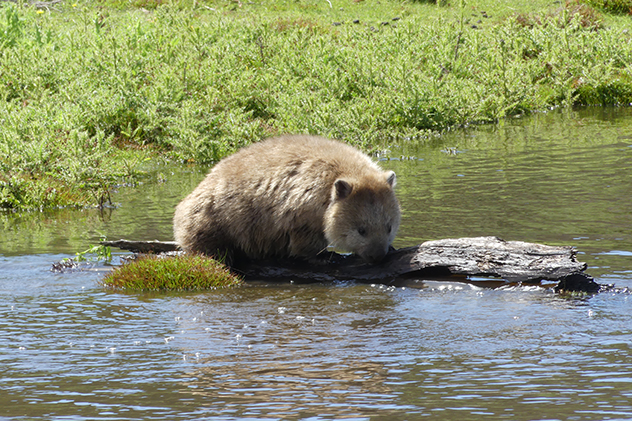
A soon-to-be-wet wombat attempts to cross a stream on Maria Island.
The guides’ enthusiasm for the natural world, nurtured by outdoor-loving families and Steiner schooling, is infectious. On the drive to Triabunna, where we board a small boat, they explain they both holidayed on Maria as kids. As we step ashore on the isolated beach of Shoal Bay, they welcome us to Wukaluwikiwayna, the island’s Indigenous name, and acknowledge the traditional owners from the Oyster Bay tribe.
Maria is an island of two halves, and we walk the connecting isthmus, first along sheltered Shoal Bay where a distant echidna waddles to the water, then beside wave-pounded Riedle Bay. Bloated bluebottles desiccate on the tideline, stranded seaweed scents the breeze and pied oystercatchers ‘pip, pip, pip’ as they scurry along the sand.
RELATED: Plan your perfect Tasmanian road trip
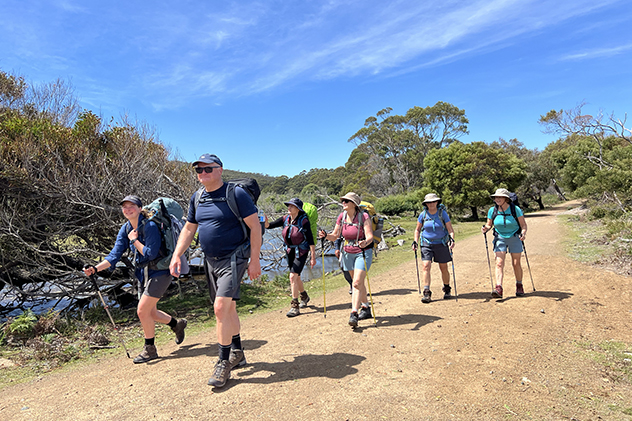
Our group of seven, aged between late 50s and early 70s, is made up of four friends and another couple, all from Melbourne. When one says, “It’s okay, you don’t need to drink your own urine,” referring to my Hydralyte-tinted water, I know we’ll get along.
Yellow-tailed black cockatoos herald our arrival at private Casuarina Beach Camp, the timber and canvas tents barely visible in the bracken. The minimal impact eco-camp uses solar power, rainwater and composting toilets – the nicest I’ve ever encountered – and an ingenious bucket system in three-sided huts for showering in the open air with a view of the bush. Dim lighting and candles on the dinner table minimise light pollution for the wildlife.
We swap to day packs for the 10km return walk to remote Haunted Bay on the island’s south. On the track through dry eucalypts, an echidna hunkers down mid-path allowing close inspection of its spines. No one’s sure how Haunted Bay got its name, whether it’s from its whaling days – whale bones are still wedged in the rocks below – or the mournful call of little penguins echoing around the granite cove. Either way, it’s a “many-layered place” says Jorgia.
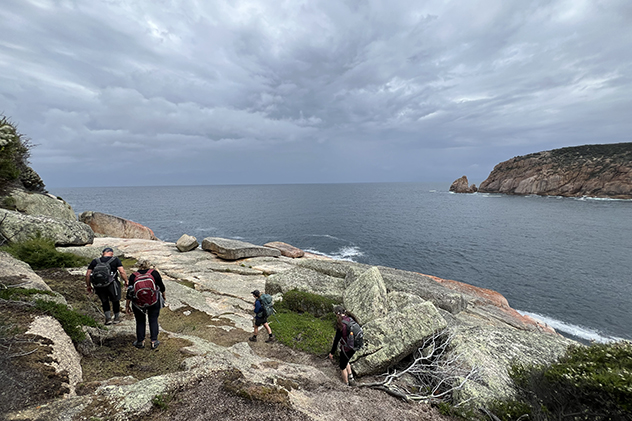
The remote Haunted Bay on Maria Island's southern edge.
The steep climb down through cream-flowering, honey-scented kunzea leads to a rock platform daubed with orange lichen, purple pigface and green moss. Ocellated skinks bask in the warmth and one of our keen birdwatchers is excited to see a Bassian thrush.
A cheese board and chilled riesling await us at camp, followed by dinner of bruschetta, saffron risotto with Tassie scallops, then Eton mess dessert. I thought my pack was heavy, but our guides also lugged in fresh produce and have been prepping, cooking and cleaning since arrival. Given their laughter-filled conversation, you’d never guess this is their first time guiding together.
We hit the sack early. I fall asleep to the sound of waves, startle a potoroo on a midnight trip to the loo, and wake with the birds. As we tidy our tents, one guest finds a tiny pygmy possum curled up under her mattress.
Day two’s 14km walk traverses five beaches and we cross the isthmus again, pausing at a vast cultural living site (previously known as a shell midden), possibly a meeting place for multiple tribes. Indigenous people ensured the sustainability of shellfish by suspending collection of a species if their shells became too small, something Europeans should have noted before nearly wiping out native angasi oysters.
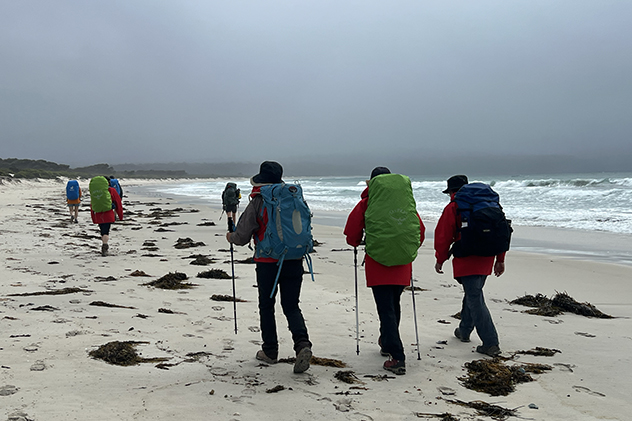
Maria Island's beaches are gorgeous in any weather.
We have morning tea at Frenchs Farm, now a camping area, on the verandah of the old manager’s house. Joseph and Christine French arrived in 1936 and raised seven sons here. They cleared the land, selling the blackwood bark for tanning leather, then raised sheep and cattle.
An earlier ‘Frenchman’, Nicolas Baudin, mapped Maria Island in 1802, hence the name Point Lesueur, which became a convict probation station in 1845. A wombat scratches its butt against the convict-built brick remains of cells that once housed 336 men. The station was short-lived, abandoned in 1850 due to isolation, management problems and lack of fresh water.
At lunch under an introduced macrocarpa tree, Jorgia recites a hilarious poem by Dennis Alexander about wombats’ square dung. It’s true, wombats poop cubes, the shape ensuring it stays on rocks and logs to mark territory.
Bloodstone Beach gets its name from the red laterite that colours the rocks, formed during monsoonal conditions 10-20 million years ago, a reminder the weather is constantly changing. We experience our own calm before the storm scenario and arrive at White Gums Camp prior to the forecast downpour, with our sweat making it wetter on the inside of our raincoats. I’m coaxed into a ‘refreshing’ swim at Four Mile Beach where Wild Bush Luxury is revegetating the foreshore to combat erosion.
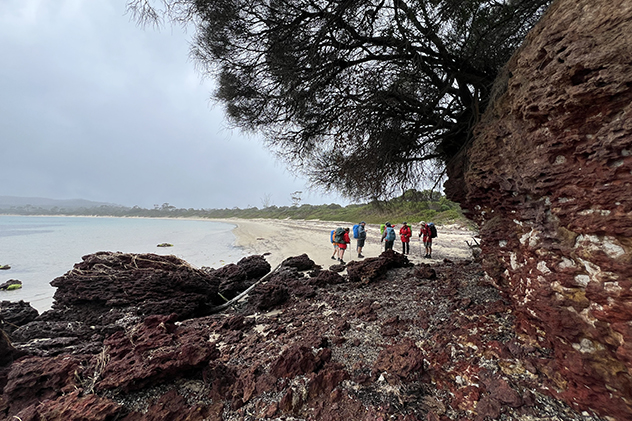
A sanguinary stop at the red-coloured rocks of Bloodstone Beach.
Dinner is a feast of leek and potato soup, marinated quail, lamb cutlets, and wallaby sausages. Yet it’s a night of little sleep when the storm hits. Rain buckets down, thrumming an explosive rhythm on the canvas roof as wind roars through the treetops.
We emerge dry in the morning and set off for Darlington under a cobalt blue sky. Creeks are flush with fresh water and the air tinged with tea tree and eucalyptus. It’s an easy, picturesque 6km amble through blue gums beside the coast and past the remains of a sandstone quarry, but it’s a wombat that makes our day. Determined to reach its burrow across a swollen creek, it scouts out the firmest footing before wading in, only to get washed off its feet. Frantic dog paddling and a logjam save it from being swept away and we all let out a cheer.
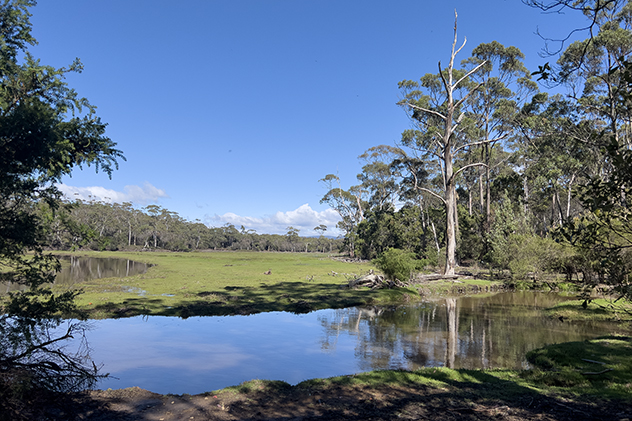
A creek swollen and beautiful after the rain.
Darlington was established as Maria’s first penal settlement in 1825 but closed in 1832 due to frequent escapes and the opening of Port Arthur. A second convict era from 1842 to 1850 focused on rehabilitation through training and education, and many of the remaining buildings were erected during that period. Despite the focus on agriculture and industry, issues with its isolation, management and maintenance forced it to close down. The World Heritage listed convict station is now a base for day visitors, campers and school groups.
We’re staying in the colonial home of Diego Bernacchi, an Italian entrepreneur whose 1880s activities across farming, fishing, timber, cement, vineyards and a mulberry plantation (for proposed silk production) saw the island’s population swell to 250. But the audacious exploits ultimately failed, and the family departed in 1896. More of Bernacchi’s story is on display in the historic Coffee Palace.
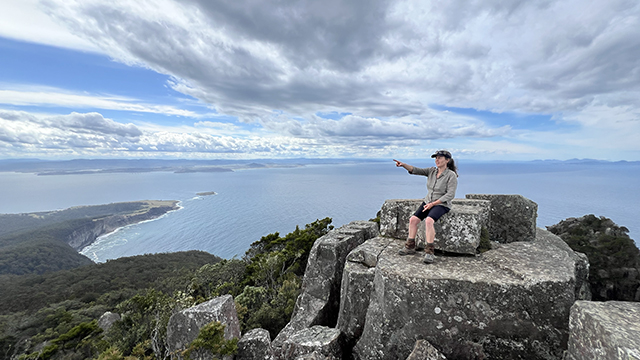
Before enjoying the luxuries of renovated period accommodation, most of us undertake the optional walk up the twin peaks of Bishop and Clerk, so named for their resemblance, when viewed from the sea, to a bishop wearing a mitre, followed by a clergyman.
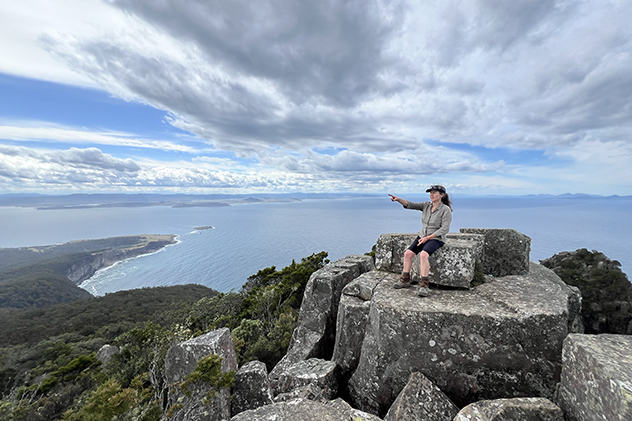
The breathtaking view from the Bishop and Clerk peaks.
I’m already hot and sweaty when we reach the grass-topped cliffs known as Skipping Ridge above Fossil Bay, and the climb hasn’t really started. Bishop and Clerk’s dolerite knobs appear like pimples on the distant headland and it’s a relief to reach the shade of whispering sheoaks, some snapped by last night’s storm, so I can’t see the daunting climb ahead. As we ascend through blue gums and stringybarks, Nomes rewards us with fun facts, from a wattle always flowering somewhere in the world, to an echidna penis having four heads.
Even that disturbing phallic image doesn’t assuage the pain of switchbacks across a steep, sunbaked, scree slope. When we do reach the 620-metre summit there’s a cooling breeze and views to die for – over Jurassic dolerite spires, back along the Fossil Cliffs and on to Freycinet Peninsula.
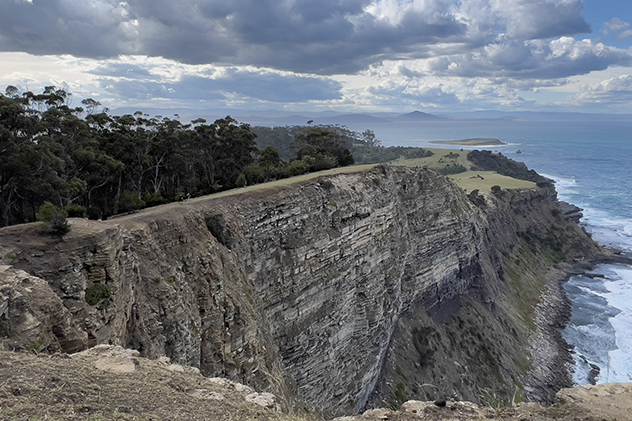
The ancient Fossil Cliffs of Skipping Ridge.
At Bernacchi House we luxuriate in long showers and fluffy towels before dinner in the formal dining room beneath a portrait of the man himself. In the morning, we choose our own adventures, most of us heading to the Fossil Cliffs where 300-million-year-old shellfish fossils have been exposed, layer upon layer, in nature’s own midden. There are Forester kangaroos, adorable wombats and Cape Barren geese on the return walk via the cemetery, cement silos, and visitor information centre.
Freshly baked focaccia and a Frogmore Creek sparkling accompany our farewell lunch before we board the return boat transfer. We detour to view the Painted Cliffs, a sandstone outcrop stained with iron oxides, reminiscent of a 1960s geometric artwork.
Watching Maria recede, I realise it’s Tasmania distilled, encompassing diverse landscapes, beguiling wildlife and Indigenous and colonial heritage, not to mention mercurial weather.
The benefits of walking
Can’t make it to Tasmania? The upside of walking isn’t limited to somewhere as special as Maria Island — you can tap into these benefits on your local streets, parks or coastline.
Good for body and soul
Walking is one of the simplest ways to improve overall health. Studies show regular walking can reduce symptoms of anxiety and depression by up to 30 per cent. Even a 20-minute walk has been shown to significantly lower stress hormone levels.
Connection with community
Walking clubs are growing across Australia, offering an easy way to meet people, build routine and strengthen local ties.
Low barrier of entry
With no special gear or steep learning curve, walking can be as gentle or challenging as you like.