Full Throttle: cars and culture in Canberra

Australia’s love affair with cars and its effect on our culture is the subject of a major new art exhibition, Full Throttle, opening exclusively in Canberra from December 5.
Inspired by George Miller’s classic Australian road movie Mad Max (1979), Full Throttle gathers more than 200 new and existing works to investigate how cars have shaped the nation and our lives.
Miller believes everyone has a “car story” and those stories form the framework for Full Throttle, which features 60 artists presenting a wide variety of cultural viewpoints.
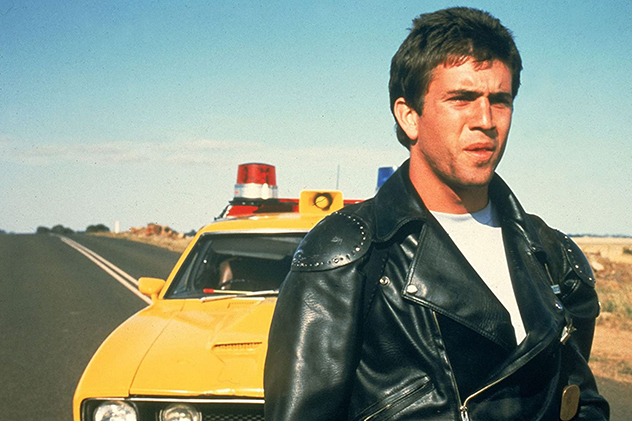
Mad Max (1979) kickstarted Mel Gibson’s Hollywood career.
“Full Throttle doesn’t glorify the automobile – it interrogates it,” says Nick Mitzevich, director of the National Gallery of Australia in Canberra, which is hosting Full Throttle.
“Progress, optimism, and transformation collide with destruction, carnage and oblivion – Full Throttle revels in these complexities and contradictions and looks at all aspects of the human condition.”
Miller shared his own car story with Mitzevich during their initial development meeting for Full Throttle. “A group of his close friends was in a fatal car accident, and he understood that the car was one of the most dangerous weapons in Australia,” Mitzevich says.
“He also spoke about the car connecting him with opportunity and with the future. Both views spurred his medical career and later his filmic work, which has been a powerful influence on our popular culture and this exhibition.”
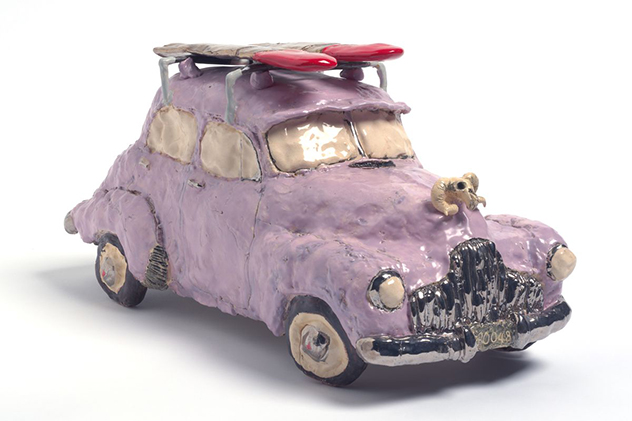
Such diversity of experience is reflected in the artworks selected for Full Throttle, ranging from the fun and satirical sculpture ‘Holden with Lipstick Surfboards’ by Margaret Dodd (below) through to eX de Medici’s haunting panorama ‘The Wreckers’, which illustrates the death, destruction and environmental damage that have arisen from our love affair with the motor car.
Photographer Trent Parke’s Mount Pandemonium series captures the wild masculine energy surrounding the annual motor race at Mount Panorama in Bathurst. “I wanted to represent the transience of the street,” he says, “where you’re there for a split second and then you’re gone.”
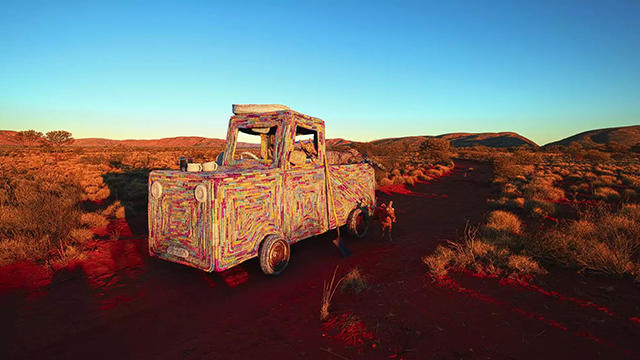
The First Nations perspective on cars is well represented, too, with Dharug artist Billy Bain contributing a beach carpark scene that reflects his indigenous identity and the surfing culture in his hometown of Manly, while the Tjanpi Desert Weavers’ cheerful Toyota HiLux sculpture celebrates the connective tissue between cars and the First Nations concept of ‘Country’ in the outback.
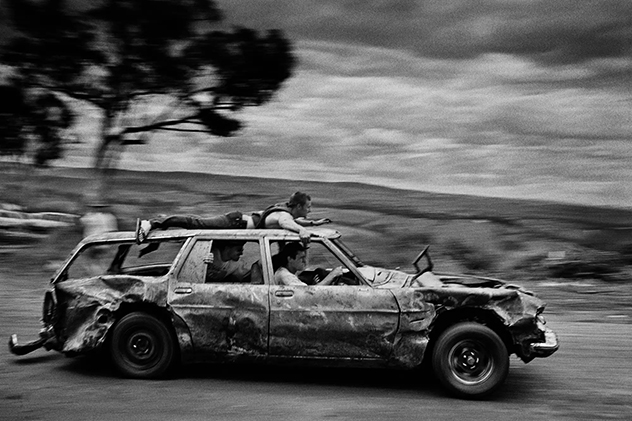
‘Untitled #4’ from Trent Parke’s Mount Pandemonium series.
When Mitzevich started planning Full Throttle and decided the first artwork commissioned should be a film that summed up the relationship between cars and culture, his mind went immediately to indigenous Australian artist, Tracy Moffatt.
“Tracy Moffatt has had this extraordinary skill for nearly four decades of weaving art, history, and popular culture together, and she does it with such a clear language,” he explains.
Together with editor Gary Hillberg, Moffatt compiled Ride, a 47-minute montage of scenes from iconic movies that will screen on loop at Full Throttle and tell the story of cars in cinema.
“It’s up and down, emotions, which is what we wanted,” says Moffatt. “It’s the ride and the journey of life – and you know, I think it’s funny too.”
Adds Mitzevich, “What Gary and Tracy do is totally turn up the dial on the human experience. That’s what makes this work such a powerful beginning to Full Throttle.”
George Miller has cut together a special montage from Mad Max which will screen at the exhibition, with the director also engaging in a conversation about his nation-defining film and its legacy at the gallery.
Full Throttle opens to the public on December 5, 2026, and entry is free. It will run through until April 11, 2027.
The exhibition makes an ideal centrepiece to a weekend itinerary exploring the thriving art, food and wine culture that defines modern Canberra alongside its rich political heritage and picturesque countryside.