
Australian government passes New Vehicle Efficiency Standard
Australia has joined the rest of the developed world in introducing rules that will ensure carmakers offer more EVs and more efficient ICE and hybrid vehicles, with the aim of significantly reducing greenhouse gas emissions.
The bill was introduced by Labor Minister for Climate Change and Energy Chris Bowen on Thursday and passed both houses with the help of the Greens in return for a deal to prevent new gas projects being fast-tracked.
The new standard will be implemented from 1 January 2025. Under it, carmakers must meet stricter emissions targets, calculated based on the fleet-wide average of CO2 emissions per kilometre. The standard is designed to progressively lower the average CO2 emissions of vehicle fleets, with specific targets set for different categories of vehicles.
This will mean carmakers must sell more low and zero emissions vehicles to offset the higher emissions of larger vehicles such as SUVs and utes. If the average emissions of a carmaker's new car sales each year do not meet the CO2 limits, they will be subject to fines.
In a statement to press, Minister Chris Bowen said: “This is not just a win for the environment, it’s a big win for motorists around the country who want access to a bigger variety of more efficient vehicles. The impact of this shift will benefit Australians for decades.”
Minister for Infrastructure, Transport, Regional Development and Local Government Catherine King said: “This is a monumental milestone for Australians, with this Standard to pave the way for Australians to access and benefit from the most advanced car, SUV and ute technology offered in other countries – which are cheaper to run and better for the environment.”
The New Vehicle Efficiency Standard (NEVS) was passed through parliament after a consultation period saw revisions introduced to reclassify certain large SUVs under the same segment as utes, and higher emissions limits added for this segment.
The preferred option put forth by the federal government in February sought to tighten annually from 141 grams per kilometre (g/km) in 2025 to 58 g/km for new passenger vehicles, and from 210 g/km in 2025 to 81 g/km for light commercial vehicles (LCVs, which includes utes and ute-based SUVs) by 2029.
Under the revised standard, carmakers will now have to target 110 g/km (instead of 81 g/km) for LCVs by 2029.
Table 1: CO2 targets for passenger and light commercial vehicles|
Year |
Passenger vehicles (g/km) |
Light commercial vehicles (g/km) |
|
2025 |
141 |
210 |
|
2026 |
117 |
180 |
|
2027 |
92 |
150 |
|
2028 |
68 |
122 |
|
2029 |
58 |
110 |
How efficient are Australia's cars?
To put these figures in context, the National Transport Commission reported in 2023 that the average emissions intensity for petrol-powered passenger cars bought in 2022 was 165 g/km, while the average for diesel cars was 171 g/km. Hybrid vehicles in that year had an average emissions intensity of 102 g/km, and plug-in hybrids had an average emissions intensity of 43 g/km.
For the LCV segment (known as MC+NA in the report,) the average emissions intensity for petrol-powered utes and large SUVs bought in 2022 was 230 g/km, and the average for diesel LCVs was 216 g/km. Hybrid LCVs bought in 2022 had an average emissions intensity of 130 g/km.
Table 2: Average emissions by powertrain and fuel type 2022 (NTC)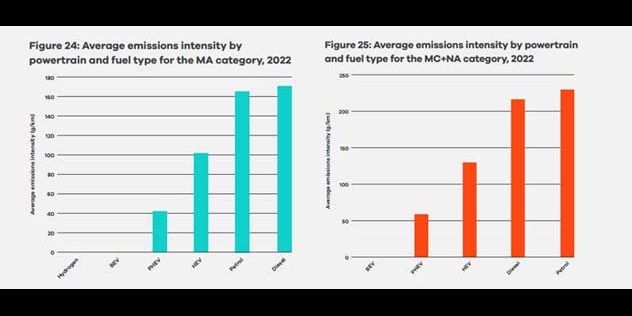
This is not just a win for the environment, it’s a big win for motorists around the country who want access to a bigger variety of more efficient vehicles.
— Chris Bowen, Minister for Climate Change and Energy
How will selling EVs help carmakers meet targets?
Because battery electric vehicles (more properly known as BEVs) have no tailpipe emissions, each one sold would effectively halve the emissions of a vehicle that has tailpipe emissions. The system is not quite as straightforward as that, but it is a good example of how EVs can drastically reduce a carmaker’s average emissions if sold in greater numbers.
By selling vehicles with emissions below the emissions targets, carmakers are allocated credits that they can then apply against vehicles sold with emissions above the target.
These credits can be sold to other manufacturers who might be struggling to meet their CO2 emission targets. Carmakers who exceed their CO2 targets need to either buy credits from those with surplus credits or pay a fine.
Are carmakers selling more EVs already?
Yes, three times as many EVs sold in Australia in 2023 than in 2022. But this still only amounted to 7.2 per cent of the market, well below 60 per cent in China and 25 per cent in Europe, according to the Global EV Outlook 2024 report from the International Energy Agency.
Carmakers are starting to advertise EVs more in Australia. In a report published by fossil fuel advertising lobby group CommsDeclare on Wednesday, it showed that money spent on advertising EVs doubled from 2022 to 2023 – equal to $51.7 million.
However, at the same time, money spent on advertising SUVs (the biggest selling segment in Australia) increased by 29 per cent from 2022 to 2023 to $125 million. Meanwhile, sales of SUVs increased from 53 to 56 per cent of the market – double that of a decade ago when SUVs accounted for just 30 per cent of the market.
The new efficiency standard marks a pivotal move for Australia's automotive landscape and for climate policy. It will now require the dedicated efforts of automakers to make it happen.


