
2021 Nissan Leaf e+ review

In 2019, Nissan’s second-generation Leaf upped the EV ante with a more powerful 110kW electric motor, larger 40kWh battery and increased range of 270km. Even so, most still see the Leaf as a city-centric vehicle, but the long-range Leaf e+ is poised to alter that perception.
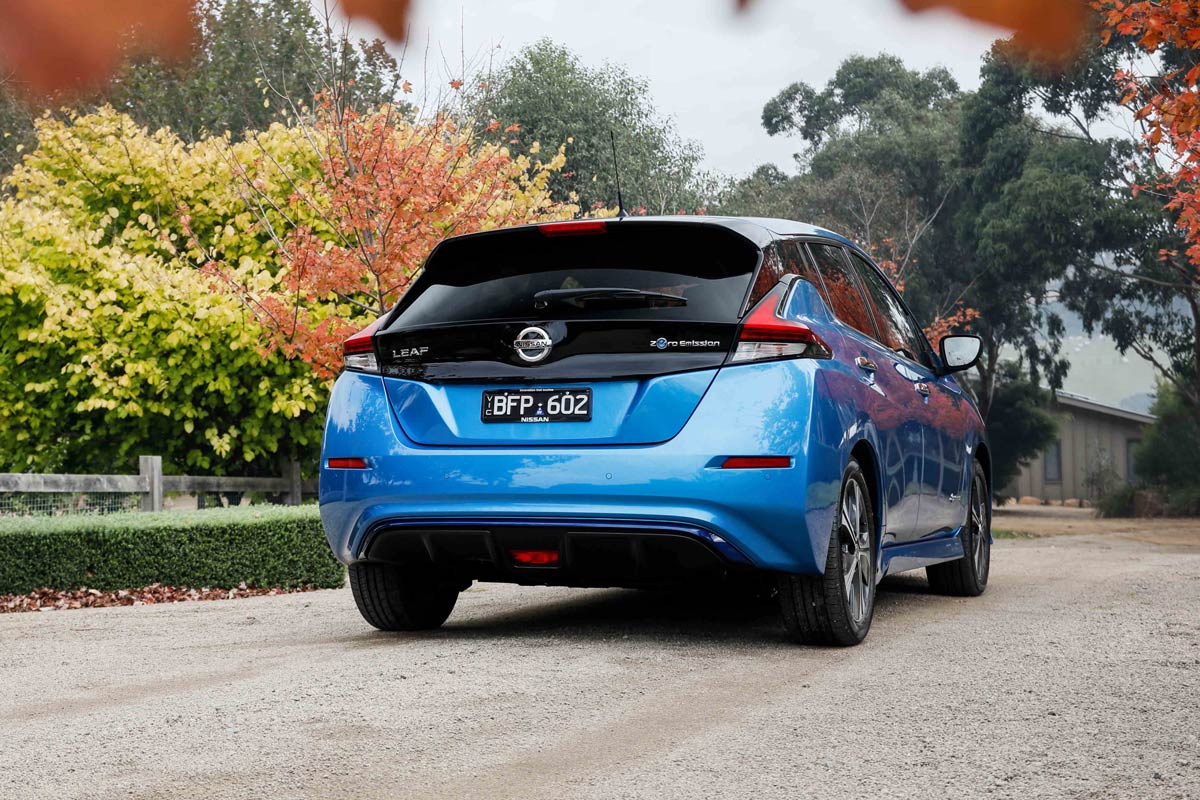
Outwardly, the e+ badge is the only real clue to differentiate models, although there’s a 5mm increase in the Leaf e+ ride height, altered to counter the extra
How much does the 2021 Nissan Leaf e+ cost?
The cost of an EV is still the single biggest barrier to the technology’s adoption and it’s a hefty jump from the standard Leaf’s price of $49,990 to $60,490 for the e+.
With range anxiety also haunting the EV conversation, a long-range Leaf is a welcome counter and the vehicle has plenty to offer – but it comes at a price.
The important differences are under the skin, where changes to the battery’s construction provide 25 per cent more energy density while maintaining a similar shape and size to the 40kWh battery. Range is pushed out to 385km, an increase of 115km over the regular Leaf.
The new battery has 55 per cent greater capacity and the electric motor outputs increase to 160kW and 340Nm, improving acceleration from 80-120km/h and reducing its 0-100km/h sprint to 6.9 seconds. Charging times have also improved, and the Leaf e+ can charge from 20-80 per cent in 45 minutes.
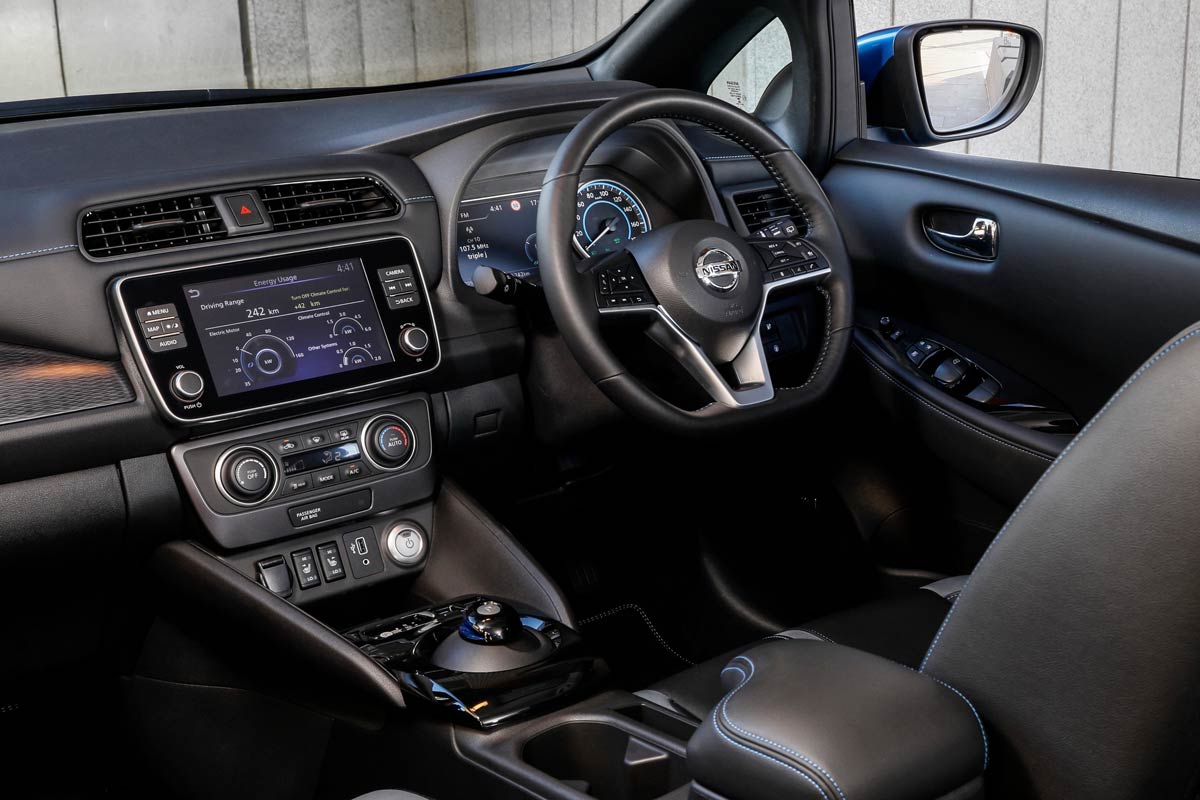
2021 Nissan Leaf e+ tech and styling
Another string in the Leaf’s bow is it remains the only fully electric vehicle currently available that offers vehicle-to-grid or bi-directional charging.
Upon installing an expensive bi-directional wall charger, it’s possible to use the Leaf’s battery to power the family home for extended periods, depending on household energy usage.
For those who see cars purely as transport, this type of emerging technology will add another perspective on future purchases. Heading off to work, finding a free charging station during the day and plugging the Leaf in to power the home at night, will have a definite appeal for some.
— Tim Pomroy
How does the 2021 Nissan Leaf e+ perform?
While most prospective buyers won’t have the Leaf’s handling uppermost in their thoughts, it’s quite adept out on the open road.
The lower centre of gravity and balanced weight distribution combine nicely, although push too hard through corners and the Leaf’s eco-focused tyre package reminds you that it’s no hot hatch.
With the battery taking space under the floor, the driving position is higher and more upright than a similar small hatch or sedan, and the lack of steering wheel reach adjustment exacerbates the feeling – something drivers may find disconcerting initially.
Performance is comparable to a regular 2.0-litre petrol vehicle and it’s likely the extra weight of the battery (approximately 155kg) offsets any performance gains from the electric motor’s increased outputs.
Nissan’s e-Pedal mode allows the driver to lift their foot off the accelerator to slow down instead of using the brake pedal. Nissan claims this method can be used in up to 90 per cent of driving scenarios. It’s a great system and it won’t be long before your reliance on the conventional brake pedal is reduced.
The 2021 Nissan Leaf e+ at a glance
Pros: Bi-directional charging; increased range; e-Pedal functionality
Cons: Performance gains are hard to discern; no electric handbrake


