Top 10 most misunderstood road rules

Even the most qualified drivers can question their knowledge of road rules.
Across NSW roads, everyday situations like roundabouts, lane changes, pedestrian crossings and school zones are governed by specific rules that are often misunderstood. These are the 10 most misunderstood road rules in the state, according to Transport for NSW
What are the most misunderstood road rules?
1. Roundabouts
Drivers approaching a roundabout must use their indicators when turning left, right or making a U-turn, but not when going straight ahead (as this would mislead other drivers into thinking you are going left or right).
When exiting a roundabout, you must indicate left just before you exit, unless it is not practical to do so (when travelling straight ahead on a small single lane roundabout as it may be impractical to indicate left when exiting).
2. Giving way to pedestrians
If a driver is turning left or right at an intersection, the driver must give way to any pedestrian crossing the road the driver is entering. This applies to intersections with or without traffic lights.
3. Mobile phones

Mobile phones can only be used while driving if it’s secured in a commercially designed and manufactured mounting fixed to the vehicle or operated by Bluetooth technology or voice activation. This includes the navigational or GPS function and audio functions of the device.
Learner, P1 and P2 drivers must not use a mobile phone at any time while driving or stationary on a road (including at lights or in traffic), whether handheld, mounted or hands-free, and this includes calls, messages, navigation, music and all other functions.
4. Merging
When a driver is travelling on a road without lane markings and the number of lanes is reduced, they must merge by giving way to any vehicle that is ahead of them. However, a driver who is moving from one lane, marked by broken lines (whether or not the lane is ending) to another must give way to any vehicle already travelling in that lane.
5. Keeping left
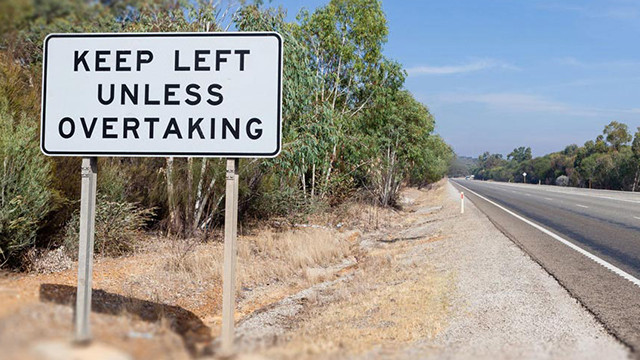
On roads with a speed limit of more than 80km/h, motorists must not drive in the right-hand lane unless overtaking, turning right, making a U-turn, avoiding an obstacle or driving in congested traffic. If a Keep Left Unless Overtaking’ sign is displayed, you must keep left regardless of the speed limit.
6. Headlight and fog light use
High beam is not permitted if travelling less than 200 metres behind a car going in the same direction or less than 200 metres from an oncoming vehicle. A driver is only permitted to use fog lights if driving in fog, mist or other atmospheric conditions that restricts visibility.
7. U-turns
When making a U-turn a driver must have a clear view of any approaching traffic and give way to all vehicles and pedestrians. Drivers are not allowed to make a U-turn across:
- across a single continuous dividing line or double continuous dividing lines
- across double lines where the line closest to you is continuous
- at intersections without traffic lights where a “No U-turn” sign is displayed
- at intersections with traffic lights unless a “U-turn permitted” sign is shown
- on motorways and freeways
8. Safe following distance
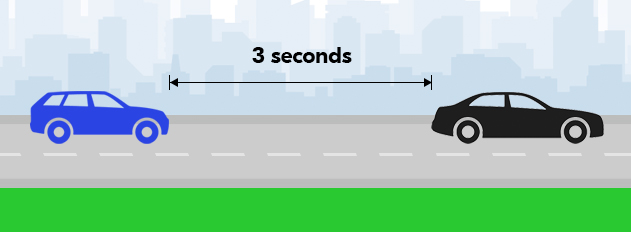
Drivers should maintain a safe following distance behind a vehicle in front of them, generally at least a three-second gap in normal conditions to allow adequate reaction time and reduce risk, and be mindful not to tailgate. In poor conditions such as rain, gravel roads or dim light, it may be necessary to increase the travelling distance to four seconds to increase the crash avoidance space. Following another vehicle too closely can result in fines and demerit points.
9. School zones
A school zone is the area around a school with a speed limit of 40km/h (normally between 8am-9.30am and 2.30pm-4pm on school days. There are a small number of non-standard school zone times in NSW. These zones are identified by red/orange school zone signs which indicate non-standard times. Signs at these schools display the times which apply.
10. Yellow traffic lights
A driver approaching traffic lights showing a yellow (amber) traffic light must stop if they can do so safely. Unless unsafe to do so, failing to stop at a yellow light can result in a $562 fine and 3 demerit points according to NSW offences and penalties.