NSW silo art road trip: Discover the state's spectacular silo murals

It’s never a nice feeling when something looms up out of the darkness while you’re driving at night, but of all the creatures I was prepared for, a cow was not among them.
It’s clear the cow is equally surprised, although it’s the kangaroo who looks most affronted, his expression making it clear I’ve interrupted something important before he hops off into the blackness.
Truth be told, we shouldn’t be out here. We definitely hadn’t planned to be, but a last-minute decision to strike out north from Gunnedah and head towards wheat and cattle country, near Barraba, takes us to one of the most striking artworks in all of Australia.
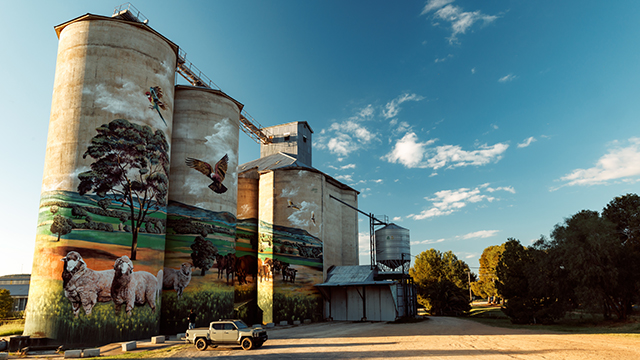
It’s certainly one of the largest. Towering 40 metres tall, ‘The Water Diviner’ silo on the outskirts of Barraba can be spotted from kilometres away, like a beacon on the horizon. We arrive at dusk, with just enough time to watch the golden sun lick the edges of all three silos. As photographer Alastair Brook busies himself with drones and tripods, I reflect on what has brought us here.
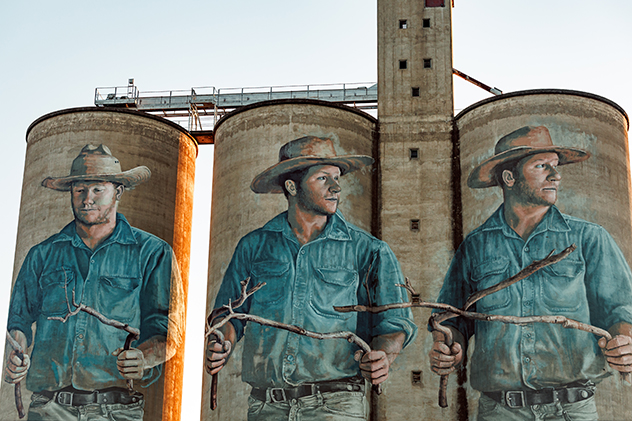
'The Water Diviner' by Fintan Magee in Barraba.
NSW silo art road trip: The story behind the trail
Our mission is simple: an old-school road trip to tap into the magic of the rapidly expanding ‘silo art trail’ in regional NSW. Now roughly 10 years old, the silo art movement has spread like wildfire across Australia, starting first as an idea for an outdoor arts program in Northam, Western Australia, in 2015, before swiftly morphing into a tourism initiative in remote towns across South Australia and the eastern states.
Depending on who you ask, Australia has upwards of 60 silo artworks, spanning a ‘silo trail’ of some 10,000km. But what is it about these giant murals that has struck such a chord? Why do they feel so uniquely Australian? And how exactly do you paint a curved cement structure that towers into the sky like an Olympic swimming pool stood on its end?
To find out, we’ve planned a three-day, 1500km trek starting in Sydney before looping counter-clockwise to see silos in Gunnedah, Dunedoo, Grenfell and Portland. Visiting Barraba was a spur of the moment decision, made from the comfort of our trusty wheels for this adventure, the capable (and still controversial) Kia Tasman, and as the sun blinks behind the horizon, I’m glad this is the first silo on our trip.
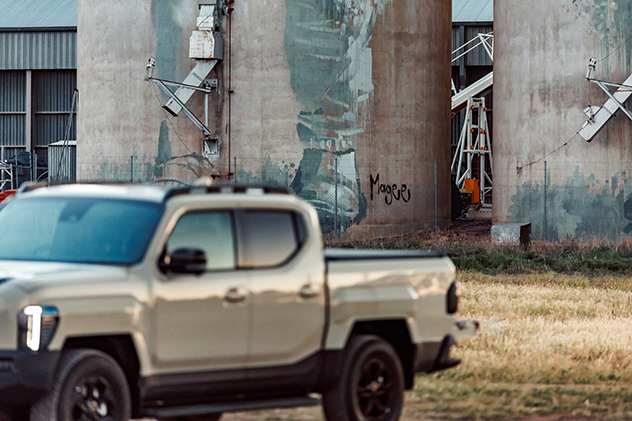
Despite its controversial looks, the Kia Tasman is a comfortable and capable country conveyance.
Barraba silo art: The Water Diviner
It’s majestic out here. And the silo is surprisingly detailed. Painted in 2019 by Sydney artist Fintan Magee, The Water Diviner was commissioned during one of NSW’s most extreme periods of drought and depicts three images of a man using divining rods to search for groundwater.
The power of the scene is only amplified by its sense of isolation. Apart from a semi-regular drumbeat of cattle trucks and horse floats, it feels as though we’re the only people for miles, the steady rustle of wind through the golden grass at the silo’s base our main companion.
With the sun a distant memory and Alastair’s camera satisfied, we head into Barraba for a brief look around. It’s a small town of around 1500 and bears the hallmarks of a community tied to working on the land. The only real activity is at the Commercial Hotel, where workers slip out of dusty LandCruisers and HiLuxes for a well-earned beer.
The night drive to our accommodation in Gunnedah is treacherous – cows, kangaroos, owls and sheep all appear in the Tasman’s powerful headlights.
Gunnedah silo art: A tribute to Dorothea Mackellar
Happily, it’s only a short stroll to our next silo in the morning. Set on the edge of Gunnedah’s bustling CBD, this silo is a tribute to Dorothea Mackellar who penned the famous poem ‘My Country’. The iconic line “I love a sunburnt country”, written by a homesick Dorothea while in England in 1904, features on the striking sepia-toned silo, which is also vastly more impressive to behold in person. It’s something the mural’s artist, Mongolian-Australian Khosnaran Khurelbaatar, better known as Heesco, says is true of all silo art.
“There’s a big difference between looking at a photograph on your computer or phone screen and looking at it in person,” he tells Open Road. “That sheer scale, you get to see the texture and the environment it was done in. It’s a different sort of experience. That’s what makes them so unique.”
The Gunnedah silo was commissioned by the town’s Dorothea Mackellar Memorial Society with support from the silo’s owner, Stephen Dangerfield. Amazingly, Stephen is working around the silo’s base when we arrive.
“It gets a lot of attention. Busloads of people come in to have a look. Actually, we need a coffee shop!” he chuckles. Stephen purchased the silo in 2000 and is about to start using it commercially once more. “It holds 5000 tonnes of maize,” he tells us. “We supply Sanitarium with all of their cornflake requirements.”
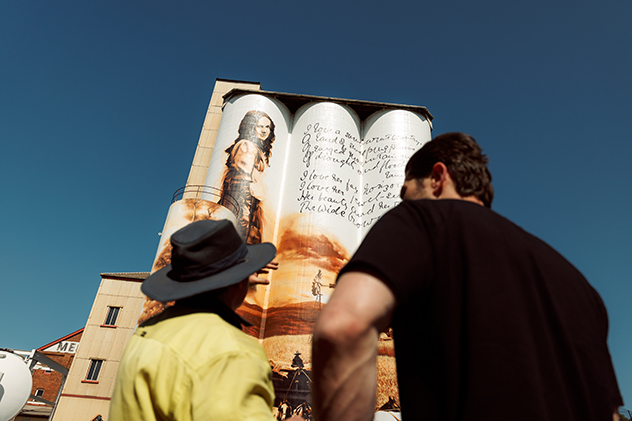
How are silo murals painted?
Like Barraba, the silo art in Gunnedah has a deep connection to its community and reflects the strong ties Mackellar’s family had to the district.
“The town wanted to honour her legacy,” Heesco says. “They had a really clear vision and that helped me a lot.”
It takes Heesco about six weeks to paint each mural, but a crucial part of the process is engaging with locals beforehand. “I enjoy travelling and seeing the land, meeting the people and hearing their stories. The silos are there to tell their story.”
In many ways, artists can become part of the community, with Heesco explaining locals will often watch him work, see the effort involved, and share stories with him at pubs and restaurants.
“It definitely gives people a sense of pride,” he says. “That they have something like this in their town and that it’s telling their story and showcasing the community.”
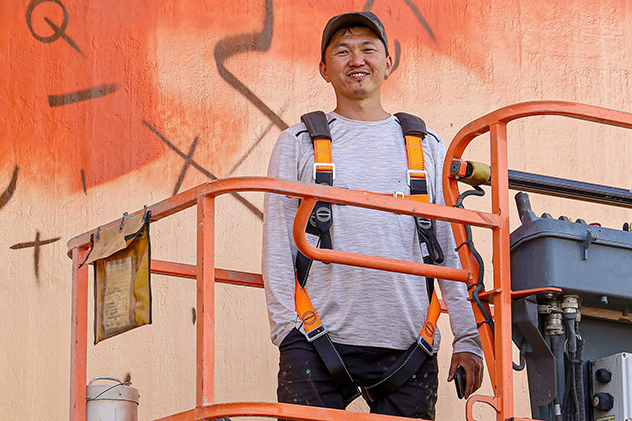
Silo mural artist Khosnaran Khurelbaatar, better known as Heesco.
As for costs, Dangerfield pegs the Gunnedah silo at around $100,000 and some silos require more than 500 litres of paint. Which begs the question: how do you physically paint something 40 metres off the ground?
“I use a cherry picker,” says Heesco, dashing my vision of him precariously hanging from the top, spray can in hand. “I’m not that scared of heights,” he laughs. “But I am scared of falling.”
Dunedoo silo art: Winx and regional life
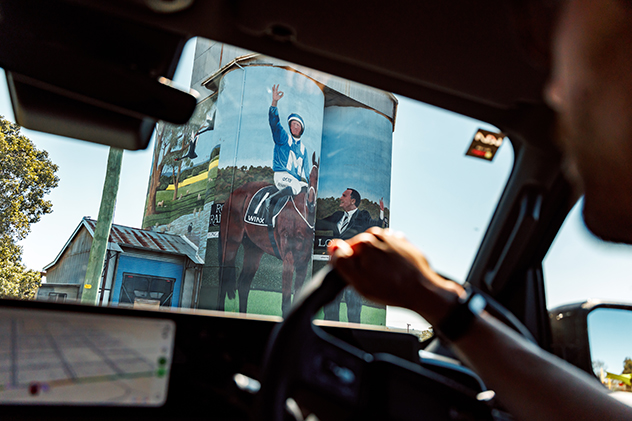
With the sun getting higher, we pile into the Tasman for the 500km drive to Grenfell. We score a bonus silo in Dunedoo on the way, this one unique because it features three distinct artworks on its sides. Sheep trucks rattle past as we drink in the visuals of local landscapes and black swans (the name Dunedoo is derived from the Wiradjuri word for black swan), but the standout mural is a tribute to one of Australia’s greatest racehorses, Winx.
How silo art supports regional towns
Anecdotally, it’s clear silo art can attract a strong economic benefit – the baker in Dunedoo tells us it brings in lots of business – but do the numbers actually back that up? According to agribusiness GrainCorp, which has been a key supporter of the silo art movement, some towns have recorded a business turnover increase of up to 20 per cent after a mural is completed.
Another benefit, and one that’s perhaps less obvious, is the sheer enjoyment of travelling between the silos. As the Kia Tasman chews up the miles, I can feel a sense of satisfaction starting to build and the worries of day-to-day life fading away. Regional NSW is awash with vibrant green fields, pops of canola and vast landscapes that seem to stretch endlessly.
It’s good for the soul to journey like this, and it’s the kind of driving the Tasman seems to relish. Our ute is the top-spec X-Pro, which retails for $74,990, although many of the luxuries making our trip so comfortable – like the widescreen digital dash, ample space and storage, and pillowy headrests – are available on every model. The 2.2-litre turbo-diesel is refined and powerful (overtaking is a breeze), and there’s no faulting the seat comfort. Even after three long days in the saddle, we don’t have a hint of discomfort or backache.
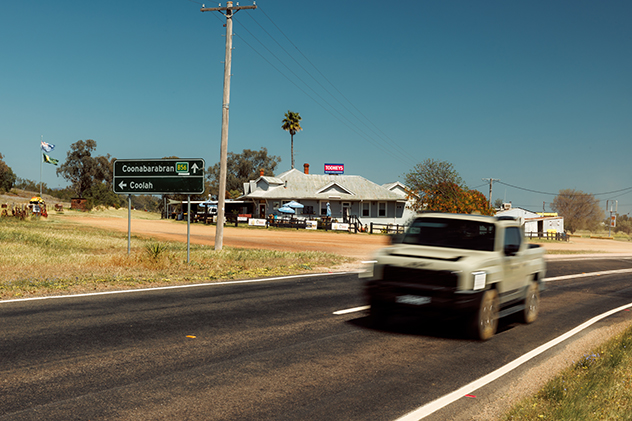
Passing through Mullaley, a small town between Coonabarabran and Gunnedah.
Grenfell silo art: A connection with the country
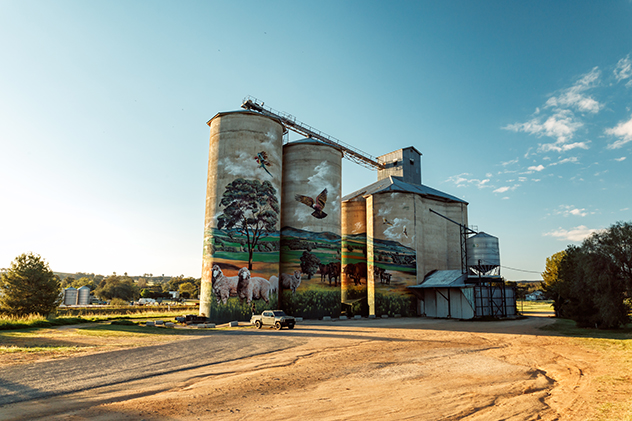
Just like Barraba, we’ve arrived in Grenfell at dusk and the entire scene is cloaked in an ethereal orange glow. Galahs screech and twirl as I clamber out and drink in the artwork, this one spread over four grain cylinders. It’s another Heesco creation and it instantly resonates. “He’s basically painted what we drove through today,” says Alastair, which it turns out, is exactly what the artist was going for.
“The Grenfell silo was privately owned and they only had one request: we want the landscape, the mountains, the cattle and sheep,” Heesco tells me. “The image connects across the silos and because you’re dealing with the curvatures, the hardest part was trying to align everything so it looked right.”
Heesco clearly has a deep respect for the towns he’s working for, but more tellingly, he seeks to understand why towns want particular scenes. “There’s definitely a sense from the locals that they want to tell the stories from their past. To make a legacy of how things used to be. It’s not that these towns are dying; they’re just changing as industries change.”
It’s an endeavour that has, on more than one occasion, seen Heesco adopted wholeheartedly by a town. In Grenfell, this manifested itself in a celebration dinner where a local chef treated Heesco and 150 residents to a Mongolian buffet – a tribute to Heesco’s heritage.
“There were dumplings, handmade noodles and all sorts of stuff,” remembers Heesco. “I took a video and sent it back to my family. I do get that sense of being accepted, you know, which is what I kind of do it for, I suppose.”
Portland silo art: The Foundations
This connection to community couldn’t be stronger than our final stop in Portland. It’s known as ‘the town that built Sydney’ because, unlike the other silos built for grain, the eight towering structures here stored cement used in many of Sydney’s major works. Huge portraits adorn its sides and, in another change, they aren’t symbols of rural Australia – they’re former employees of the Portland Cement Works. The attraction goes beyond the murals, too; Portland has developed the site into a hub known as ‘The Foundations’ where markets and cultural events are regularly held.
Reflecting on an epic journey
As Alastair takes his final pictures, I ponder our journey and how my own preconceptions about these enormous artworks have evolved. It’s easy to think of silo art as billboards for towns whose best days are behind them. The reality is a far more nuanced collision of heritage, pride and hope.
Even better is the realisation that the journey between them, where we’ve met interesting locals, taken detours and explored new towns and landscapes, has been just as satisfying. Just keep an eye out for cows lurking in the night.