BYD targets 200 Australian service sites and shorter wait times

Key points
- BYD targets 200 Australian sites by early 2027.
- Regional service sites will also support Denza.
- Service waits are targeted to fall to four to five days.
BYD plans to expand its Australian dealer network to around 200 locations by early 2027, with regional centres forming a major part of the next phase of its growth.
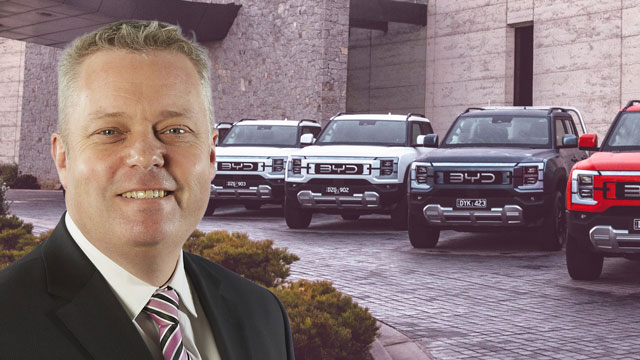
The Chinese car maker currently has around 120 sales and service sites across Australia, according to BYD Australia chief operating officer Stephen Collins.
Another 30 are planned by the end of 2026, followed by about 50 more in early 2027, taking the total network to approximately 200 locations.
That would put BYD's planned network in a similar size to the dealership networks of established mainstream brands like Ford and Mitsubishi. Toyota has the highest number of dealers in Australia, with more than 275 locations.
Collins said much of BYD’s expansion would be outside Australia's major cities as BYD looks to improve access to sales, servicing and parts for regional customers.
The regional rollout will also support Denza, BYD's premium brand, with service facilities in some non-metro locations to be shared across the two marques.
“Regional and provincial, that’s been our focus for our rollout of more dealers, which is more sales, service and parts capacity,” Collins told Open Road.
“Many non-metro buyers will start to see BYD dealerships popping up in local towns.”
“For us, that national footprint is a big part of the ecosystem that we’re building.”
The expansion comes as BYD's Australian sales continue to grow rapidly, increasing pressure on its supporting dealer, service and parts network.
Collins acknowledged the company's after-sales operations had needed significant improvement as the number of BYD vehicles on Australian roads increased.
“If I was sitting here six or nine months ago, one of our areas that we needed vast improvement on was after-sales,” he said.
“We’ve put a lot of effort and a lot of work into improving that. So that’s parts distribution, parts warehousing, service capacity, service wait times.”
Also read: BYD investigates Shark 6 cybersecurity vulnerability as it defends Australian data safeguards
BYD targets four to five-day service waits
Average service booking waits are now around seven days across the BYD network, according to Collins, although individual locations may be shorter or longer.
The company is aiming to bring that national average down further.
“We think that’s okay, but I think we can do better,” Collins said. “I think the sweet spot is more that sort of four to five-day spot.”
Collins said improving the chances of repairing a vehicle correctly on its first visit would depend on technician training, workshop processes and having parts readily available.
“Fix it right first time is all about the right training, the right technicians and the right processes when something goes wrong, because it doesn’t always go right,” he said.
A significant part of that is ensuring replacement parts are already available in Australia.
BYD currently claims a local parts fill rate of 95 per cent, meaning that in 95 per cent of cases where a replacement part is required, the company says it already has that part somewhere in Australia.
It may still need to be transferred between cities or dealerships, but Collins said this reduced reliance on waiting for parts to arrive by sea from overseas.
Where a required part is not already in the country and a vehicle is off the road, BYD can use air freight to speed up delivery.
“If we don’t [have a part], we would do what people would typically expect of us,” Collins said.
“If the vehicle’s off the road, air freighting. That’s a big part of the experience that we need to deliver to customers.”
The 95 per cent figure differs slightly from the 97 per cent fill rate cited by BYD during its broader product presentation, highlighting that the company's parts availability can vary depending on how the measure is calculated and when it is taken.
After-sales becomes increasingly important
BYD's Australian expansion has until recently been heavily focused on increasing its model range, sales volumes and retail footprint.
But as its earliest Australian customers begin replacing vehicles, Collins said the ownership experience after purchase would increasingly influence whether buyers returned to the brand.
“Selling the car is one thing, but giving people a really good experience throughout the lifecycle of the vehicle, ultimately the measure is people coming back,” he said.
The push into regional Australia could also address one of the hurdles facing newer brands entering the local market.
While metropolitan buyers may have several dealerships and service centres within reach, customers in smaller towns can face significantly longer journeys for servicing and repairs if a brand has limited regional representation.
For BYD, growing from around 120 outlets today to approximately 200 would substantially expand that footprint, particularly if the majority of the additional sites are established outside the capitals as planned.