
Charging your EV if you live in an apartment or terrace
If you’re thinking of switching to an electric vehicle (EV) but live in an apartment or the inner city, odds are you are wondering about how you will keep the car charged.
EV charging at home is easy if you have a garage or at least a driveway; you can just simply use a standard power outlet or upgrade to a wall box.
If you don’t have access to these, councils are making moves to help residents make the switch more easily. Additionally, new changes to NSW strata rules are expected to see the installation of EV chargers become a more straightforward process for apartment lot owners.
Can I install EV chargers at my apartment?
If you live in an apartment and want to discuss adding EV charging with strata management, the NSW Government’s EV-ready buildings program helps guide and co-fund infrastructure upgrades. Read on for changes to strata rules that will make it easier for apartment owners to install EV chargers.
Both NSW and the ACT have adopted new energy efficiency standards in the National Construction Code which state that electrical boards in new apartments must include capacity for the installation of EV chargers in carparks (see Table 4.31 in the Apartment Energy Efficiency Handbook.)
Other states and territories are also moving towards EV-ready apartment buildings through the National Construction Code, which requires new Class 2 apartment buildings to include electrical capacity for future EV charging in car parks. However, start dates and local implementation vary by jurisdiction, and the rules generally apply to new buildings rather than existing strata schemes.
Changes to NSW strata rules
Sweeping changes to NSW strata rules aim to make it much easier for apartment owners to install EV charging in their own parking space, including power outlets and AC wall chargers.
Previously, lot owners wanting to install EV chargers in NSW apartment car parks have been held back by several factors: complex strata approval processes, the need to access common property, uncertainty over who pays for upgrades and maintenance, and risk-averse or restrictive committee decisions. Questions around electrical capacity in older buildings have also raised concerns.
Under the current proposed changes in the Strata Schemes Legislation Amendment (Miscellaneous) Bill 2025, owners would be able to apply directly to the strata committee for approval to install an EV charger on their lot.
The committee would need to respond with written reasons for objection within three months, and may not unreasonably object. If it fails to respond in time, approval would be deemed to have been given. If there is an objection, the owner can apply to the Tribunal for a no-objection order.
The draft bill, dubbed the ‘Right to Charge’ law, would also mean strata by-laws cannot unreasonably block EV charger installations. However, the lot owner would still generally be responsible for installation costs, maintenance, operation and any damage to common property.
While the passing of the draft bill is certainly a positive step forward for apartment owners who own EVs, it’s important to note there may still be further amendments in the upper house and timelines for implementation of regulations to support the bill are still unclear.
How do councils help residents charge EVs at home?
There are two ways local government assists apartment and inner-city residents with going EV.
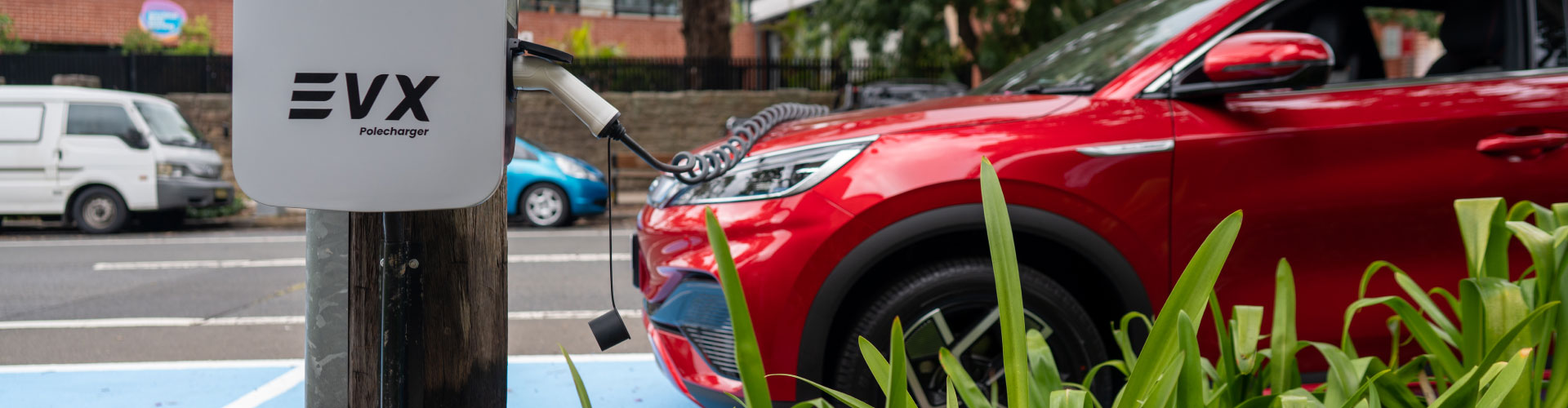
These include installing publicly accessible AC street chargers (sometimes also known as “smart poles” or “kerbside chargers”) and in some cases, DC fast chargers.
Local governments are also developing planning controls for new apartments, and strata guidelines for existing blocks, to make installing EV chargers in private car parks simpler.
To help councils cover the cost of installing AC street chargers, the NSW state government in July 2023 announced kerbside EV charger grants worth $3 million for up to 500 locations. Destination charger grants are now closed, though site hosts can still register interest.
In 2025, the Australian Renewable Energy Agency (ARENA) also committed $2.4 million in funding to EVX for 250 public kerbside EV chargers across 60 local government areas in New South Wales, Victoria and South Australia.
— Bridie Schmidt
Is there an AC street charger or kerbside charger in your area?
The locations of street chargers can be found on the NSW government’s Eventure website, this EV charging map or nationally via the Plugshare map. You can download the Plugshare app for free here.
Filter “Type 2” plugs, and then hide dealerships and restricted access sites.
The map will also show locations that are publicly accessible in other locations such as car parks in shopping centres or at other local businesses. Street charger results typically include the word “Parking” or “Street” in the name.
How do I use an AC street or destination charger?
Some public AC chargers may be tethered, which means they have a cable attached. Others require you to bring your own cable.
Most modern EVs have a Type 2 plug so would require a “Type 2 to Type 2” cable. A few, such as the Nissan Leaf, use a Type 1 plug, so would require a “Type 2 to Type 1” adapter.
Plugshare will indicate if the site is free-to-use or if it is pay-per-use, and which EV charging network manages the site.
Free sites may need no app to activate, but paid sites will first require an app to be downloaded to your phone, and payment details entered. You can find a list of charging network operators here.
To activate a kerbside street charger, plug your car in, open the app and find the location, then activate.
How quickly will my EV charge at an AC street charger?
How long you need to charge for depends on the speed of the charger, how fast your car can charge and how empty or full your battery is.
Kerbside AC chargers with a top charge rate of 22kW can add up to 130km of driving range an hour. Some AC chargers may have a top charge rate of 7kW, and add 40km driving range or so an hour. Please see our article here for more information on EV charging times and speeds.
Also, it is good idea to follow EV etiquette by checking in on Plugshare, to let others know when you expect to finish charging and move your car so others can charge there.
Can I install my own kerbside charger?
As far as convenience goes, having your own private EV charger outside your terrace or ground-floor flat is as good as it gets.
Also known as cable gullies, privately installed kerbside chargers are a potential solution for terraces or other residences that do not have access to off-street parking but do have street-front access.
Inner West Council in Sydney is trialling private kerbside charging, which involves running a cable out from the home via a channel dug into the footpath, until July 2026. At the kerb, a small charge unit allows access to the powerpoint. Typically, the charging unit sits flush with the pavement until it is needed for use. When needed, the owner uses a key to unlock the unit so that it pops up and then the EV charging cable can be connected to it.
If you are interested in testing a similar solution, you’ll need to get your local council on board to approve the installation.
Also, keep in mind that while you might have the right to use your EV kerb charger, you cannot guarantee that the car parking space next to it will be available – particularly if you live in the inner city. Consider building good relationships with your neighbours to manage access to the parking space outside your home.
Are private kerbside chargers legal in NSW?
The good news is that the NSW government has introduced legislation as part of its State Environmental Planning Policy aimed at paving the way for private kerbside charging.
Under the legislation, homeowners or occupiers wishing to install an EV charging unit on public land next to the home must comply with specific conditions.
Installation is permitted, with appropriate consent from the local council, if the charging unit is placed next to a legal parking area. It must be directly connected to the occupant’s electricity meter and be solely for personal use (not commercial).
Additionally, the infrastructure must be discreet: cables must run underground, and the charging unit should be capable of retracting below ground when not in use, adhering to the manufacturer’s installation guidelines.
EV chargers that sell space for advertising to offset the cost of charging are not allowed under the rules, keeping the focus on EV charging functionality rather than commercial interests.
Can I run my EV cable across the pavement?
If you live in a terrace, it may be tempting to run an extension cable out to your car from your home. However, be sure to seek an approval permit from your local council first and follow safety guidelines or you may incur a fine.
For example, in 2023 the Inner West Council gave approval to a small number of residents to run a covered cable on the pavement to their electric vehicles for charging.
To find out if you can get a permit for a covered electric car charging cable, try contacting your local council’s Certification team.


