Are electric cars cheap to run?

The cost of filling up continues to hit drivers in the hip pocket, with rising fuel prices gouging household budgets significantly.
While internal combustion engine (ICE) drivers scramble to find the cheapest service station, electric vehicle (EV) drivers are now also seeking out the best EV charging options.
So what does it cost to charge an electric vehicle and how does that compare with the fuel costs of petrol, diesel and hybrid cars?
How much does it cost to charge an EV?
In most cases, electric vehicles cost less to power than petrol or diesel cars, particularly when they are charged at home. However, the size of the saving depends on the vehicle’s efficiency, the electricity tariff, and how often the driver relies on public fast charging.
Without considering savings on EV servicing and maintenance, there are four main factors that determine how much an electric car costs to run:
- The vehicle’s energy consumption in kWh/100km
- Where and when the car is charged
- The price paid for electricity as a result
- Driving conditions and driving style
As with petrol and diesel vehicles, some electric cars are inherently more efficient than others. A smaller electric hatchback will generally use less energy than a large electric SUV, while higher speeds, steep terrain, heavy loads and extreme temperatures can all increase consumption.
What’s the cost to charge an EV at home, work or on the road?
The cheapest way to charge an EV is generally at home, particularly for households that can access an off-peak electricity tariff, an EV-specific energy plan, or surplus rooftop solar.
Public AC chargers, such as ‘destination chargers’ at shopping centres, may cost more than home EV charging, while high-powered public DC chargers typically have the highest electricity rates. However, they also provide the convenience of adding substantial range during a short stop.
This means EV charging costs generally fall into three scenarios:
- Home charging: Usually the lowest-cost option, depending on the household electricity tariff.
- Mixed charging: A combination of home, public AC and occasional DC fast charging.
- Public DC charging: Usually the most expensive option and most commonly used on longer journeys or by drivers with no access to home charging.
Some energy providers also offer discounted or free charging periods at home for EV owners. Charging from rooftop solar can bring the cost down further, although the installation cost and household energy use add another layer to the calculation and are not considered here.
The NRMA’s EV charging network offers discounts for Members too. You can find out more here.
How much do EVs cost to run compared with hybrids and petrol cars?
To compare electric, hybrid and internal combustion engine vehicles, we used energy and fuel consumption data from the Green Vehicle Guide.
For petrol and diesel vehicles, consumption is measured in litres per 100 kilometres or L/100km. The EV equivalent is kilowatt hours per 100 kilometres, written as kWh/100km.
The interactive chart below includes popular vehicles from several market segments and uses the most efficient, lowest-cost variant of each model listed. Energy costs are based on 32.5c/kWh as an average of mixed home and public charging for EVs. For combustion vehicles we calculate official combined fuel economy x average fuel price (minimum RON for each car) x average annual driving distance. According to ABS data, the average annual distance for passenger cars is 11,100km, while dual-cab utes cover 15,300km. Fuel costs are based on NSW averages for the first six months of 2026: 189.3c (91 RON), 206.5c (95 RON), 213.8 (98 RON) and 242.2c (diesel)
The results show that EVs generally cost less to power than comparable petrol and diesel vehicles. However, that advantage can narrow when an EV is charged exclusively at public DC fast chargers, particularly when it is being compared with a highly efficient hybrid.
For example, a Toyota Yaris Hybrid would cost about $693 a year to fuel at $189.3 a litre (91 RON) when driven 11,100km a year. A BYD Dolphin Dynamic covering the same distance would cost about $839 if it were charged entirely at public DC chargers priced at 60c/kWh.
That does not mean the Dolphin will ordinarily cost more to run. A driver who charges mainly at home would pay considerably less.
How do I work out how much my EV will cost to run?
First, determine the vehicle’s average energy consumption in kWh/100km.
The official combined energy-consumption figure can be found via the Green Vehicle Guide. Most EVs also display actual recent or average energy consumption through the digital instrument panel or infotainment screen.
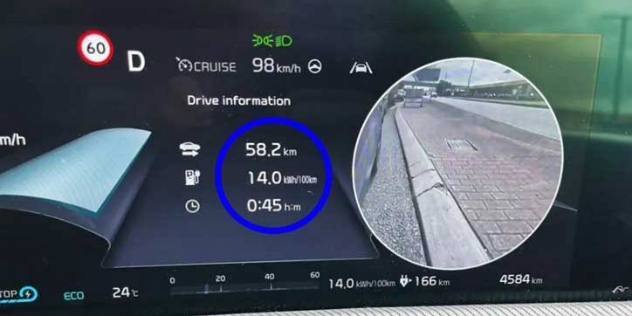
Official figures provide a useful way to compare vehicles, but real-world consumption varies. EVs generally use more energy at sustained highway speeds than they do around town, where lower speeds and regenerative braking can improve efficiency.
Weather, hills, tyre pressure, the number of passengers, and the use of heating or air conditioning can also change the amount of electricity used.
How to calculate the cost of a full charge
To manually work out how much it would cost to ‘fill’ your battery, use this formula:
EV battery capacity (kWh) x
Price per kilowatt hour ($/kWh) = Charging cost
For example: 60kWh x $0.30/kWh = $18
This is a simplified estimate. The amount billed at the electricity meter may be slightly higher because some energy is lost during charging. Drivers also rarely arrive with a completely depleted battery and charge it to 100 per cent.
For a more typical partial charge, multiply the battery capacity by the percentage being replenished. Charging a 60kWh battery from 20 to 80 per cent means adding about 36kWh before charging losses are considered.
How to calculate the cost of an EV journey
If you need to estimate the cost for a particular trip you can use this formula:
Energy consumption (kWh/100km) / 100 x distance (km) x
electricity price ($/kWh) = charging cost ($)
For an EV using 15kWh/100km over a 900km journey, with electricity priced at 60c/kWh:
15 ÷ 100 × 900 × $0.60 = $81
For journeys involving several charging stops, the final cost may vary because different charging networks and locations can have different rates.
The Green Vehicle Guide also offers calculators that allow drivers to estimate annual fuel or electricity costs and compare different vehicles. Its home-charging calculator estimates the time and cost of charging based on the battery size, charger power, and household electricity tariff.
For eligible work-related EV expenses, the Australian Taxation Office’s PCG 2024/2 electric vehicle home-charging rate is 4.2 cents per kilometre for the 2022–23 to 2025–26 income years. Eligibility and record-keeping requirements apply.
*Note, although the Green Vehicle Guide uses lab testing data that may differ from real world driving conditions, it does provide a good comparison of energy/fuel usage and costs between vehicles. Actual energy and fuel costs may vary based on individual driving styles, driving conditions and the age and condition of the vehicle.The Green Vehicle Guide advises that, "the estimated annual fuel cost associated with an Electric Vehicle on the Green Vehicle Guide (GVG), energy consumption is declared by the manufacturer in accordance with Australian Design Rule 81/02 (Fuel Consumption Labelling for Light Vehicles), and electricity price data is based on the most recent residential electricity price trends reported by the Australian Energy Market Commission (AEMC)." That is, where the 2021 AEMC report provides estimates, on the GVG this is rounded up to 30c/kWh.