Spec battle: 2026 BYD Sealion 7 vs 2026 Toyota RAV4

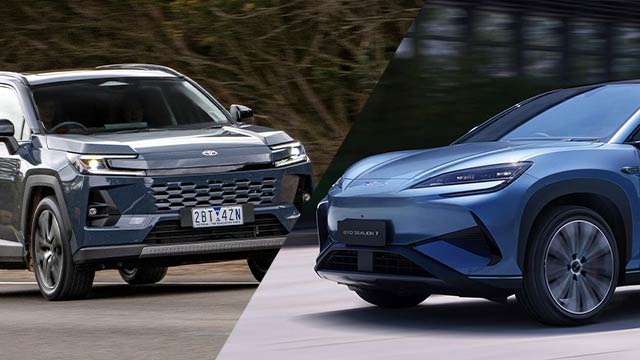
The BYD Sealion 7 and Toyota RAV4 sit in the same broad SUV lane, but they go about the job in very different ways. One is a dedicated battery electric vehicle with sharp outputs and fast charging, the other spans conventional hybrid and plug-in hybrid variants with a wider model spread and a lower entry price.
Comparing the specs between the two, the Sealion 7 makes its case with stronger outright numbers, a punchy electric motor, a larger footprint and EV-specific kit like a frunk and vehicle-to-load capability. The incoming RAV4, meanwhile, packs the same 5th generation 2.5 litre engine paired with either a small hybrid battery or a larger 22.7kWh plug-in hybrid powertrain, and is the safer middle-of-the-road pick for buyers who want more choice across the range, more ground clearance and a familiar hybrid ownership path.
Pricing and variants
BYD keeps things fairly tidy with two Sealion 7 variants, Premium at $54,990 before on-road costs and Performance at $63,990.
Toyota casts a much wider net. The RAV4 range starts at $45,990 before on-road costs for GX and runs through GXL, Edge and Cruiser grades, right up to XSE and GR Sport plug-in hybrid variants topping out at $66,340.
That means the cheapest RAV4 undercuts the Sealion 7 Premium by $9,000. At the other end, the dearest RAV4 sits $2,350 above the Sealion 7 Performance. In short, Toyota gives buyers more steps on the ladder, while BYD lands closer to the middle and upper end of the market.
|
Manufacturer |
BYD |
BYD |
Toyota |
Toyota |
Toyota |
|
Model |
Sealion 7 |
Sealion 7 |
RAV4 |
RAV4 |
RAV4 |
|
Variants |
Premium |
Performance |
GX | GXL |
Edge | Cruiser |
XSE | GR Sport |
|
Price (before on roads) |
$54,990 |
$63,990 |
$45,990 - 52,340 |
$55,340 - $60,340 |
$58,840 - $66,340 |
Performance and range
This is where the Sealion 7 starts to stretch its legs.
The Premium is rated at 230kW and 380Nm, with a 0-100km/h time of 6.7 seconds. The Performance lifts that to 390kW and 690Nm, cutting the 0-100km/h sprint to 4.5 seconds. Both use an 82.56kWh battery, with the Premium driving the rear wheels and the Performance switching to AWD.
The RAV4’s figures are more mixed because the range spans hybrid and plug-in hybrid models. The hybrid grades are listed at 152kW and 243Nm, while the plug-in hybrid is listed at 201kW in 2WD form or 227kW in AWD guise. Toyota does not state torque or 0-100km/h times on the supplied sheet, so it is harder to line them up cleanly against the BYD.
Range figures also need context. The Sealion 7 is listed at 482km WLTP for Premium and 456km WLTP for Performance (real world figures will depend on driving style and conditions.) The RAV4 is listed at an estimated 1145km, taking into account the 55 litre tank and real world driving efficiency of 4.8 litres per 100km.
If pure shove matters, the BYD is clearly the quicker car on paper. If long-distance flexibility without charging stops is the priority, the RAV4 hybrid still has a strong hand.
|
Manufacturer |
BYD |
BYD |
Toyota |
Toyota |
Toyota |
|
Model |
Sealion 7 |
Sealion 7 |
RAV4 |
RAV4 |
RAV4 |
|
Variants |
Premium |
Performance |
GX | GXL |
Edge | Cruiser |
XSE | GR Sport |
|
Battery / Tank |
82.56kWh |
82.56kWh |
55 litres |
55 litres |
22.7kWh / |
|
Motor / Engine |
Single Motor |
Dual Motor |
5th Gen 2.5-litre Hybrid |
5th Gen 2.5-litre Hybrid |
2.5L 6th Gen Plug‑In Hybrid Electric |
|
Drive |
RWD |
AWD |
2WD or AWD |
2WD or AWD (Edge AWD only) |
AWD |
|
WLTP Range (km) |
482km |
456km |
1145km* |
1145km* |
1145km* |
|
Power Output (kW) |
230 |
390 |
152 |
152 |
201kW (2WD) | 227kW (AWD) |
|
Torque (Nm) |
380 |
690 |
243 |
243 |
Not stated |
|
Acceleration (secs, 0-100) |
6.7 |
4.5 |
Not stated |
Not stated |
Not stated |
Practicality and towing
There are a few useful details here that will matter in the real world.
The Sealion 7 offers 500 litres of boot space plus a 58-litre 'frunk' under the bonnet, handy for cables or smaller bags. The RAV4 has the edge in rear cargo volume at 542 litres, though it does not offer any front storage.
EV charging is another clear point of difference. The Sealion 7 supports 11kW AC and 150kW DC charging. The RAV4 hybrids do not charge externally, while the XSE and GR Sport plug-in hybrids are listed with 11kW AC and 50kW DC capability (and need to be charged regularly if they are to meet their fuel consumption claims.)
On towing, the Sealion 7 Premium is rated at 750kg braked and 750kg unbraked, while the Performance steps up to 1500kg braked and 750kg unbraked. The RAV4 is listed at 1500kg braked and 750kg unbraked across the range, so Toyota has the more consistent towing story.
There is also a small point of difference in ability to power devices from the vehicle’s battery. BYD lists V2L capability for both Sealion 7 variants, while Toyota lists a 1500W inverter for the XSE and GR Sport.
|
Manufacturer |
BYD |
BYD |
Toyota |
Toyota |
Toyota |
|
Model |
Sealion 7 |
Sealion 7 |
RAV4 |
RAV4 |
RAV4 |
|
Variants |
Premium |
Performance |
GX | GXL |
Edge | Cruiser |
XSE | GR Sport |
|
Max Charge Rate (AC/DC) |
11/150 |
11/150 |
- |
- |
11/50 |
|
Cargo space (litres) |
500 |
500 |
542 |
542 |
542 |
|
Frunk Cargo Space |
58 |
58 |
- |
- |
- |
|
Tow Rating (braked / unbraked) |
750/750 |
1500/750 |
1500/750 |
1500/750 |
1500/750 |
|
V2L |
Yes |
Yes |
- |
- |
1500W inverter |
Size
The Sealion 7 is the bigger SUV in most directions.
It measures 4830mm long, 1925mm wide and 1620mm tall, with a 2930mm wheelbase. The RAV4 comes in at 4601mm long, 1855mm wide and 1680mm tall, with a 2690mm wheelbase.
That gives the BYD a clear advantage in footprint and wheelbase. In theory, that should help cabin space and give it a more planted feel on the road.
Toyota claws some of that back with running clearance. The RAV4 is listed at 194mm, well up on the Sealion 7’s 140mm. If you regularly deal with rougher access roads, steep driveways or the odd campsite track, that extra clearance is worth keeping in mind.
|
Manufacturer |
BYD |
BYD |
Toyota |
Toyota |
Toyota |
|
Model |
Sealion 7 |
Sealion 7 |
RAV4 |
RAV4 |
RAV4 |
|
Variants |
Premium |
Performance |
GX | GXL |
Edge | Cruiser |
XSE | GR Sport |
|
Length (mm) |
4830 |
4830 |
4601 |
4601 |
4601 |
|
Width (mm) |
1925 |
1925 |
1855 |
1855 |
1855 |
|
Height (mm) |
1620 |
1620 |
1680 |
1680 |
1680 |
|
Running Clearance |
140 |
140 |
194 |
194 |
194 |
|
Wheelbase (mm) |
2930 |
2930 |
2690 |
2690 |
2690 |
Warranty and ownership costs
BYD covers the Sealion 7 with a six-year, 150,000km vehicle warranty, plus an eight-year, 160,000km battery warranty.
Toyota offers a five-year, unlimited kilometre vehicle warranty, with an eight-year, 160,000km battery warranty.
Service costs differ significantly – more than half the cost of the all-electric thanks to the simpler drivetrain. The Sealion 7 costs $2288 to service over the first 120,000km, whereas the RAV4 comes in at about $4,900 for GX and GXL, about $4,820 for Edge and Cruiser, and about $5,090 for XSE and GR Sport.
Annual running costs on the sheet also favour the BYD, at $902 for Premium and $857 for Performance, against about $1,200 for the RAV4. As always, those figures depend on the assumptions behind them, so they are best treated as a guide rather than gospel.
|
Manufacturer |
BYD |
BYD |
Toyota |
Toyota |
Toyota |
|
Model |
Sealion 7 |
Sealion 7 |
RAV4 |
RAV4 |
RAV4 |
|
Variants |
Premium |
Performance |
GX | GXL |
Edge | Cruiser |
XSE | GR Sport |
|
Vehicle Warranty |
6 years/ 150,000km |
6 years/ 150,000km |
5 years/ unlimited km |
5 years/ unlimited km |
5 years/ unlimited km |
|
Battery Warranty |
8 years/ 160,000km |
8 years/ 160,000km |
8 years/ 160,000km |
8 years/ 160,000km |
8 years/ 160,000km |
|
Service Costs ** |
$2288 |
$2288 |
~$4900 |
~$4820 |
~$5090 |
|
Annual Cost to Run* |
$902 |
$857 |
~$1200 |
~$1200 |
~$1200 |
Verdict: Which one should you buy?
On specs alone, the BYD Sealion 7 is the more convincing buy if you want to escape the bowser entirely. It’s also a punchier and more practical vehicle, going off specs alone. It has much stronger outputs, faster charging, a useful frunk, V2L capability and a bigger footprint, all while keeping service costs in the same ballpark as the RAV4.
The Toyota RAV4 still makes plenty of sense, though. It is cheaper to get into, drives a long way on a single tank, has more boot space, much better clearance, and a 1500kg braked towing rating across the range. For buyers who are not ready to make the jump to full electric, these are convincing reasons to go for the hybrid.
The short take: if you're looking at different types of electric vehicles, the Sealion 7 is the sharper package for buyers who specifically want an electric SUV and can make the charging routine work. The RAV4 remains the easier all-rounder for families who want hybrid efficiency, a broader model line-up and fewer question marks around long-distance use.