Toyota GR Corolla vs VW Golf GTI vs Hyundai i30N

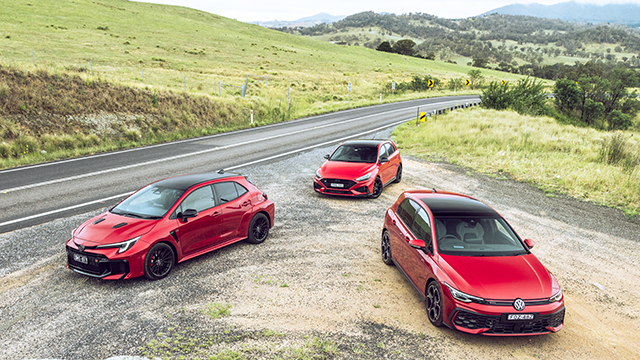
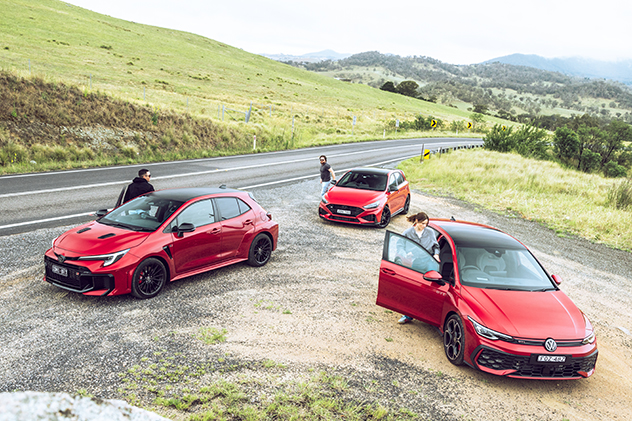
All the ingredients point to a scintillating comparison test, but the weather has other ideas.
Our trio of fettled passenger cars has rolled into swathes of fog and misty rain; enough to saturate the winding roads that lured us here.
There was a time conditions like this would force a change of plan, a detour in search for drier roads. Now, however, they’ve simply cemented our thinking. Consumer expectations and modern safety have made the modern hot hatch the ultimate all-rounders on our roads.
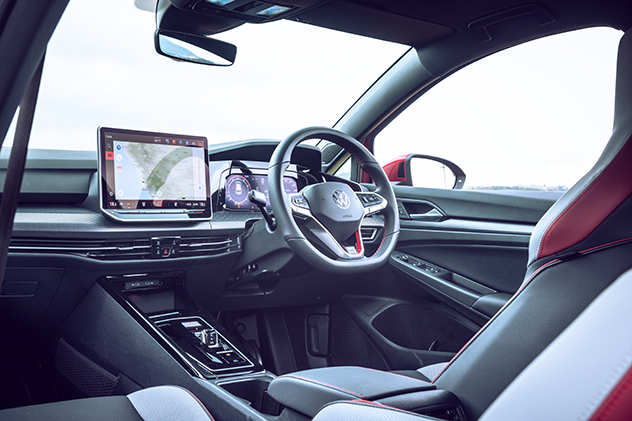
Volkswagen originally popularised the theme with the launch of the Volkswagen Golf GTI back in 1975. The tartan seats and golf ball-textured manual shifter of the original GTI feel like ancient history as we pore through the luxe Vienna leather-lined cabin of its Mk8.5 successor, replete with seat warmers and a quick-thinking 195kW drivetrain.
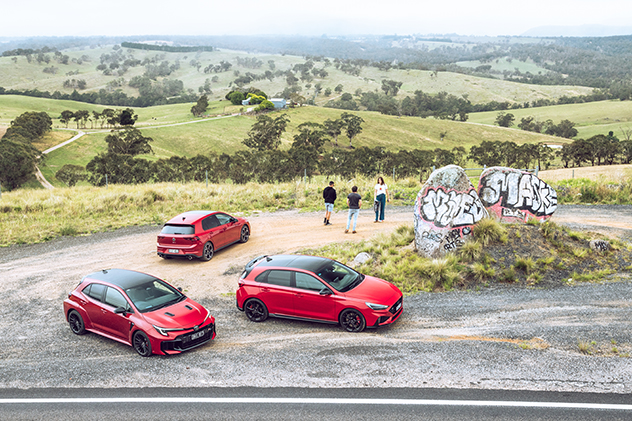
Just as the Golf has evolved, so has the hot hatch brigade. The newest of them is the rally-inspired Toyota GR Corolla developed by Toyota Gazoo Racing. Then there’s the rambunctious Hyundai i30 N, a riotous hatch whose snap, crackle and pop announces its modern cult status. Let the games begin.
Pricing and specifications
As broad as the hot hatch segment has become in recent years, one thing has remained critical: affordability. By their very definition, hot hatches are based on garden-variety hatchbacks and thus should be reasonably priced.
The Hyundai i30 N is the cheapest of our trio at $52,000, while the Toyota GR Corolla is the most expensive at $67,990 – a factor partly owed to the fitment of an all-wheel-drive system, the only one in this test. We’ve selected manual versions of each, but you can have both in automatic trim (at no cost in the i30 N and a $2500 premium in the GR Corolla).
Meanwhile, the Golf occupies the middle ground on price at $58,990, and only comes in automatic. Our test car balloons that figure by $3900 with the fitment of a Leather Package.
Although you could argue the affordability factor, there is no question around equipment levels. All three competitors offer alloy wheels (18-inch for the Corolla, 19-inch for the others), dual-zone climate control, LED and daytime running lights, keyless entry and start, plus partial leather seats with seat warmers up front.
Infotainment is likewise uniform, with centre touchscreens of varying sizes, matched by digital instrument clusters, Apple CarPlay/Android Auto, Bluetooth and more.
On the safety front, each of our contenders is fitted with quick-thinking features such as electronic stability control and anti-lock brakes, plus a full complement of airbags. Driver aids including autonomous emergency braking, lane departure warning, lane keeping assistance and rear cross-traffic alert are likewise shared. Behind the wheel, however, the intervention of these systems varies between benign (Volkswagen) to plain agitating (Hyundai).
All three cars offer a five-year/unlimited kilometre warranty, but capped price servicing is varied. The Toyota requires shorter six-month/10,000km servicing intervals, totalling $1860 over three years. The Hyundai has slightly better 12-month/10,000km provisions, capped at $1098 over three years, while the Volkswagen offers 12-month/15,000km intervals but is the dearest over a three-year period ($1973).
The VW and Hyundai offer a space-saver spare tyre standard, while the Toyota only has a tyre inflation kit.
Interior and practicality
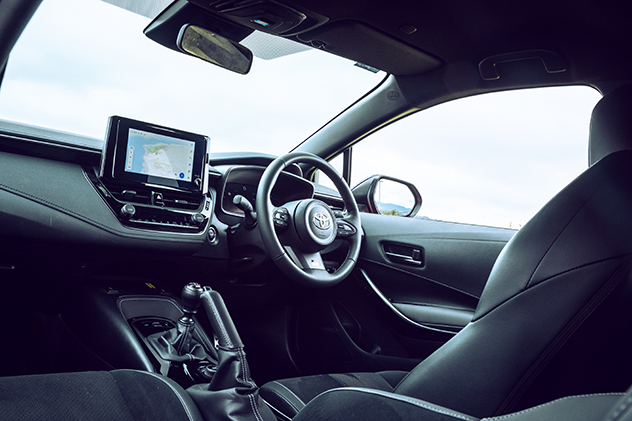
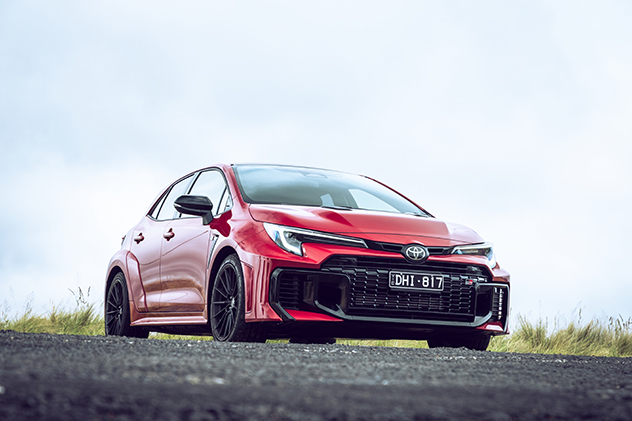
Toyota’s GR Corolla feels decidedly boy-racer, with low-set front bucket seats, GR badging and sophisticated touchpoints. Upon digging deeper, though, it seems not so different to a garden-variety Corolla and it becomes clear that its drivetrain and engineering are where the bulk of the additional spend has gone.
The racy approach isn’t infallible. Even up front, the Toyota’s incidental storage is basic, with a wireless charger that is prone to letting your phone slide off into the abyss, no centre console, and short, narrow door pockets. The rear is more of the same, with no dedicated door pockets (just a solitary cup holder in the door skin), while the 213-litre boot is the smallest of the three here. The Toyota’s raked roof means the window line is quite pinched in the rear, causing it to feel dark and claustrophobic for passengers.
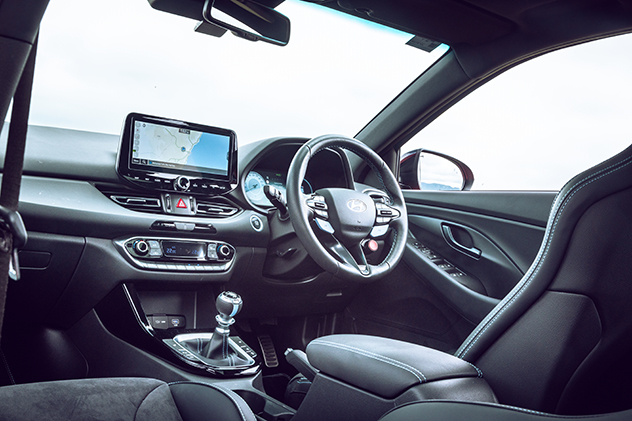
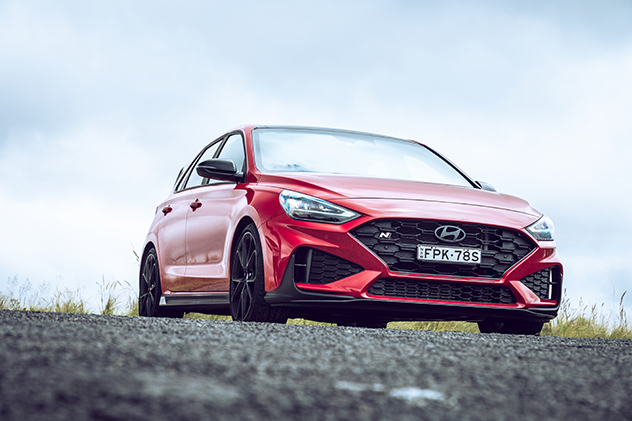
Next up, the Hyundai i30 N feels less special again, with more ties to its donor car and harder, cheaper-feeling plastics. That said, it makes the best use of its proportions, with the roomiest rear seat, a practical, open window line and the largest boot (381 litres). Like its rivals, it has two Isofix attachment points on the outbound rear seats, but the additional space and larger door openings make it the easier option with children.
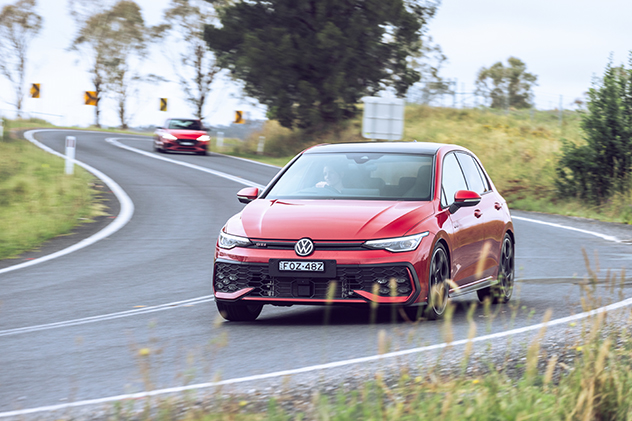
Then there’s the Golf, which steps more into premium territory with the layout of its cabin and use of different materials, thanks in part to the Leather Package fitted to our test car (the standard car offers tartan cloth seats and fewer trinkets). It has less switchgear than its competitors, a trait which looks pretty and streamlined but is less practical in reality. That said, VW should be applauded for reintroducing some physical controls in the Mk8.5, following customer backlash.
While the Golf is on the smaller side of rear-seat space in this trio, an open glasshouse design means it doesn’t feel it. Ditto the fitment of rear air vents and larger door pockets in this company. A 374-litre boot space cements its all-rounder positioning.
Under the bonnet
The old saying goes that only milk and juice come in two-litre packages, but you’d be remiss to underestimate the performance of these little hatches.
Both the VW and Hyundai have 2.0-litre turbo-petrol four-cylinder engines; the former outputting 195kW and 370Nm, while the latter advertises 206kW and 392Nm figures. Both send drive to the front wheels via an electronically controlled limited-slip differential, and have greater torsional rigidity than their donors, as well as uprated brakes and performance tyres.
Meanwhile, the Toyota’s 1.6-litre turbo-petrol three-cylinder trumps both, with 221kW and 400Nm and a benchmark 0-100km/h time of 5.3 seconds. The Toyota mirrors the Hyundai in offering either manual or auto transmissions, but is in a company of its own with an all-wheel-drive system. Supporting its sporty intentions are front and rear limited-slip differentials, performance brakes with red callipers, a vented bonnet, low-rise rear spoiler, and a carbon-fibre roof.
How do they drive?
Beginning with the Hyundai, you immediately sense why the i30 N has made its mark in hot hatch circles. Switching to ‘N mode’ on the drive-mode selector reveals its aggressive side. The engine takes on more purpose (think a motivated torque curve, yet with the propensity to march confidently past 6500rpm), the controls become weightier and the N’s fruity exhaust note burbles to life.
That aggression is the i30 N’s strength, but it is also partly its undoing. So intent on giving the driver its all, the steering tends to feel a bit nervous immediately off-centre, meaning small inputs can cause the car to dance around in your hands and feel disconnected from the surface underneath. The suspension’s propensity for pitch and roll contributes, too – taking a winding road at speed, it feels like there’s a lot going on inside, and not always in a good, harmonious way.
Persistent road noise and wind noise mean the Hyundai isn’t as easy to live with, while its manual transmission feels caught between gears on occasion, especially in headier driving.
That brings us to the Golf GTI. Amid this trio it seems more rounded, with lighter controls in daily conveyance and a quieter, more civilised ride – especially on the softest setting of its 15-stage adaptive dampers. It feels decidedly Euro, deftly dispatching bumps underneath while enamouring occupants with its plush interior. The exception here is the seven-speed dual-clutch automatic transmission, which is prone to an occasional misstep as you apply the accelerator.
While the Golf GTI isn’t as rich in its feedback to the driver, it offers a taut chassis and a surprising level of depth at the limit – thanks in part to clever electronics underneath. Rather than hastily tightening the electronic leash upon any semblance of traction being broken (as older GTIs tended to do), the Mk8.5 uses its extended electronic front differential lock to claw through corners and even offer some mid-corner rotation when really pushed. The drive experience is better for it; we just wish VW still offered a manual transmission.
A fruitier exhaust note for this Mk8.5 generation adds more aural drama, without matching the belching and bassy tones of GTIs 10 to 15 years ago, when emission rules weren’t as strict.
For all the fun-factor these two bring, however, neither can outshine the Toyota GR Corolla for unadulterated driving thrills. Its powerful engine imparts more speed, sound and theatre, with an unequivocal ace up its sleeve: all-wheel drive. Whereas its rivals try to make up this deficit with clever torque vectoring and electronics, the Toyota’s underlying hardware elicits additional grip, traction and cornering prowess. Moreover, the weighting and precision of the steering is spot on, and there’s a heavy-duty veneer to the controls, making it the one you’d pick as an enthusiast car or occasional track chariot.
Downsides? The GR Corolla simply doesn’t straddle the road as well as its peers, despite having the biggest overall proportions. Gearing is quite short, too, meaning at highway speeds you’re sitting quite high within the rev range. It also emerges the thirstiest on test, averaging 13.0L/100km on a mix of roads, versus 12.2L/100km for the Golf and 12.5L/100km for the i30 N.
The verdict
You could justify any of our three candidates as your winner, depending on priorities. The i30 N is a standout if interior space, value and raucous noise are your big buying prerequisites, while the GR Corolla is the one you’d want for pure driving fun and street presence.
But given the brief of the modern-day hot hatch as the ultimate all-rounder, our outright winner lands on the Volkswagen Golf GTI. It’s the most versatile of our trio, and a deserving winner – the original hot hatch and still the benchmark by which others are judged.
| Vehicle | Toyota GR Corolla | VW Golf GTI | Hyundai i30N |
| Engine | 1.6-litre 3cyl turbo | 2.0-litre 4cyl turbo | 2.0-litre 4cyl turbo |
| Gearbox | six-speed manual | seven-speed DCT | six-speed manual |
| Power | 221kW | 195kW | 206kW |
| Torque | 400Nm | 370Nm | 392Nm |
| Economy | 8.4L/100km | 7.2L/100km | 8.5L/100km |
| ANCAP | Not rated | 5 stars | Not rated |
| Price (before ORC) | $67,990 | $58,990 | $52,000 |