2026 Chery Tiggo 9 review

Starting out as little more than a curiosity a decade ago, the plug-in hybrid (PHEV) has become a serious force in the Australian car market. Combining the best aspects of combustion engine and electric vehicles, they deliver smooth performance without the potential range anxiety and inconvenience of a pure EV. Chinese car maker Chery has driven down the PHEV route multiple times with its Super Hybrid SUVs, the latest being the Chery Tiggo 9, a seven-seater large SUV. But does it offer enough to convince Aussie car buyers to part with $60,000?
How much does the 2026 Chery Tiggo 9 Super Hybrid cost?
From just a handful of players a few years ago, the large SUV segment in Australia has since grown enormously to encompass a staggering 30 models (and that’s just the sub-$80,000 offerings).
The Chery Tiggo 9 Super Hybrid is available in a single grade, the Ultimate AWD CSH, which retails for $59,990 before on-road costs.
Segment leaders include the Tiggo 9’s stablemate the Tiggo 8 Pro ($36,990), as well as the Subaru Outback ($48,990), Kia Sorento ($51,630), Mitsubishi Pajero Sport ($57,640), Isuzu MU-X ($57,900), Ford Everest ($59,490), Toyota Kluger ($62,410) and Toyota Prado ($72,500).
As a large plug-in hybrid SUV, however, the Chery Tiggo 9 has few direct competitors and measured against those its value proposition improves markedly, with the Chery Tiggo 8 Super Hybrid retailing for $45,990, the Kia Sorento S PHEV priced at $70,880 and Mazda CX-80 going for $75,250 (although it was on sale for around $67,000 at the time of writing). Its strong blend of space, equipment and hybrid efficiency also saw the Tiggo 9 earn a Highly Commended accolade in the 2026 Best Value Family Car Awards.
What is the 2026 Chery Tiggo 9 Super Hybrid like inside?
In a word, pleasant.
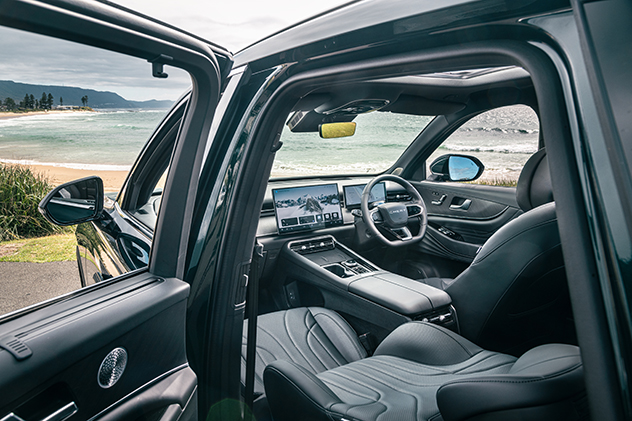
Chery has taken a subdued approach to styling, with dark colours and gently curved shapes the key themes. ‘Garish’ is not a word you would use about the Tiggo 9’s interior – iron-grey faux woodgrain panels are as ostentatious as it gets. There’s nary a hard surface to be found throughout the cabin and the seats are skinned in thick artificial leather, as are the steering wheel, armrest and door sills. Some interior panel fit is not what you’d call Lexus standard, but the overall impression is one of affordable luxury.
A high driving position is well-suited to this segment and ensures good forward vision. The seats are well-padded and comfy for a long stint (although they’re quite wide across the back – more on that in our drive impression below). A well-considered cabin layout ensures easy access to the central touchscreen, wireless phone charger and drink holders, while seat adjustment controls on the door and the gear shifter operated via a stalk on the steering column are very Mercedes-Benz.
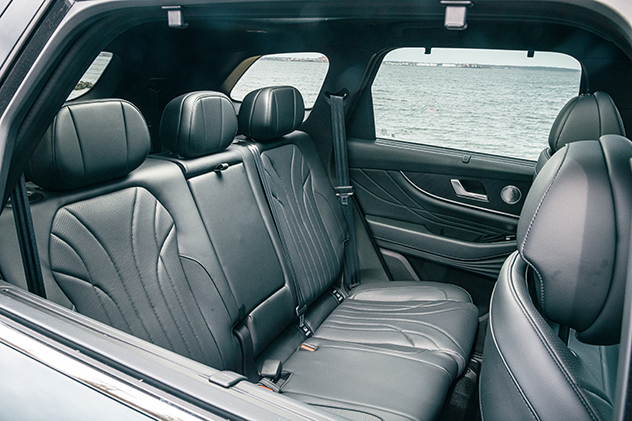
Second row seats in the Chery Tiggo 9 aren’t amazingly comfortable, however, and while foot and knee room are only adequate, head room is generous.
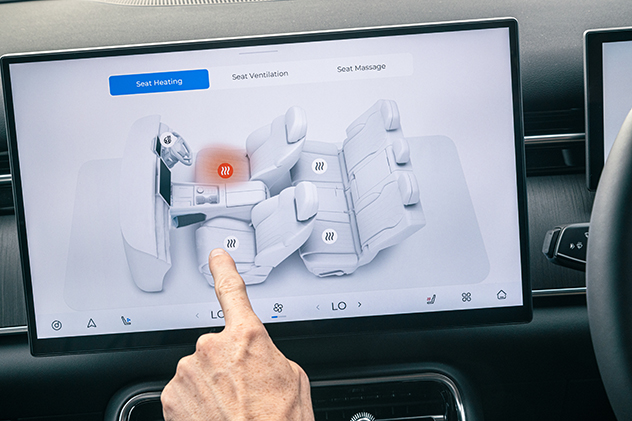
Second-row passengers are provided with one USB-A and one USB-C port, controls for their seat heating/ventilation and air conditioning fan speed (which displays on the main dashboard screen), four vents (two in the rear of the centre console and one in each B-pillar), a window shade on both sides, seat pockets, and good sized door pockets. The second-row seats also tilt and slide.
Access into the third row requires some climbing and clambering and once you’re in there it becomes clear it’s a kids-only affair for anything more than short trips, with minimal leg and head room (even my five-foot-nine bonce brushed against the roof). But, more annoyingly, there’s no easy way to make the second-row fold down from the passenger’s side seat, so it’s exit on the road side or wait for someone to let you out and perform more acrobatics. Occupants six and seven do get a drink holder, a slot for a smartphone, and reading lights.
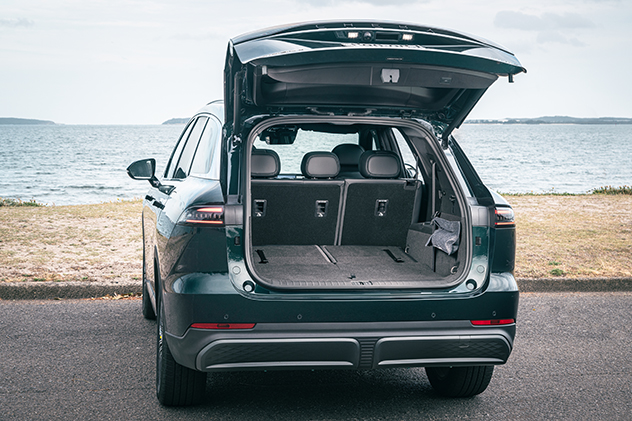
At a visual the cargo space appears long and narrow, but in this case looks are deceiving. Busting out the tape measure reveals more than a metre between the wheel arches and from the second-row seat back to the load lip. It’s also 800mm from the floor to the top of the boot aperture, although the sloping rear window does limit total capacity. Nevertheless, with the second row up there’s still a very substantial 819 litres.
There’s no spare wheel (not even a space saver), which makes a mockery of the Tiggo 9’s modest off-road pretensions, such as sand and snow modes. The tyre repair kit is stored in a small bag velcroed to the furry wall of the cargo bay, meaning it becomes obstructive when you’re trying to load a wide object. Surely there had to be a better solution.
— Kris Ashton

What equipment does the Chery Tiggo 9 Super Hybrid come with?
Most of the single-variant models from Chery and its subsidiary brands are kitted out to premium specification, which is the case with the Tiggo 9.
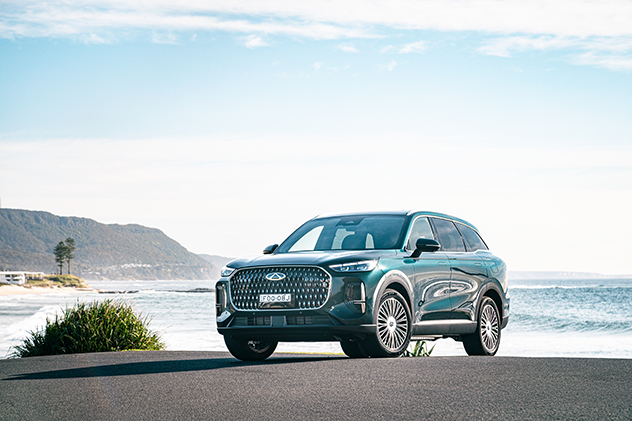
Among the standard inclusions are 20-inch alloy wheels, keyless entry and start/stop (it doesn’t even have a starter button), LED headlights, taillights and daytime running lights, a 10.25-inch driver information screen, 15.6-inch infotainment screen, heated and ventilated seats front and rear with electric adjustment and massage function, heated steering wheel, 14-speaker Sony sound system, native sat-nav, wireless Apple CarPlay/Android Auto, a head-up display, 50-watt wireless phone charger, intelligent voice commands, colour-selectable ambient lighting, puddle lights, a panoramic sunroof, acoustic glass and a powered tailgate.
In a weird twist, Aurora Green is the standard paint colour, while black, white and grey are deemed premium and cost extra.
The Chery Tiggo 9 comes with a seven-year/unlimited kilometre warranty, plus a separate eight-year/unlimited kilometre warranty on the battery. The capped-price servicing schedule amounts to $3173 over the eight-year warranty period.
How safe is the Chery Tiggo 9 Super Hybrid?
At the time of writing the Chery Tiggo 9 has not been ANCAP crash tested. It has a full array of safety technology, though, including 10 airbags, autonomous emergency braking, emergency lane keeping assistance, and forward collision warning. Nothing about these systems is particularly onerous or irritating – a welcome trend among the newer Chinese cars.
What powers the 2026 Chery Tiggo 9 Super Hybrid?
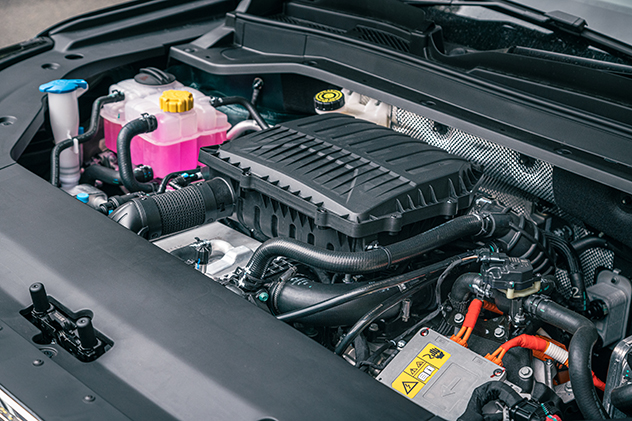
The Chery Tiggo 9 has an unusual drivetrain arrangement. A 1.5-litre turbocharged four-cylinder engine works in tandem with two electric motors on the front wheels, while a third motor drives the rear axle. A dedicated ‘3DHT’ or hybrid transmission directs power between the wheels, simulating all-wheel drive.
Complicated as it may seem, this unit works seamlessly and delivers a combined output of 315kW/580Nm – performance car territory – and the Tiggo 9 can travel up to 146km (WLTP) on electric power alone.
The turbo petrol engine requires 95RON unleaded petrol and the maximum DC charging rate is a mere 71kW, so you’re looking at 30 minutes or more to charge the 34kWh battery from 0-80 per cent. It’s the same story with AC charging, which has a max of 6.6kW for a likely 0-80 charge time of four or five hours.
What is the 2026 Chery Tiggo 9 Super Hybrid like to drive?
Up to this point, you might be wondering what could possibly justify the Chery Tiggo 9’s hefty premium over the Tiggo 8 Super Hybrid – and the answer comes when you accelerate for the first time.
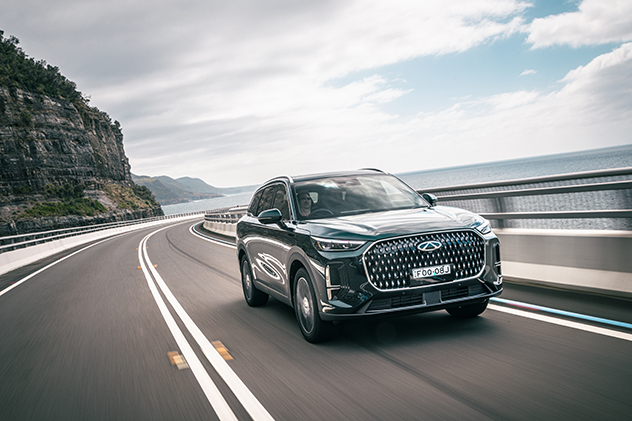
The hybrid system delivers loads of grunt with a silky quietness and, while the electric motors do take a second to get the Tiggo 9’s 2800kg rolling, once underway the amount of power on tap is alarming – it almost feels excessive for a vehicle with such a high centre of gravity.
All-wheel drive and McPherson strut/multi-link suspension do a lot to manage the power and mitigate the realities of physics, so what should be a cumbersome and potentially terrifying bus stays remarkably stable and manageable in corners while ironing out even the worst bumps and potholes. The Tiggo 9 is prone to leaning though, as all tall SUVs are to one degree or another, and if you have a small frame the wide driver’s seat means your back is barely touching the bolsters and there’s a tendency to slide sideways during sharper turns.
Claimed fuel consumption is 1.4L/100km for a total range of 1250km, and if the Tiggo 9 is operating with a full charge, we’d believe it. When we gave ours back after a week of continual driving, its range meter still showed more than 800km. Poor charging discipline, however, will result in a small petrol engine trying to lug around the best part of three tonnes – don’t expect good fuel economy in that scenario.
What about user-friendly tech? Well, an awful lot of functions are buried in the touchscreen, but its large size, high definition and intuitiveness do somewhat alleviate the typical issues with using a touchscreen on the go. A voice command system that understands the Australian accent and can infer meaning (my son asked it to close the sunroof “curtain” and it proceeded to close the shade as he intended) further relieves any concerns about the largely buttonless dashboard.
The Sony audio system is pretty lacklustre given the number of speakers scattered around the cabin, reiterating the adage that quantity is no substitute for quality when it comes to sound.
Other irks and quirks? Well, Chinese car makers continue to struggle with software bugs and the Tiggo 9’s on-screen welcome never worked properly, plus the steering wheel upholstery seemed to have minuscule threads coming off it, suggesting it may not wear well long term.
Open Road’s take on the 2026 Chery Tiggo 9 Super Hybrid
Despite the Chery Tiggo 9’s various peccadilloes (and our test vehicle having wheels that, as one wit put it, looked like they’d come off an early 1990s Holden Calais), the drive experience is such a pleasure it’s impossible to dislike it. Third-row limitations and a few accessions to budget aside, it’s a heck of a lot of SUV for $60,000, especially if you value performance and fuel economy, which is why it was awarded Highly Commended honours in the 2026 Best Value Family Car Awards.
What we liked
- Economical hybrid driveline with gluts of power
- Handles well for a large SUV
- Comfortable ride and plush interior
What could be better
- Most functions are buried in the touchscreen
- Third-row seats are cramped and hard to access
- Steering wheel upholstery raises quality concerns