
2026 Hyundai Santa Fe review

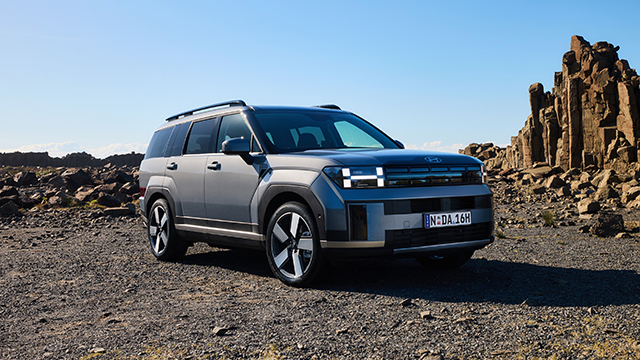
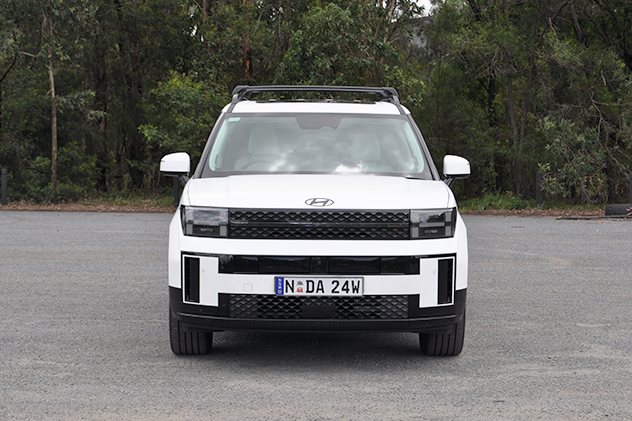
The Hyundai Santa Fe has been around more than 25 years now, permutating through five distinct and ever-larger incarnations along the way. Present at the dawn of Australia’s SUV revolution, its popularity has remained steady, although with competition expanding in the large SUV segment, it only rated mid-pack for sales in 2025. One wonders if its polarising looks played a role, as it sure hasn’t wanted for plaudits in the motoring press. We took the 2026 Hyundai Santa Fe on an extended touring test to see how it endured the rigours of a family holiday.
How much does the 2026 Hyundai Santa Fe cost?
The 2026 Hyundai Santa Fe range consists of ten models powered by one of two engines depending on grade: a 2.5-litre turbo petrol four-cylinder, or a 1.6-litre turbo four-cylinder hybrid.
The base model Hyundai Santa Fe is a FWD seven-seater that runs the 2.5-litre turbo engine and costs $53,650. Just above that is an AWD version, also with seven seats, which starts at $56,650.
The entry point if you want the hybrid Santa Fe is the 2WD HEV, which retails for $57,650 before on-roads, while the AWD hybrid crosses the $60k threshold at $60,650.
The mid-spec petrol-only Hyundai Santa Fe Elite starts at $63,150 and the hybrid version takes a sizeable price leap to $67,150. Both are AWD.
Things get more complicated once you reach top-spec Calligraphy grade. An ICE Calligraphy with six seats will set you back $73,650, while the hybrid costs $77,650. Both models can be optioned with a black, brown or green interior.
A seven-seater version of the Calligraphy, interestingly, costs the same as a six-seater with an ICE engine and a touch less as a hybrid ($77,150). Every Calligraphy Santa Fe is AWD.
While the Ford Everest, Toyota Prado and Isuzu MU-X dominate this space, the Santa Fe is more comparable with road-focused vehicles such as the Chery Tiggo 8 Pro Max (from $36,990) and MG QS ($46,990) at the budget end and traditional competing marques like the VW Tayron ($48,290), Kia Sorento ($51,630), Mazda CX-80 ($55,200), and Toyota Kluger ($62,410).
What is the 2026 Hyundai Santa Fe like inside?
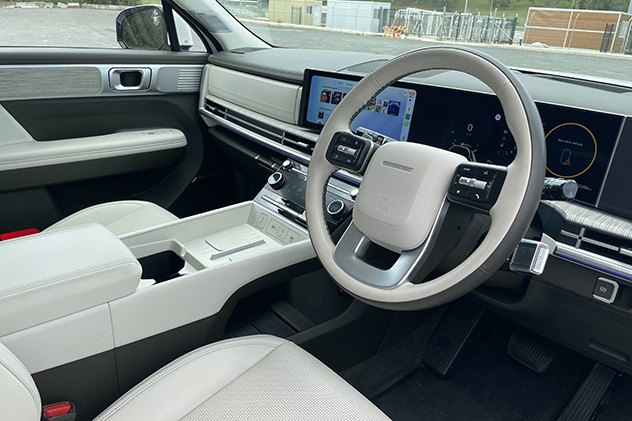
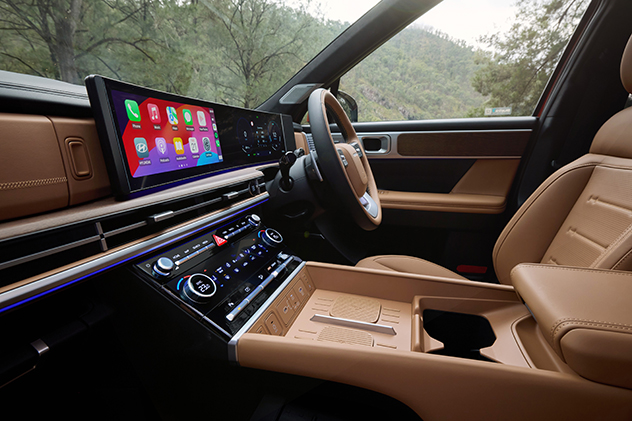
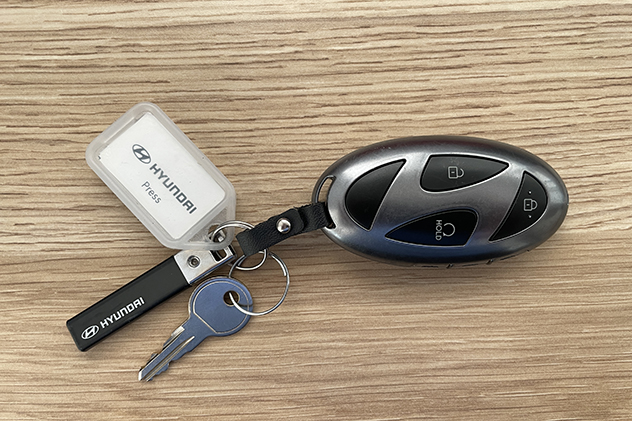
There’s an immediate sense of spaciousness, cohesion, and considered design inside the 2026 Hyundai Santa Fe. Even the key fob incorporates the Hyundai badge in a subtle and stylish way.
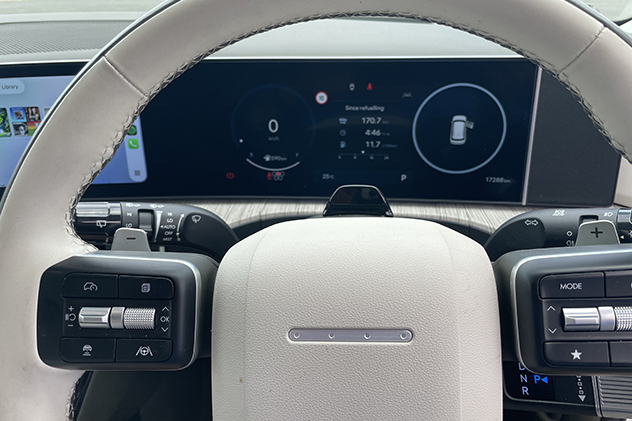
The panoramic 25-inch infotainment screen/instrument cluster has a slight curve that makes it both driver-focused and pleasingly futuristic. The centre console is a delight of logical and inventive design, with a broad armrest that lifts at both ends (so rear passengers can open it), two drink holders that accept bottles small and large, and an induction charger (two in the higher grades) with rubber grips so phones don’t slide around. In front of these are two USB-C ports and above those is a combination of dials, knobs, switches and a touch-panel that controls just about every key function.
This is made possible by deleting a traditional gear shifter and relocating it below the indicator stalk on the right-hand side of the steering column. It’s one of those units where you twist it forward for drive, back for reverse, and press a button in at the end for park. It’s quite practical, albeit a little close to the indicator (which can become an issue when trying to signal a turn in a hurry).
On the steering wheel is a user-friendly assortment of buttons, rollers and switches, and the generous driver’s display all but makes the head-up display in the Calligraphy redundant.
Soft-touch surfaces abound in the Elite and Calligraphy models (our two test vehicles for this review) and even the harder surfaces somehow manage to please – the door handles in the Calligraphy are brushed aluminium with a textured surface on the inside contact point. The unconvincing faux bleached-oak panelling in our cream-interior Calligraphy press vehicle was about the only blight on the Santa Fe’s presentation.
Storage options up front comprise a glove box (the Calligraphy has a second storage box in the top of the dash that can emit UV-C rays to sterilise objects), the aforementioned armrest box, a big open space below the centre console, and front door pockets with room for a drink bottle and smaller items.
Jump in the second row and there’s yet more storage, including a pull-out bin at the bottom of the centre console, two drink holders in the fold-down armrest, and three more in each door. The air con vents are in the B-pillars at mid-section height, although that’s as much control as second-row passengers are afforded over climate. In the Calligraphy they are treated to seat heaters, however, and there’s a USB-C connection in the side of both front seats for their use.
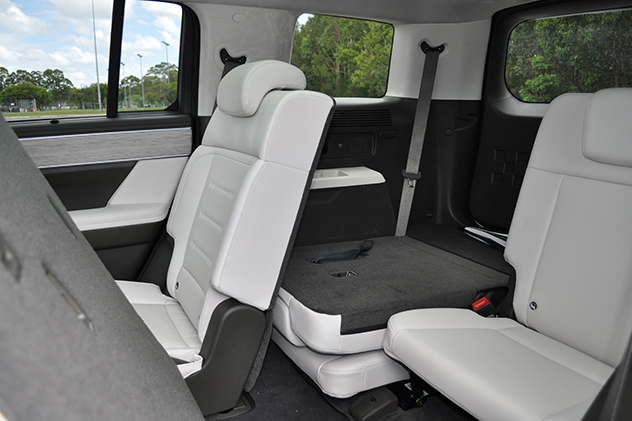
The second-row seats tilt and slide forward at the touch of a button, providing surprisingly convenient access to the third row. An adult’s knees are up pretty high while occupying seats six or seven, but otherwise it’s tolerably comfortable and the children for which the seats are intended will likely be very content – in the Calligraphy the third row gets two drink holders on each side, a rear air conditioning vent with temperature and fan controls, two USB-C ports, and two reading lights.
All five rear seats have top tether and Isofix points for child restraints.
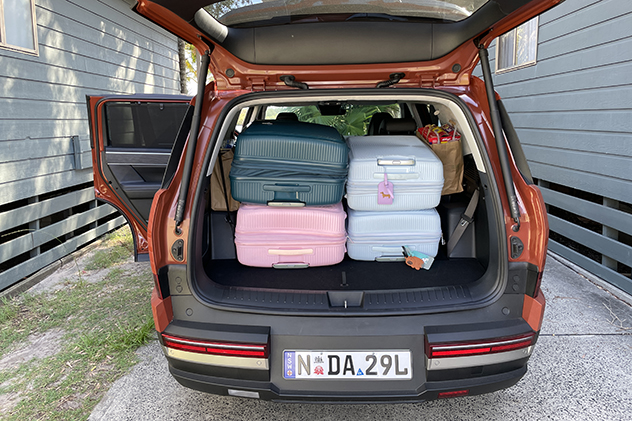
Even with all seven seats in upright position, there’s still a useable luggage space. With the third row folded, the cargo area is capacious indeed, measuring 628 litres in the hybrid and 642 litres in the petrol variant. In the hybrid we comfortably fit four suitcases with room left over for additional items such as backpacks and shopping bags.
A full-size spare wheel lurks underneath the Santa Fe – not convenient, perhaps, but far more reassuring on a long trip than a temporary use spare wheel.
— Kris Ashton
What equipment does the Hyundai Santa Fe come with?
Late last year, Hyundai added ‘Digital Key 2’ to its Santa Fe and Tucson lineups, which lets you lock/unlock and start the vehicle via a smartphone.The base model Santa Fe also comes standard with 18-inch alloy wheels, keyless entry and start, an electric tailgate, a 12.3-inch instrument cluster and 12.3-inch central touchscreen, wireless Apple CarPlay/Android Auto, dual-zone climate control, a 10-way power-adjustable driver’s seat, a leather steering wheel, a single wireless phone charger, and six-speaker audio. The AWD version of the base model also gets snow, mud, and sand driving modes.
Go for the mid-spec Elite and you’ll receive 20-inch alloy wheels, a premium Bose audio system, two wireless phone chargers, leather seats, a heated steering wheel, and an eight-way electrically adjustable passenger’s seat.
The full-fruit Calligraphy adds a dual sunroof, head-up display, Nappa leather seats with memory and relaxation function, and a UV-C sanitation compartment.
How safe is the Hyundai Santa Fe?
All variants received a five-star ANCAP safety rating in December 2024. The Hyundai Santa Fe scored maximum points for driver protection in full-width and side impact tests, and for child protection in frontal offset and side impact tests.In addition to 10 airbags throughout the cabin, the Santa Fe has myriad active and passive safety systems including autonomous emergency braking, blind spot monitoring, child and cyclist detection and alerts, a driver monitoring system, adaptive cruise control, and speed sign recognition and warning. The overspeed alert chimes aren’t as noisy as they used to be, but they still drive you buggy after a while.
What powers the Hyundai Santa Fe?
One of two powertrains: a 2.5-litre turbocharged four-cylinder petrol engine mated to an eight-speed gearbox that produces 206kW/422Nm, or a hybrid unit that combines a 1.6-litre turbocharged four-cylinder petrol engine, 44kW electric motor and a six-speed gearbox for a total system output of 132kW and 367Nm.What is the Hyundai Santa Fe like to drive?
Hyundai has long provided well-designed and user-friendly infotainment interfaces and the Santa Fe continues this trend, with connection to Bluetooth and Apple CarPlay as simple as can be and large icons for navigation through various menus.
Hyundai has had a bet each way with its air conditioning controls, employing a flat touch-sensitive panel below the main screen. In theory it’s not a bad compromise between digital and analogue, but the ‘buttons’ are quite small and difficult to hit accurately on the road, plus the dark and reflective surface can make them hard to see in bright sunlight.
On road, the hybrid system isn’t what you’d call seamless and you can detect what’s happening as it swaps between ICE and electric power, but there’s no quibbling with the results. A substantial well of power resides beneath the driver’s right foot and throttle response is immediate, with no detectable lag or gaps in its delivery, making the Santa Fe equally at home cruising the motorway or zipping in and out of roundabouts on suburban streets. Power delivery does taper off at higher speeds, but it’s not something that affects everyday driving.
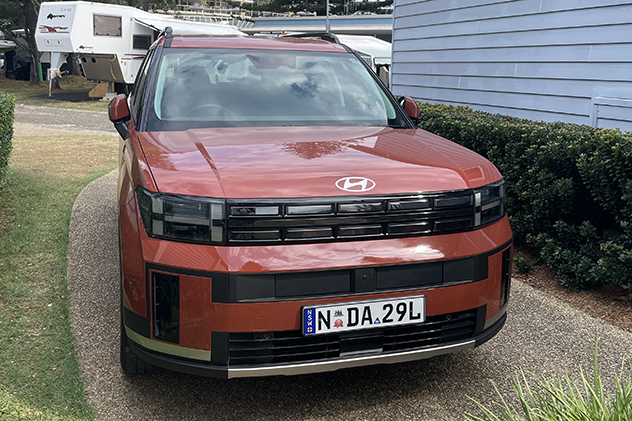
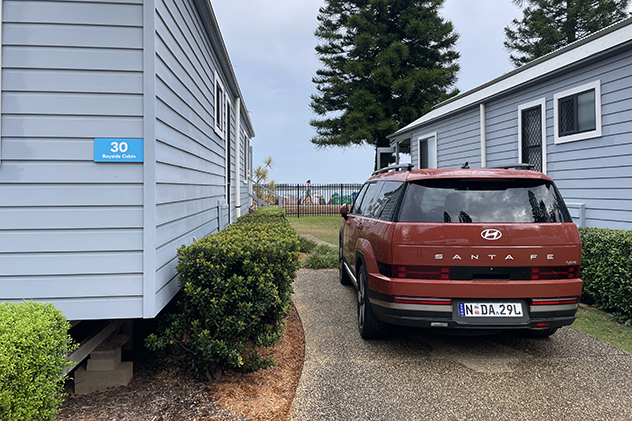
We made two extended trips in the Santa Fe Elite hybrid. During the first, which incorporated a long journey between Sydney and Yamba with a full load and several days of suburban squirts hither and yon, we recorded 6.8L/100km. The second, which was almost exclusively freeway driving with a full complement of passengers and luggage, returned 7.0L/100km. This isn’t too far above the claimed combined figure of 5.6L/100km and impressive considering the load carried and the performance on offer. Armed with a 67-litre fuel tank, the Santa Fe hybrid is a genuine 1000km-per-fill vehicle under the right conditions. We found the seats comfortable for a couple of hours’ drive, although that comfort level waned over a long haul, especially in the buttock region.
After driving the hybrid for a week, the turbo petrol version feels like last-generation technology. It’s a noisy unit (although there’s nothing thrashy about it) and there’s a delay between pressing the throttle and power delivery as the turbo winds up. But once it’s filled its lungs the engine provides plenty of muscle and it easily pushes the Santa Fe’s 2000kg bulk around. Fuel economy is another matter; while the hybrid is a miser, the ICE version returned over 10L/100km from a week of suburban trips (claimed 9.1L/100km).
The Santa Fe’s ride is well-cushioned over all surfaces and handling is what you’d expect from a taller SUV in the modern era – pitch and roll exist but are reined in effectively and there’s nothing ponderous or nautical about the drive experience. Vision all around is excellent and while the Santa Fe gives the impression it would be like driving a house, it doesn’t feel large or cumbersome in an urban environment.
Open Road’s take on the Hyundai Santa Fe
Believe every good report you’ve heard – the Hyundai Santa Fe presents as a family car designed by someone who actually has a family. The 2.5-litre turbo petrol engine could use more immediate throttle response, the speed alert chimes remain an issue, and some might find the ‘saggy bum’ exterior styling a sticking point, but otherwise it remains the yardstick by which all other large SUVs should be measured. With a good spread of models to accommodate a wide range of budgets and preferences, it’s as close to a no-brainer purchase as you’ll find in the Australian new-car market today.


