2026 Hyundai Tucson review

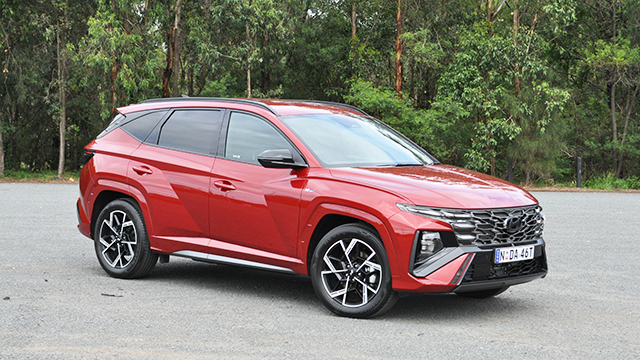
For 2026, Hyundai has added new tech, paint colours and wheels, while trimming the asking price across the range. But will that be sufficient to see it through the year when so many Chinese brands are putting the squeeze on margins and inflating consumer expectations?
How much does the 2026 Hyundai Tucson cost?
The 2026 Hyundai Tucson model lineup remains largely unchanged. The base model Tucson, which runs a 2.0-litre four-cylinder petrol engine and six-speed transmission with front-wheel drive, kicks things off at $38,100 before on-road costs. Just above that is the Tucson Hybrid, which has a 1.6-litre petrol hybrid drivetrain and retails for $42,600.The Elite versions of the abovementioned models cost $43,100 and $48,100 respectively, while the Tucson Elite hybrid can be optioned with an N Line pack that pushes its price up to $50,600. Choosing an all-wheel drive version of the Elite hybrid nudges the price to $50,600, and if you add the N Line pack to that you’re looking at $53,100.
In Premium trim, the Tucson comes standard with AWD and costs $58,100 or $59,600 when optioned with the N Line pack.
All prices have been reduced by $1000-$2500 compared to the equivalent 2025 models.
The Tucson is up against more than 30 potential competitors, everything from the Chery Tiggo 7 which starts at just $27,990 before on-roads, to the category-leading Toyota RAV4 (from $45,990) and pure electric vehicles such as the Skoda Elroq ($47,990) and BYD Sealion 7 ($54,990).
What is the 2026 Hyundai Tucson like inside?
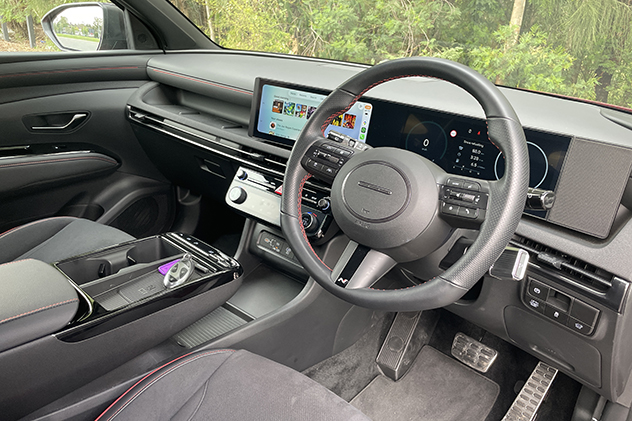
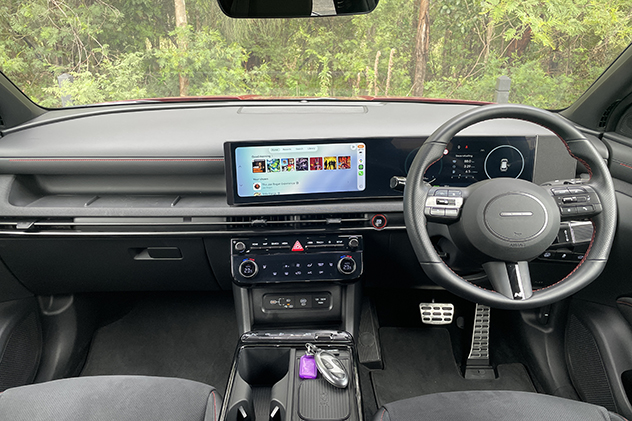
Considering prospective buyers won’t get any change from $40,000 once they’ve paid on-road costs for the base model 2026 Hyundai Tucson, decent interior presentation should be non-negotiable. For the most part that’s the case, with cloth seat upholstery and hard plastic on the sides of centre console the only indications it’s entry-level trim.The cabin’s commonsense layout and cohesive appearance is typical Hyundai, and while the traditional gear selector perhaps ages it a little, the expansive driver information/central touchscreen unit plants it firmly in 2026. The steering wheel in the Tucson is shiny faux leather but it’s a little tacky to the touch, especially in hot weather, which detracts from the intended premium feel.
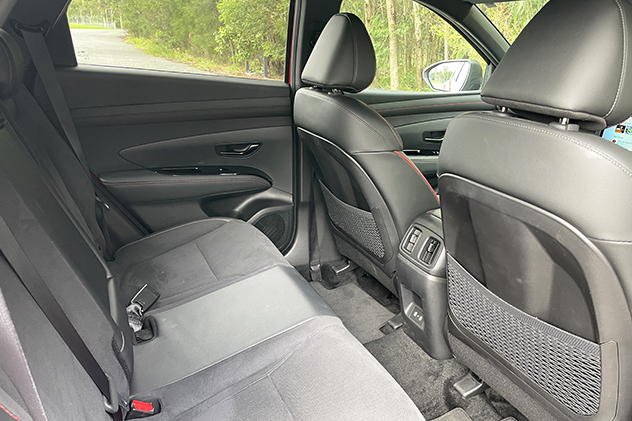
Rear passengers enjoy two USB-C ports, two air-conditioning vents, and a speaker and drink holder in each door.
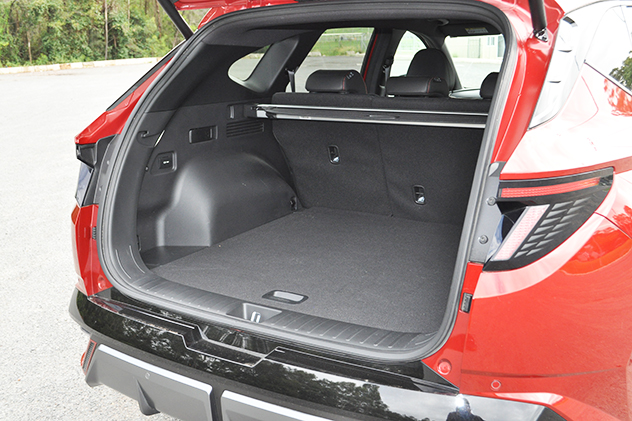
The Tucson gets a par score for cargo space, with more than a metre between the wheel arches but less than a metre from the load lip to the second-row seats, which are fixed. Hyundai lists total cargo volume at 539 to 582 litres depending on the model.
In addition to the base model Tucson, we drove an Elite fitted with the optional N Line pack. A digital gear shifter on the steering column and revised centre console certainly help elevate the Elite’s appearance. The N Line pack adds some nice-to-haves, including special 19-inch wheels and suede upholstery, although the overall effect on the interior is quite subtle considering the financial outlay (see specifics on the N Line pack below).
— Kris Ashton
What equipment does the 2026 Hyundai Tucson come with?
Along with its bigger brother, the Santa Fe, the 2026 Hyundai Tucson has been fitted with ‘Digital Key 2’ technology, which allows the owner to connect a smartphone to the vehicle for remote starting and locking/unlocking.
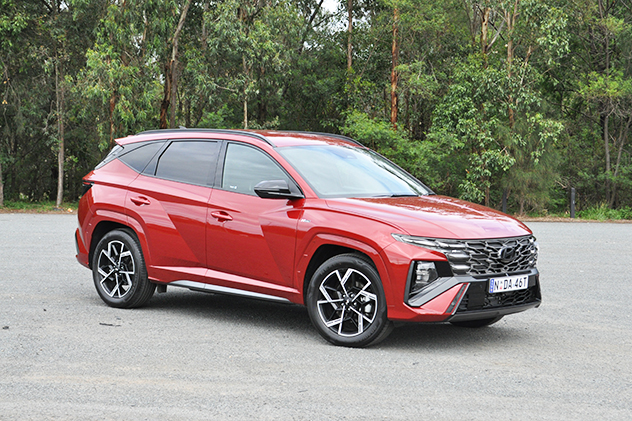
The other key changes for 2026 are 17-inch alloys on base trim and new grade-specific wheel designs, plus the Titan Grey metallic paint has been retired in favour of Ecotronic Grey, which is available in pearl finish across the range and a matte finish in N Line variants.
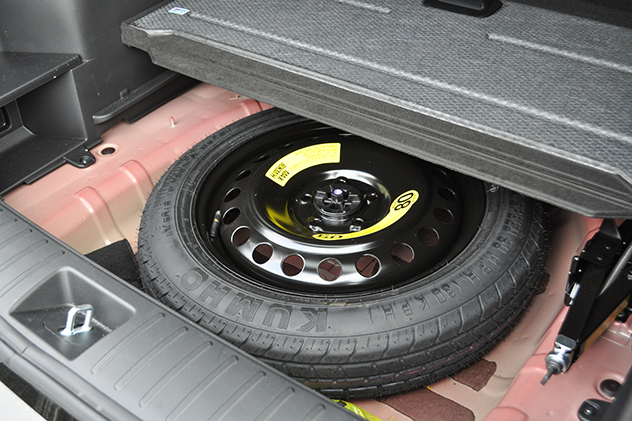
In addition to Digital Key 2 and 17-inch alloys, the base Tucson comes standard with keyless entry and start, a 12.3-inch multimedia screen, 4.2-inch instrument cluster, LED headlights and taillights, high beam assistance, and a full-size spare wheel.
Fork out for the Elite and you’ll get 18-inch alloys, a dark chrome grille with integrated daytime running lights, ‘solar control’ glass in the windscreen and front windows, rear privacy glass, rain sensing wipers, 12.3-inch driver information and multimedia screens, a powered tailgate, leather appointed and heated front seats with power adjustment for the driver, alloy scuff plates, and an electro-chromatic rearview mirror.
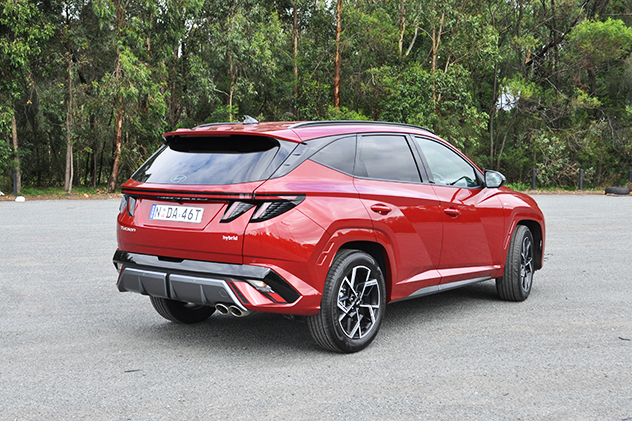
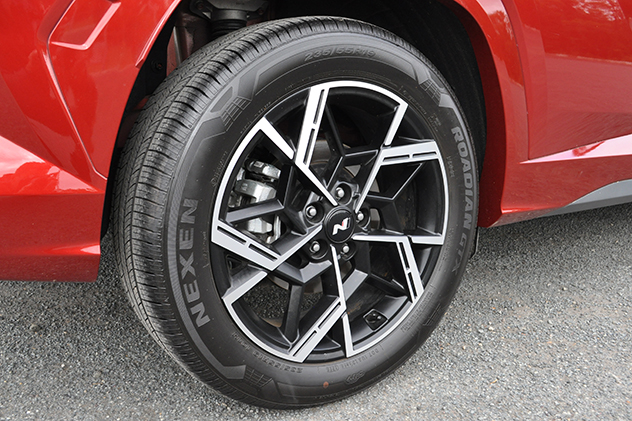
Option the Elite with the N Line pack and it gets 19-inch N Line alloy wheels, projection type LED headlights, LED reversing lights, cosmetic exterior enhancements including colour-coded cladding, gloss black belt line and chrome muffler outlet, leather/suede upholstery with red highlights, and alloy pedals.
Unique N Line wheels fitted to a Hyundai Tucson Elite.
Shelling out for the Premium brings unique-design 19-inch alloys, a powered passenger’s seat, heated rear outboard seats, ventilated front seats, premium Bose audio system, a head-up display, surround view monitor, LED reading lights for the second row, and ambient cabin lighting. The Premium can also be optioned with the N Line pack outlined above.
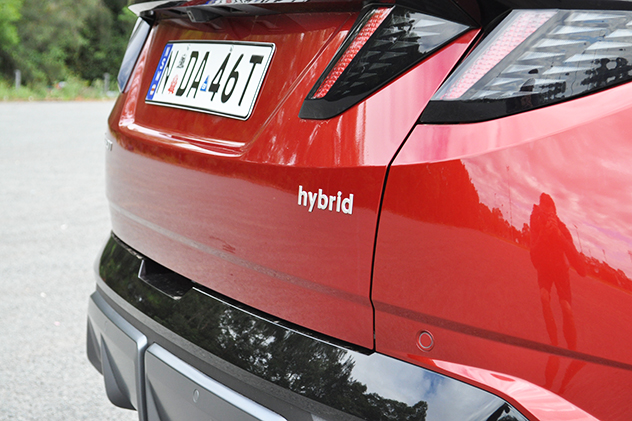
In hybrid models the traditional gearshifter is deleted from the centre console in favour of an electronic selector below the indicator, making way for additional storage in a void below the console. Hybrids do have to settle for a temporary use spare tyre to accommodate the electrics, however.
Across the range premium paint costs $750, while the Premium grade can be optioned with matte paint ($1000) and a two-tone interior ($295).
How safe is the 2026 Hyundai Tucson?
The Hyundai Tucson was awarded a five-star ANCAP rating in 2021, and that remains valid until 2027.The SmartSense safety equipment suite includes forward collision avoidance, blind spot monitoring, blind spot collision assistance, driver attention warning, forward collision avoidance with junction turning assistance, various lane keeping assistance technologies, and much more.
What powers the Hyundai Tucson?
Depending on the model, one of two powertrains drives the Hyundai Tucson: a 2.0-litre four-cylinder petrol engine mated to a six-speed transmission (115kW/192Nm), or a 1.6-litre petrol hybrid with a six-speed transmission (172kW/367Nm).Claimed fuel consumption is 8.1L/100km for the 2.0-litre petrol engine and 4.9L/100km for the hybrid 1.6-litre engine.
What is the 2026 Hyundai Tucson like to drive?
The 2.0-litre naturally aspirated engine in the base model 2026 Hyundai Tucson is frankly showing its age. With maximum power and torque not arriving until 6200rpm and 4500rpm respectively, it needs to lift revs to develop any quick acceleration – and this means the transmission is up and down like a yo-yo trying to satisfy the driver’s requests for power while also maintaining fuel economy. That isn’t such a problem while traversing a motorway, but it makes scooting through the suburbs a rather herky-jerky experience.The hybrid is in total contrast, with its combined system torque of 367Nm delivered at just 1000rpm for instant acceleration and the turbo engine providing grunt higher up the range. No one’s going to accuse this drivetrain of being the quietest or smoothest on the market, but it provides fuss-free performance in any situation and it’s also a sight more economical than its petrol sibling, which during our time returned a gluttonous 10.3L/100km, while the hybrid recorded just 5.8L/100km (albeit a considerable measure above its claimed consumption).
Being comparatively lightweight and compact for the segment, the Tucson handles competently, even if the steering doesn’t offer a great deal of feedback. Ride is excellent and the suspension can deal with anything Australia’s unpredictable suburban roads can throw at it.
Casting a pall across both drive experiences, however, is Hyundai’s infamous ADAS equipment, which includes relentless speed alert chimes and active lane centring that never stops tugging at the steering wheel no matter where you position the car – in one instance it tried to ‘centre’ the Tucson when there were no lane markings at all. You can deactivate these systems if you dig three-deep into the infotainment menu, but dare to switch off the engine and they’ll be back.
Open Road’s take on the 2026 Hyundai Tucson
It’s almost a tale of two engines with the Hyundai Tucson. The 2.0-litre petrol is hyperactive and thirsty while the 1.6-litre hybrid provides ample power with fewer trips to the bowser – so that one’s the pick if budget allows.
Annoying safety equipment notwithstanding, the Tucson continues to be an appealing mid-sized SUV with good build quality and all-round capability as family transport.
What we liked
- Stylish and user-friendly infotainment screens
- Hybrid drivetrain provides plenty of get-up-and-go
- Full-size spare wheel in petrol variants
What could be better
- Unrefined 2.0-litre petrol drivetrain
- More than $40k to get into a hybrid
- Infuriating lane centring and speed alerts