2026 Mazda3 review

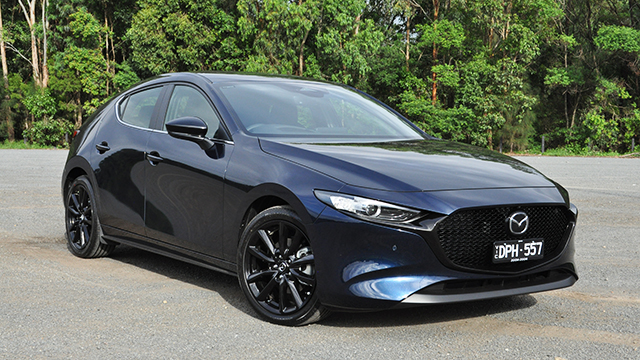
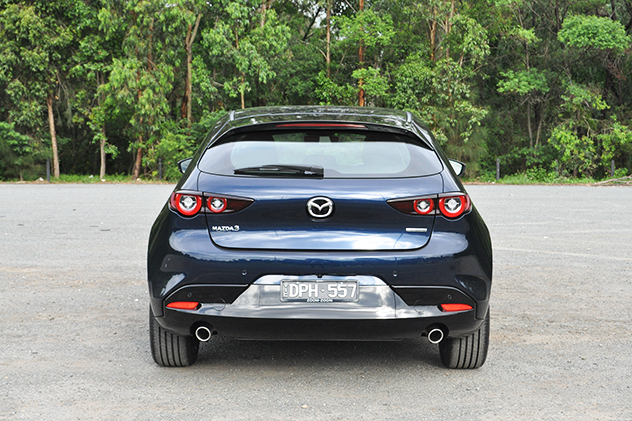
Since it debuted in 2003, the Mazda3 has passed through 23 years and four generations, although even that summary is somewhat misleading, as the hatchback can trace its lineage all the way back to the Mazda 323 – which debuted in 1977. Put the original beside the 2026 model and their shared DNA remains evident in sleek exterior styling and robust four-cylinder engine options.
Not surprisingly, time is starting to catch up with the Mazda3 and, while no one can dispute its build quality or driving dynamics, on metrics such as fuel consumption and interior styling it looks increasingly like a museum piece. But is that such a bad thing?
How much does the Mazda3 cost?
Notwithstanding some updated nomenclature around variants, the Mazda3 model list hasn’t changed a great deal in recent years.
For 2026, the range kicks off with the G20 Pure ($31,610 before on-roads for sedan and hatch) and G20 Pure Vision ($33,610).
Making up the mid-range offerings are the G20 Evolve sedan ($31,410) and hatchback ($33,410). A step above these is the G20 Evolve Vision ($35,410 for both sedan and hatchback).
The G20 Touring Vision is the priciest of the 2.0-litre engine versions, at $37,410 before on-road costs.
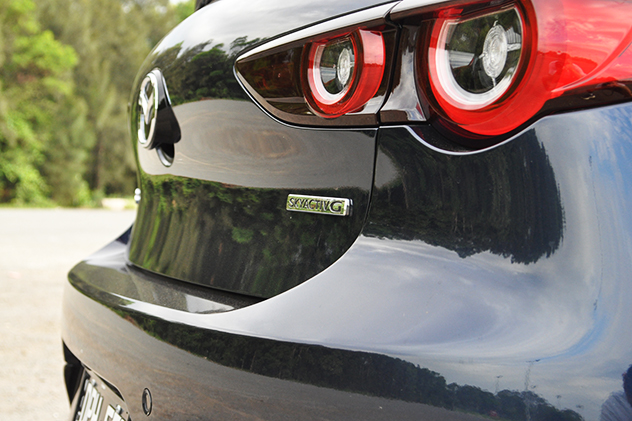
First among the models sporting Mazda’s gruntier 2.5-litre engine is the G25 Evolve SP Vision (our test vehicle for this review) at $37,410 before on-roads. Above that is G25 GT Vision at $40,410, and at the top of the heap is the G25 Astina for $43,610.
Long-established competitors for the Mazda3 include the Hyundai i30 (starting at $30,000), Toyota Corolla ($32,110), Volkswagen Golf ($39,290) and Honda Civic ($49,900).
The Mazda3 comes with a par-score five-year/unlimited kilometre warranty. Servicing is every 12 months or 15,000km and costs between $362 and $566.
What is the Mazda3 like inside?
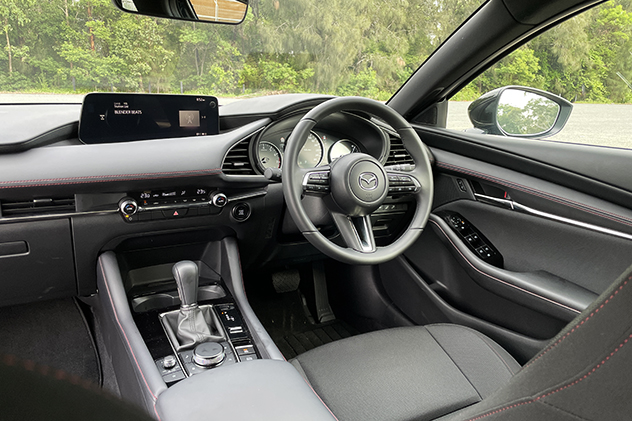
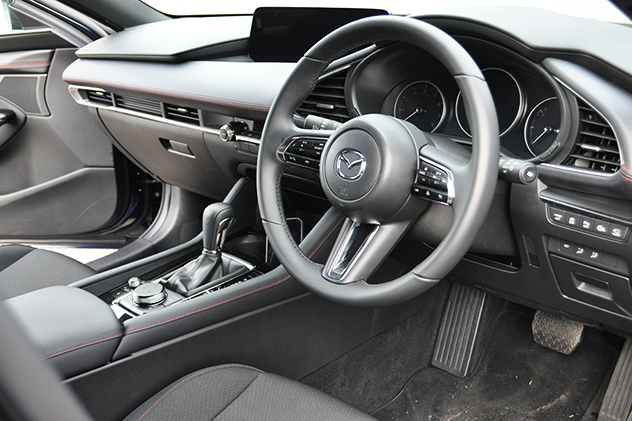
When it comes to volume-selling models such as the Mazda3, ‘conservative changes to cater for conservative buyers’ has long been Mazda’s credo. The fourth-generation Mazda3 emerged in 2019 with a smoother, more minimalist approach to styling, but in 2026 ‘vintage’ is the word that comes to mind. Traditional gear shifter, traditional instrument cluster, basic black colour palette, a central touchscreen that lurks in the top of the dashboard like an afterthought.
Yet these self-same qualities also provide much of the Mazda3’s ongoing appeal. The gear shifter is where you expect it to be and does what it’s supposed to without fuss. The indicator is on the right, the windscreen wiper stalk is on the left, there are no weird surprises or operational quirks. The driving position is just so, the seats are comfortable without half a dozen moveable panels, and even with its hunkered stance and slippery shape, the Mazda3 offers good vision in all directions.
Padded surfaces abound in the G25 Evolve SP Vision and it’s hard to locate anything hard, let alone cheap and scratchy. The steering wheel is wrapped in smooth upholstery that gives it a premium tactility, although the steering wheel itself is a weird, edged shape that grows uncomfortable in the hands after a long drive.
Controls and instruments are classic Mazda. The binnacle behind the steering wheel consists of three dials (two analogue, one digital mimicking analogue) that house the speedo, tacho and gauges. A large rotary dial and four buttons in the centre console provide screen navigation (additional to the touchscreen), and there’s a physical knob for volume and track skip, plus buttons and dials for all air conditioning functions. The infotainment screen isn’t within easy reach of the driver, however, and given how many motorists now default to Apple CarPlay or Android Auto, this is something of an issue.
Beside the driver is a versatile console box with a lid that both lifts and slides. Inside that are two USB-C ports and towards the front of the console higher grades have a wireless phone charger (not cooled, though, which can be a problem in an Aussie summer). Rounding out this configuration are two drink holders behind the gear shifter.
The Mazda3 has never purported to be a family car and that’s evident in the second row. The roof is quite low and tall people will struggle for head room, although leg and foot room are unexpectedly good for a small hatchback. The narrow middle seat is suitable for a child only.
Rear passengers do get two air conditioning vents, two drink holders (in the fold down armrest), two speakers, and two very small door pockets.
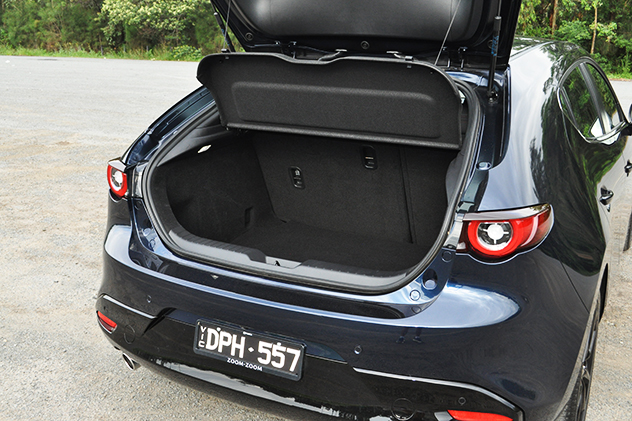
If called on to do family duties, the Mazda3 has two Isofix points and three top tether points for child restraints. While the 295-litre cargo space does offer a full metre between the wheel arches, it is very limited when it comes to bulky items, with just 400mm in height at the boot lip. Under the boot floor is a temporary use spare wheel.
— Kris Ashton
What equipment does the Mazda3 come with?
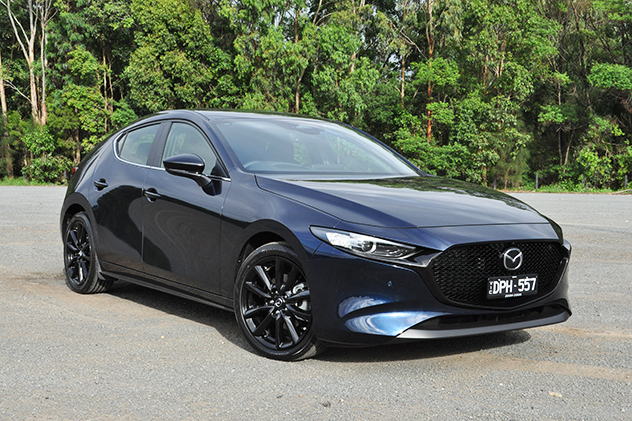
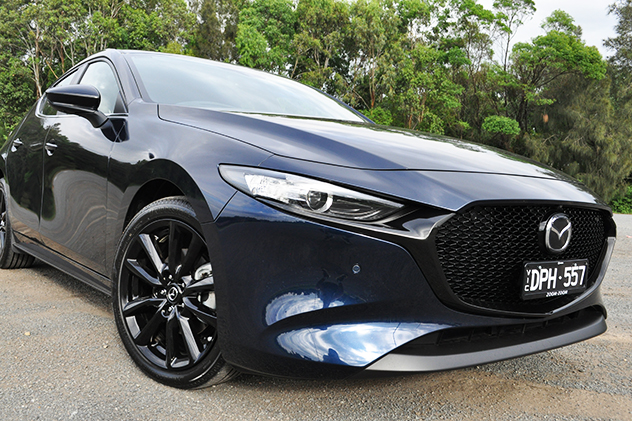
It’s been a long time since the Mazda3 was considered cheap transport and the base model specification reflects this. Standard features include 16-inch alloy wheels, power adjustable and folding side mirrors, rain-sensing wipers, LED headlamps, air conditioning, a leather steering wheel, 8.8-inch central touchscreen, satellite navigation, wireless Apple CarPlay/Android Auto, push-button start, an eight-speaker sound system, and cloth seat trim.
The G25 Evolve SP Vision (the cheapest of the 2.5-litre models and our test vehicle) comes with 18-inch black metallic alloys, keyless entry and start, a 10.25-inch central touchscreen, wireless phone charger and 360-degree around-view monitor.
Leather seat trim only appears in the G20 Touring, G25 GT and G25 Astina.
How safe is the Mazda3?
Until last year the Mazda3 boasted a five-star ANCAP safety rating, but that expired in December 2025 and the 2026 year-model is listed as unrated.
Standard safety features on the base model G20 Pure include seven airbags, blind spot monitoring, driver attention alert, forward obstruction warning, high beam control, intelligent speed assistance, lane departure warning, lane keeping assistance, rear parking sensors, rear cross traffic alert, and a reversing camera.
For the most part the Mazda 3’s safety gizmos don’t feel unduly intrusive and only beep or intervene when necessary.
What powers the Mazda3?
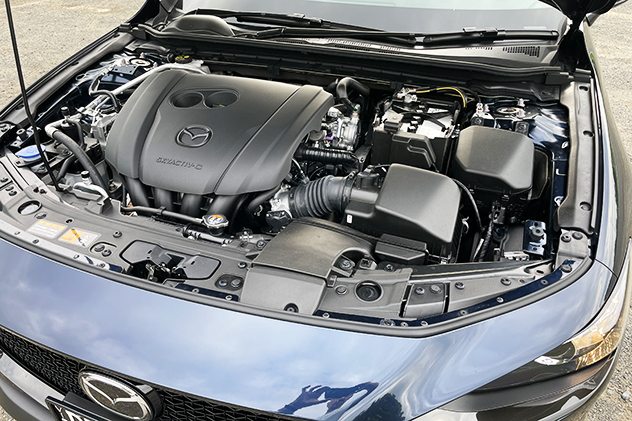
Two drivetrains that have served the Mazda3 since what seems like antiquity: a 2.0-litre four-cylinder petrol engine (114kW/200Nm) or a 2.5-litre four-cylinder petrol engine (139kW/252Nm).
Both are mated to a six-speed automatic transmission and can take regular unleaded fuel. Drive is through the front wheels.
Mazda did offer a mild hybrid engine for a while in the Mazda3 G20e, but that was discontinued in 2023 due to lack of consumer interest.
What is the Mazda3 like to drive?
After all these years in production the Mazda3 is refined within an inch of its life and that shows on the road. The touch sensor for the keyless locking system, for instance, is wonderfully sensitive and there’s no need to fumble and fondle to get it to work, unlike those from some cheaper brands.
The 2.5-litre engine in our G25 Evolve SP Vision test vehicle offers more than adequate grunt and the six-speed automatic transmission reacts quickly to throttle input, shifting up and down with an impressive smoothness (although in normal mode it can be a tad reluctant to kick down as it seeks to conserve fuel). Even this drivetrain is starting to feel antiquated in 2026, however, especially when you head to the bowser at week’s end and discover it has consumed 10L/100km despite forcing you to put up with its irksome ‘i-stop’ fuel saving system.
By contrast, the driving dynamics haven’t aged a day. The G25’s suspension is tuned for a firmer ride but not to the point where it rattles your skeleton and, combined with linear steering and a competent chassis, it tracks through bends and roundabouts with sporty composure. Wheelspin and torque steer are all but non-existent under throttle and, in sport mode, the Mazda3 holds its revs to provide proper fun on a winding country road.
The Aussie market has become so accustomed to heavy and high-riding hybrid SUVs that getting into a low-slung and well-sorted hatchback like Mazda3 can be a driving revelation.
Open Road’s take on the Mazda3
If its conservative styling and increasingly quaint powertrains aren’t deterrents, the Mazda3 continues to provide a fun and reliable drive at a pretty sensible price.
For performance and build quality the Mazda3 G25 Evolve SP Vision approaches the superb Honda Civic hybrid without getting anywhere near that car’s absurd $50,000 asking price, making it the sweet spot in the current Mazda3 range.
What we liked
- Light with well-sorted driving dynamics
- Refinement and attention to detail
- Plenty of physical knobs and switches
What could be better?
- Touchscreen set too far back for easy reach
- Irritating and outdated stop/start fuel saving tech
- 2.5-litre engine is thirsty by modern benchmarks