
2026 Toyota RAV4 review

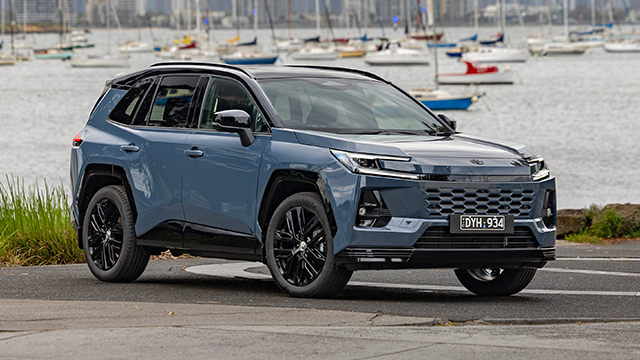
Australia's best-selling SUV has been reborn for 2026, with the Toyota RAV4 sporting a fresh look inside and out and gaining a host of connected tech courtesy of a new software system.
The sixth-generation model will also welcome a plug-in hybrid system later in 2026.
While it shares plenty beneath the skin with the model it replaces, the new RAV4 has revised hardware to deliver a sharper driving experience.
There are some sticking points, however: prices have risen by up to 10 per cent, the hybrid drivetrain has less power than before and now requires premium unleaded, and the car won't carry an ANCAP safety rating until late 2026.
How much does the 2026 Toyota RAV4 cost?
Prices for the Toyota RAV4 have headed north with the 2026 model, in some cases by about 10 per cent.
The broad model range - which encompasses regular and eventually plug-in hybrid options - kicks off at $45,990 plus on-road costs for the GX.
You can then step up to the better equipped GXL ($48,990), Edge ($55,340), XSE ($59,015) and Cruiser ($56,990).
For the regular hybrid variants, XSE and Edge models have an all-wheel drive system as standard - adding another electric motor to the rear wheels - but for other variants that’s a $3350 step-up.
The XSE is also offered as a plug-in hybrid (PHEV) for $59,515 as a front-drive model to $64,015 with all-wheel drive, each prior to on-road costs.
A new range-topping GR Sport model - with unique design elements for a sportier aesthetic - is available only as a PHEV driving all four wheels for $66,340.
While standard hybrid models are now in dealerships, PHEV variants aren’t arriving until later in 2026.
There’s no battery electric vehicle version of the RAV4, with Toyota instead using the similarly sized bZ4X to tempt EV buyers.
.jpg)
.jpg)
.jpg)
.jpg)
.jpg)
.jpg)
.jpg)
.jpg)
.jpg)
.jpg)
.jpg)
.jpg)
.jpg)
.jpg)
.jpg)
.jpg)
.jpg)
.jpg)
.jpg)
.jpg)
.jpg)
.jpg)
.jpg)
.jpg)
.jpg)
.jpg)
.jpg)
.jpg)
.jpg)
.jpg)
.jpg)
.jpg)
.jpg)
.jpg)
.jpg)
.jpg)
.jpg)
What is the 2026 Toyota RAV4 like inside?
Size-wise the new Toyota RAV4 is almost identical to the model it replaces because the two share the same basic underpinnings.
That means interior space is essentially unchanged.
No dramas there because it’s a well-proportioned family hauler, with generous seating for five people (though unlike the Honda CR-V, Nissan X-Trail and Mitsubishi Outlander, there’s no seven-seat option).
Head- and legroom are decent front and rear, although a hump on the floor in the rear robs the middle seat occupant of foot space; that middle occupant is also perched a fraction higher due to the sculpting of the seat base.
The biggest change to the RAV4 is the interior freshen-up.
While there’s still Toyota tradition to the grey plastics, the dash has been modernised and analogue gauges have given way to a customisable digital instrument cluster.
As before, the touchscreen is mounted high on the dash where it's close to the driver’s field of vision.
Running beneath all of that is Toyota's new Arene operating system, developed in-house and representing a genuine step up in functionality.
As well as more capability through the myToyota Connect app – locking and unlocking doors and sending navigation destinations to the car remotely – it also allows you to use a smartphone as a key.
All of which has hints of Tesla, as does over-the-air software updates that promise to improve functionality.
Despite all of that, the RAV4 hasn't gone fully touchscreen-zealot on us. There are still physical buttons and a proper volume dial, which means you can easily adjust the audio without having to navigate a menu or press a button multiple times.
The controls fall naturally to hand and the whole experience is reassuringly unfussy.
It's some welcome restraint in a car that still nods to tradition.
Storage is strong throughout the cabin, and there's a clever reversible centre console lid that can be opened towards the driver or front-seat passenger or removed entirely and flipped over to create a hard shelf.
Further back the 60/40 split-folding rear seat gives you flexibility when you need the extra cargo room, feeding into a 705-litre boot that also features a split underfloor for keeping valuables out of sight.
What equipment does the 2026 Toyota RAV4 come with?
Toyota has improved the RAV4’s in-cabin technology and overall equipment levels.
All variants now feature a 12.3-inch digital driver’s display and Toyota’s latest infotainment system, which supports over-the-air updates and integrated connected services, allowing owners to lock and unlock the car remotely or even close the windows via the myToyota Connect app.
There’s also dual-zone ventilation and integrated navigation, as well as five USB-C ports.
The GX and GXL models get a modest 10.5-inch central touchscreen but the GX misses out on the wireless phone charger fitted to all others.
Even the larger 12.9-inch screen in more expensive variants is only just ticking the box in an era of pixels aplenty.
The GXL, which gets 18-inch alloys (an inch bigger than those on the GX) also gets a power adjustable driver’s seat and rain-sensing wipers.
A space saver spare is standard across the range but for the GX you can option a full-size spare for $300.
The Edge adds unique exterior design elements, leather-look trim, heated front seats and a powered tailgate.
XSE variants get 20-inch alloys and add some black styling touches, a sunroof, ventilation for the front seats, 360-degree camera, power adjustable passenger seat and a memory function for the driver’s seat.
The Cruiser picks up a larger panoramic sunroof, partial leather trim (it’s a mix of real and synthetic), a second wireless phone charger, head-up display and a nine-speaker JBL sound system.
The PHEV-only GR Sport reverts to synthetic leather trim and a regular (rather than panoramic) sunroof and also deletes the ventilated front seats (they’re still heated).
But it picks up a bunch of aesthetic upgrades for a sportier look that includes the liberal use of GR Sport logos (even on the brake calipers), a rear spoiler and aluminum pedals.
It also has a wider footprint with the left and right wheels spaced 20mm further apart, while also adopting a sportier suspension tune with adjustable dampers.
How safe is the 2026 Toyota RAV4?
The Toyota RAV4 gets eight airbags and an array of driver assistance tech, including auto braking, blind spot warning, lane keep assist, exit assist and front and rear cross traffic alert.
However, for much of 2026 the new RAV4 will do without an ANCAP safety rating.
Toyota says it will update the car later in 2026 with “some enhancements to the passive and active safety systems”, which are expected to earn the car a five-star rating to the latest 2026 ANCAP protocols.
Toyota wouldn’t detail what those changes involve, other than to confirm they wouldn’t require any changes to the structure of the vehicle.
Those updates also won’t be retrofittable to early vehicles.
— Sam Charlwood
What powers the 2026 Toyota RAV4?
Since late 2024 the RAV4 has been hybrid-only, and nothing changes with this new model
The drivetrain is largely unchanged: a 2.5-litre four-cylinder petrol engine paired with electric motors.
But there are also hardware changes, including a new front motor and an updated lithium-ion battery replacing the previous nickel-metal hydride unit. That battery has a capacity of 1.1kWh.
The 2.5-litre engine makes 105kW and 221Nm while the electric motor that drives the car (there’s a separate one for regenerative braking) produces 100kW and 208Nm.
All-wheel drive variants add a 40kW/121Nm electric motor to the rear axle.
As before, there’s no mechanical link between the engine and rear wheels in those all-wheel drive variants, with the addition of another electric motor to drive the rear wheels independently.
There is a catch with this latest RAV4: Tougher emissions regulations mean combined power – what the engine and e-motors can produce together - has actually gone backwards.
The previous model produced up to 163kW whereas this one is rated at 143kW across both the front-wheel drive and all-wheel drive variants.
Peak torque - the pulling power you use most day-to-day - is unchanged at 221Nm, and Toyota says there’s more available lower in the rev range for a more responsive feel.
Front-drive models are claimed to hit 100km/h in 8.0 seconds while all-wheel drive variants lower that to 7.7 seconds.
Fuel consumption improves marginally with this latest RAV4 to a claimed average 4.5L/100km for front-wheel drive models and 4.6L/100km for all-wheel drives, although the RAV4 now requires more expensive premium unleaded fuel.
Towing capacity is 800kg for front-wheel drive variants and 1500kg for all-wheel drive.
Later in 2026 a plug-in hybrid joins the range, using a new sixth-generation hybrid system with a 22.7kWh battery, which should translate to something like 100km of electric-only driving.
Power climbs as high as 227kW in all-wheel drive form, with the flagship GR Sport PHEV AWD covering 0–100km/h in 5.8 seconds.
What is the 2026 Toyota RAV4 like to drive?
Current Toyota RAV4 drivers will get a sense of familiarity when getting behind the wheel of the latest iteration.
The transition from a standing start is smooth and seamless, with the electric motor picking up the slack before the petrol engine steps in.
Toyota's claim of improved response lower in the rev range does ring true; it feels slightly more eager off the mark, something that makes darting out of an intersection or a tight corner that little bit easier.
As with the previous model, calling on maximum performance for overtaking or hill climbing spins the petrol engine into an uninspiring drone.
Tweaks to the suspension and the stiffening of the architecture have led to notable improvements to the way the RAV4 drives.
It corners with confidence, something helped by tyres that deliver impressive grip levels.
There’s also meaningful weight to the steering and excellent body control over bumps and undulations, settling things swiftly.
Refinement at highway speeds is good, and the overall ride quality is well-sorted for Australian roads.
In short, the RAV4 is also easy to live with.
The NRMA's take on the 2026 Toyota RAV4
The 2026 RAV4 is quintessential Toyota: safe, sensible, and competent – and it doesn’t deviate from an immensely successful formula, instead focusing on the areas that needed attention.
A more modern look inside and out is teamed with wisps of tradition to make for a car that’s easy to live with.
The latest generation tech also adds to the ownership experience.
Of course for some, the short-term lack of an independent crash test rating will be a deterrent.
Another negative is prices that have crept up further.
Not that it detracts from the core of a car that has shot back to the pointy end of the mid-size SUV category.
Pros
- Improved cabin technology and a noticeably more modern interior feel
- Excellent driving manners, both in town and on the open road
- Strong fuel efficiency contributes to low running costs
Cons
- Prices are up and lower grades skinny on equipment
- Hybrid drivetrain has less power and now requires premium unleaded
- No ANCAP safety rating until late 2026


