2026 Volkswagen Tayron eHybrid review

The Volkswagen Tayron has proven a noteworthy addition to Volkswagen’s Australian ranks, reaffirming the brand’s ‘premium for the people’ mantra and extending the wares of the marque’s growing SUV line-up.
Now, the Tayron has added depth with the introduction of a plug-in hybrid variant. The fuel miser arrives in Australia without all-wheel drive availability or the option of seven seats, but in many ways it extends the Tayron’s appeal and gives VW a fighting chance against the onslaught of electric Chinese SUVs.
How much does the Volkswagen Tayron eHybrid cost?
The Volkswagen Tayron eHybrid range opens at $62,390 plus on-road costs for the Tayron 150TSI eHybrid Elegance. Stepping into the flagship 200TSI Tayron eHybrid R-Line will set buyers back $75,990 plus on-road costs.
Those figures mark a $2000 premium on the regular Tayron equivalents, which first graced Aussie showrooms last year as a replacement to VW’s seven-seat Tiguan Allspace.
The Tayron goes head-to-head with rivals including the Kia Sorento PHEV (from $78,755 plus ORCs), the Mazda CX-60 P50e (from 71,790 plus ORCs), and the Mitsubishi Outlander PHEV (from $58,990 plus ORCs).
What is the Volkswagen Tayron eHybrid like inside?
With the larger Volkswagen Touareg about to go the way of the dodo in Australia, the Tayron has been conceived to occupy that model’s luxury space – a task it embraces admirably.
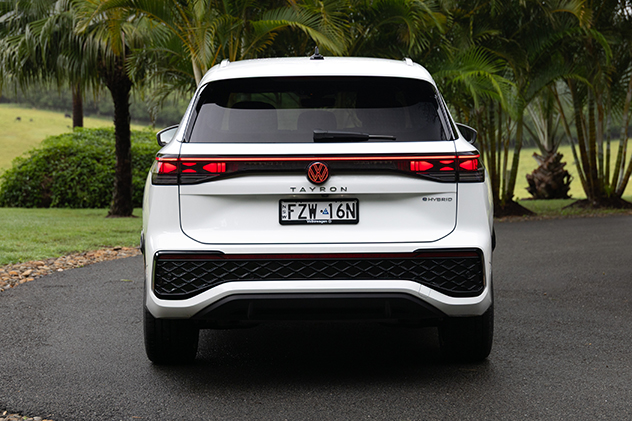
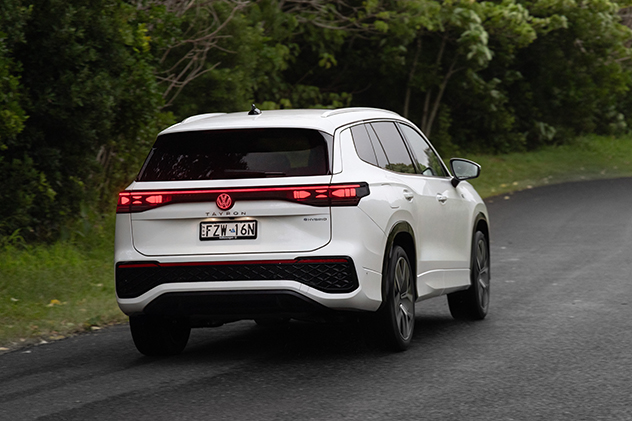
The interior is festooned in premium materials, feels well put together, and offers enough space across its two rows and boot to impart a sense of luxury and functionality all at once.
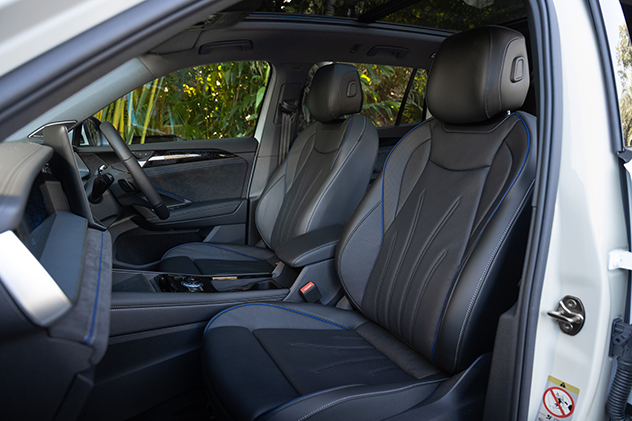
The driving position feels low slung and sporty, though with a considered outward view and front seats comfortable and supportive enough to hold their own on longer journeys.
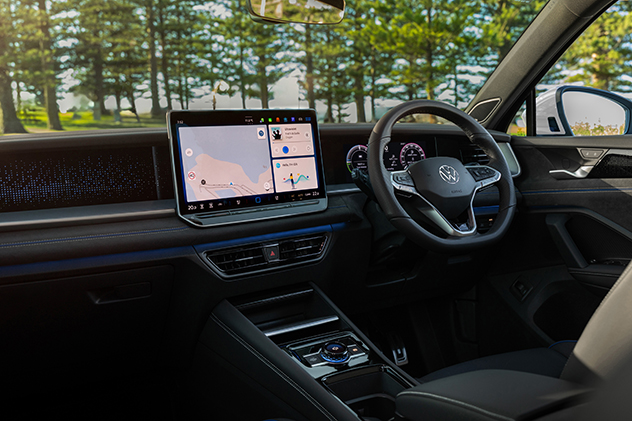
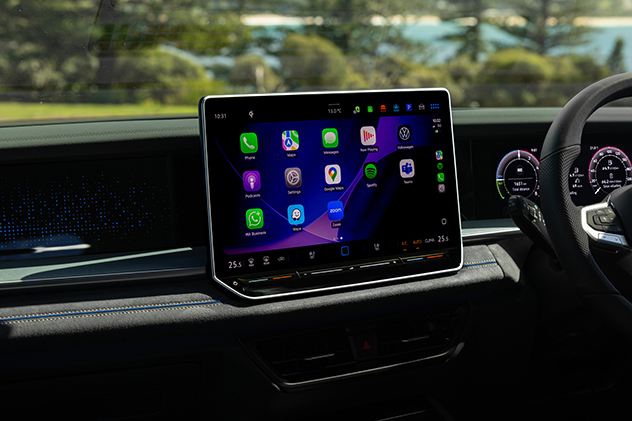
The infotainment offering is a minimalist one, with barely any physical buttons and dials in the dashboard centre fascia. However, VW has done the next best thing by offering a set selection of climate controls at the base of the centre touchscreen for easy access.
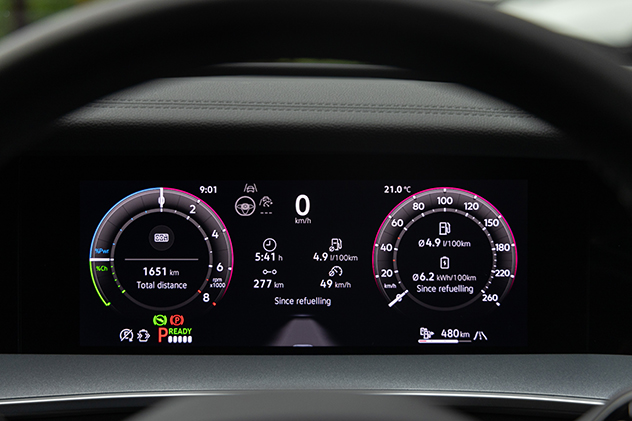
Otherwise, the 12.9-inch display is fast to react to inputs, is legible in its display and layout, and teams harmoniously with the car’s different functions. The matching digital instrument cluster is likewise intuitive and concise in its layouts.
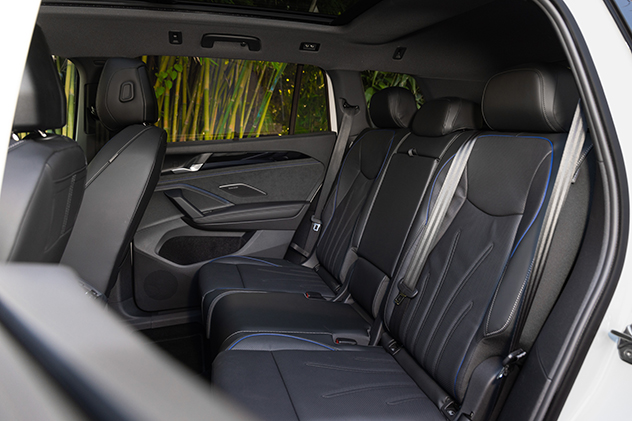
With a 110mm longer wheelbase and 253mm additional length over the more established Tiguan, the Tayron unsurprisingly offers more rear leg room and a 200-litre-larger boot.
The interior proportions offer ample room for a couple of adults on longer journeys, or conversely a couple of child seats.
Separate rear air vents and heated rear seats underpin the Tayron’s strong rear seat amenity, while the tinted rear windows and rear sunshades offer additional practicality on the family front. There are also Isofix attachment points on the outbound pews as well as three top tether points.
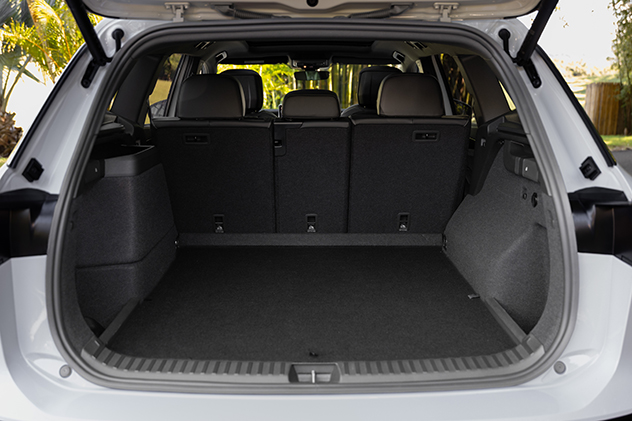
From the boot area, the Tayron offers a commodious 705 litres – marginally smaller than its donor (which also offers two seats underneath, it must be said).
You can stow the split-folding rear seats from the boot area too, thanks to levers.
— Sam Charlwood
What equipment does the Volkswagen Tayron eHybrid come with?
The Tayron bundles in a decent amount of standard equipment for its starting price.
In the ‘base’ Elegance trim you get 19-inch alloy wheels, LED headlights, electric tailgate, wireless phone charging, leather-appointed upholstery, three-zone climate control, front seats with memory function, ventilation, heating and massage, a heated steering wheel, heated outboard second row seats, privacy glass and a luggage partition net.
Optional extras include a Sound and Vision Package ($4200) bringing a larger 15-inch centre touchscreen, sat-nav, 700-watt Harman Kardon sound system, head-up display, Matrix LED headlights and more.
Metallic paint costs $800, premium metallic paint costs $1100, and a panoramic sunroof will set buyers back $2200.
The Tayron eHybrid is backed by a five-year/unlimited kilometre factory warranty in Australia, as well as annual roadside assistance.
Servicing packages are available at the point of purchase, for a fee of $1605 over three years or $3391 over five years, based on 12-month/15,000km intervals.
How safe is the Volkswagen Tayron eHybrid?
The Tayron eHybrid aptly toes the line on safety, fitted standard with adaptive cruise control, autonomous emergency braking with pedestrian and cyclist detection, front cross traffic alert and rear cross traffic alert, driver attention monitor, speed sign recognition, lane assistance, lane departure warning, a rear view camera and overhead 360-degree camera, plus much more.
Downsides? Many of those driver aids are quite onerous in their interventions and cannot be turned off. Sadly, this is becoming the norm in many new cars.
The Tayron carries a five-star ANCAP safety rating in Australia based on 2025 protocols.
What powers the Volkswagen Tayron eHybrid?
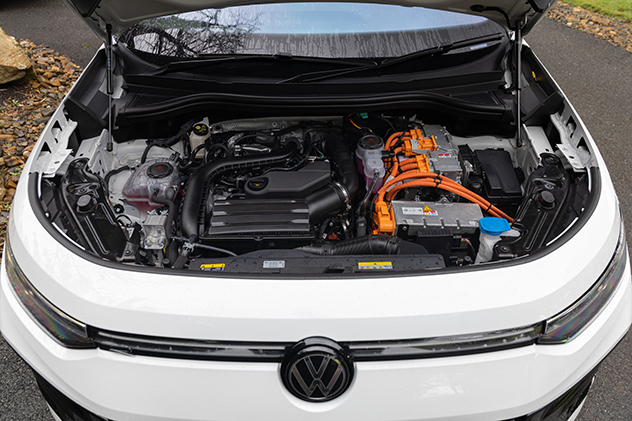
So here’s the rub. Doing duty under the bonnet is a 1.5-litre turbo-petrol engine paired with an electric motor driving the front wheels and fed by a 19.7kWh battery.
The petrol engine makes 110kW and 250Nm on its own, but with the 85kW/330Nm electric portion taken into account, the driveline offers total outputs of 150kW and 350Nm.
As with other Tayron models, drive is shuffled via a dual-clutch automatic transmission – though this one is a six-speed unit to account for the electrification.
Efficiency is impressive on paper, with a combined fuel consumption figure of 1.7L/100km. The Volkswagen Tayron eHybrid also claims an electric-only range of 116km on the WLTP cycle. Read on to see whether these figures are achievable.
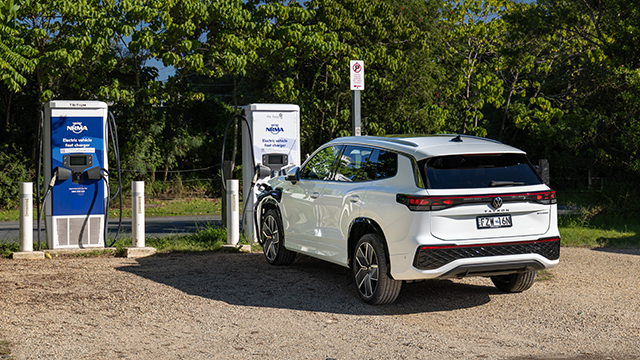
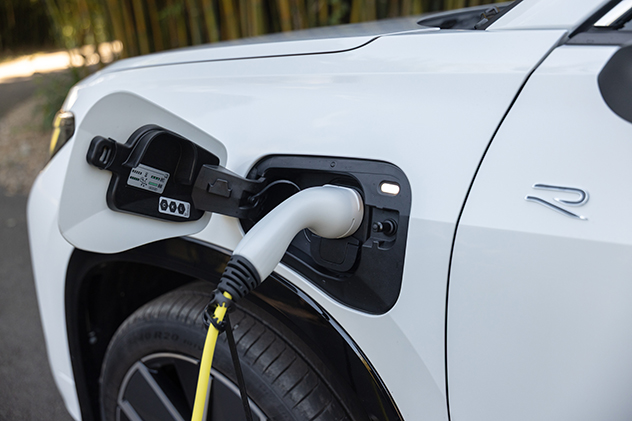
The battery offers a maximum DC charging rate of 40kW, and a maximum AC charging rate of 11kW. That means from public infrastructure you’ll get a 10-80 per cent charge in as little as 26 minutes, while from home you’re looking at 2.5 hours on an 11kW connection, or 12 hours on a 2.3kW AC connection.
It’s hard to overlook the Tayron eHybrid’s circa 300kg weight penalty over the lightest petrol variant and it does impose some on-road compromises. That said, 15-stage adaptive dampers are fit standard.
The battery underneath the boot floor necessitates a smaller 45 litre fuel tank (instead of 58 litres in other models), while braked towing capacity is reduced to 1800kg.
What is the Volkswagen Tayron eHybrid like to drive?
The Tayron eHybrid introduces newfound depth to the Tayron range, and happily, manages to extend many of the virtues of the donor on road. For the most part, anyway.
The drive experience is refined and considered, with the electric component of the drivetrain assuring smooth and seamless low speed passage, and the petrol chiming in as it needs to.
What’s more, the electric motor ensures greater straight-line continuity from a standstill and offering excellent torque fill in bigger acceleration moments – and the six-speed dual-clutch automatic offers seamless, well-timed shifts.
There are a couple of caveats around the drivetrain, however. The first one is around physics: in the face of a 2000kg kerb weight, the small 1.5-litre engine is made to work hard under urgent acceleration and can feel languid when pushed.
A nought to 100km/h claim of 8.6 seconds confirms our seat-of-the-pants impression; the eHybrid lacks the zip of the regular Tayron, which is up to 300kg lighter and scores a larger 2.0-litre engine.
Otherwise, the six-speed dual-clutch transmission (one gear fewer than the donor) means the Tayron eHybrid sits quite high in the rev range during highway speed. Think north of 2500rpm, which hurts open road fuel consumption.
In any case, the ride and handling mix remains strong here. The Tayron eHybrid offers meaningfully weighted steering and outright poise over bumps and through changes in direction alike. It will occasionally take an extra moment to compose itself over larger undulations in the road, but all things considered it feels premium and refined.
We averaged 3.3L/100km at the end of our drive and 13.0kWh/100km in energy consumption.
Open Road's take on the Volkswagen Tayron eHybrid
For our money, the slightly smaller, lighter and more traditional Tiguan eHybrid feels like a better sell than the new Tayron eHybrid, undergoing less compromise and upholding more of the donor’s excellent ride and handling virtues.
That’s not to say the Tayron eHybrid is a bad car – we quite enjoyed it – but other than miserly fuel consumption there aren’t too many reasons to consider it.
At this stage of the game, you’d argue the PHEV formula has moved on.
What we liked
- Sophisticated cabin and excellent technology and functionality
- PHEV drivetrain offers excellent real-world efficiency based on our initial test
- The availability of DC charging capability and 100km-plus range
What could be better?
- Onerous safety features detract from driving experience
- No seven-seat availability, front-drive only in PHEV, no spare tyre
- 1.5-litre engine can feel languid in the face of 2000kg kerb mass