2026 Volkswagen Tiguan eHybrid review

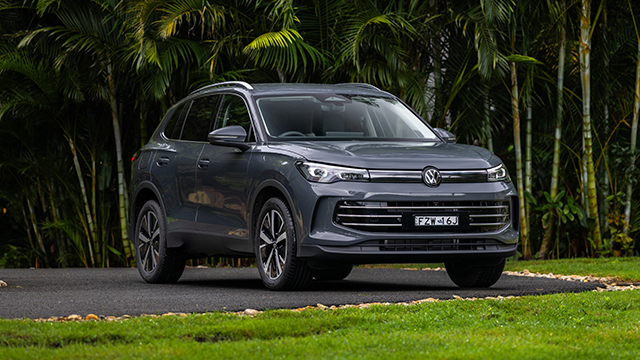
The Volkswagen Tiguan has long been a pioneer for Volkswagen in Australia. As the brand’s first compact SUV in 2008 – back when the segment was still a novelty, not mainstream – the Tiguan ushered in a new wave of family buyers to the Volkswagen fold and has continued to expand its role since its introduction.
So it stands to reason that, amid the mass electrification of Australia’s new car fleet, the Volkswagen Tiguan should now take on plug-in hybrid power. Available in two variants, the Tiguan eHybrid builds on the third-generation Tiguan first introduced to our shores in 2025.
In some respects, it is even the pick of the Tiguan bunch.
How much does the Volkswagen Tiguan eHybrid cost?
The Volkswagen Tiguan eHybrid range opens at $64,590 plus on-road costs for the Elegance trim.
Stepping up into the R-Line grade will set buyers back $74,550 (plus on-road costs).
Although the Elegance pricing marks a circa $19,000 premium on the most affordable Tiguan available (the petrol-powered Life, at $45,650 plus ORCs), when you compare it to the equivalent Elegance petrol model, the difference comes down to $3000 for the PHEV option.
Against rivals the Volkswagen Tiguan eHybrid is quite competitive on price, aligning closely with the Toyota RAV4 XSE Auto 2WD (from $59,515 plus ORCs), Mitsubishi Outlander Aspire PHEV (from $58,990 plus ORCs) and Mazda CX-60 (from $68,290 plus ORCs).
What is the Volkswagen Tiguan eHybrid like inside?
The Volkswagen Tiguan eHybrid is mostly like its donor car inside, with a couple of concessions.
The first one is the absence of seven-seat availability and a spare tyre. Instead, the eHybrid is strictly a five-seat affair on account of its additional driveline hardware underneath the boot area, which shrinks to 490 litres (from 652 litres) because of packaging.
Otherwise, the electrified version of Volkswagen’s popular Tiguan is carry-over. This is great news for buyers.
Occupants are treated to a decidedly upmarket interior, with premium materials, consistent panel gaps and a strong design ethos punctuated by clever lighting and an airy outlook.
Space is plentiful across both rows of seating, with adequate head room, shoulder room and leg room. With its more traditional SUV shape, even rear seat passengers are afforded adequate proportions for a couple of adults or child seats.
Those traits are complemented by decent storage front and rear, with ample open cubbies, cup holders and compartments for odds and ends.
While the touchscreen has kind of become the nerve centre of the car - controlling everything from climate control to drive settings and infotainment - a selection of fixed 'buttons' means you're not delving through needless menus for simple commands. This isn't always the case but it's certainly an improvement on recent VW offerings.
Isofix attachment points on the rear outboard seats are standard fare, while the open window line bodes well for carrying little ones on longer journeys. There are ample USB-C power outlets dotted around the cabin, and split-fold second-row seats to fit longer items in the boot.
Speaking of cargo space, though it has shrunk compared with the donor Tiguan, there is still enough space for a couple of full-size suitcases or a designer pram. We wouldn’t call it a deal breaker by any means.
What equipment does the Volkswagen Tiguan eHybrid come with?
Volkswagen hasn’t shied away from equipment with its Tiguan eHybrid models.
The Elegance trim driven here comes standard with 19-inch alloy wheels, Matrix LED headlights, electric tailgate, keyless entry and start, wireless phone charging, leather-appointed upholstery, front seats with memory, heating and ventilation, a heated steering wheel and a Harman Kardon audio system.
Infotainment comprises a 15-inch infotainment display with Apple CarPlay and Android Auto compatibility, a digital instrument cluster, and a head-up display.
Optional extras include metallic paint ($800), premium metallic paint ($1100) and a panoramic sunroof ($2100).
The Volkswagen Tiguan eHybrid is backed by a five-year/unlimited kilometre factory warranty in Australia, as well as annual roadside assistance.
Servicing packages are available at the point of purchase, for a fee of $1605 over three years or $3391 over five years, based on 12-month/15,000km intervals.


How safe is the Volkswagen Tiguan eHybrid?
The Volkswagen Tiguan eHybrid comes with a comprehensive safety suite including adaptive cruise control, autonomous emergency braking with pedestrian and cyclist detection, front cross traffic alert and rear cross traffic alert, driver attention monitor, speed sign recognition, lane assistance, lane departure warning, a rear view camera and overhead 360-degree camera, plus much more.
The downside of this safety kit is that it is much more vigilant (and annoying) than earlier Tiguan examples. You can turn some of the features off, but we found the systems overbearing in their interventions on launch.
The Tiguan carries a five-star ANCAP safety rating in Australia.
What powers the Volkswagen Tiguan eHybrid?
The Volkswagen Tiguan eHybrid bundles a 1.5-litre turbo-petrol engine with an electric motor driving the front wheels and fed by a 19.7kWh battery.
The petrol engine makes 110kW and 250Nm on its own, but with the 85kW/330Nm electric portion taken into account, the driveline offers total outputs of 150kW and 350Nm.
As with other Tiguan models, drive is shuffled via a dual-clutch automatic transmission – though this one is a six-speed unit to account for the electrification.
Efficiency is equally impressive, with a combined fuel consumption figure of 1.6L/100km. The Volkswagen Tiguan eHybrid also claims an electric-only range of 117km on the WLTP cycle. Read on to see whether these figures are achievable.
The battery offers a maximum DC charging rate of 40kW, and a maximum AC charging rate of 11kW. That loosely converts to a charging time
The Tiguan eHybrid’s circa 300kg weight penalty over the lightest Tiguan variant is worth noting, but the fitment of 15-stage adaptive dampers and progressive steering are claimed to mitigate it when it comes to ride and handling.
The battery underneath necessitates a smaller 45-litre fuel tank (instead of 58 litres in other models), while braked towing capacity is reduced to 1800kg.
What is the Volkswagen Tiguan eHybrid like to drive?
Given the handling strengths of its donor, the Tiguan eHybrid offers very few surprises around its on-road abilities, with retained weighting and accuracy in its steering, excellent body control and an inherent refinement on mixed roads.
What is surprising is how the plug-in hybrid system improves low speed amenity from the drivetrain.
Long maligned for being hesitant and lurchy from a standstill – a symptom of the dual-clutch transmission and some turbo lag – the eHybrid system effectively removes those traits. The electric motor picks up the slack from a standstill, ensuring smooth and seamless passage, while also offering adequate torque-fill upon take-off to ensure minimal hesitation.
The on-road translation is a driveline that feels smoother and more assured as you lay down the power, particularly in more urgent circumstances.
Otherwise, the engine percolates confidently and teams mostly harmoniously with the electric motor, chiming in and out depending on throttle input. The smaller capacity of the engine becomes evident in its acoustics at high revs, but it is nonetheless punchy and adequate.
The Tiguan eHybrid system does offer different levels of braking regeneration under electric power, but you have to go into the screen to adjust them; you cannot do so via the steering wheel-mounted paddles, which simply adjust gear selections.
Speaking of which, the gearbox is another strong point with smooth and seamless shifts, and intuitive downshifts under braking. The fitment of a six-ratio gearbox (for packaging reasons) means the dual-clutch transmission sits a little higher in the rev range at highway speeds, though not disconcertingly so (about 2200rpm).
In headier proceedings the Tiguan eHybrid offsets its obvious front-drive bias to offer decent balance and composure through faster corners, and adequate pull for the overtaking lane. A 300kg weight disadvantage over the most affordable Tiguan is largely offset by clever suspension and electronics, only occasionally revealing itself over big undulations in the road.
Meantime we’d say acceleration is spritely rather than all-out explosive (a 0-100km/h claim of 8.2 seconds verifies this).
What about that all-important fuel consumption? We averaged 2.6L/100km on a launch loop which encompassed some country roads, around-town passage and a stint at highway speed. The electric figure came to 10.3kWh/100km, while the claimed 117km electric range seems largely plausible in reality.
Importantly, those figures were achieved with a full charge and with the vehicle set to its standard hybrid mode. We’re sure you could do better again by making use of the strict EV mode to make the most of the battery.
Open Road’s take on the Volkswagen Tiguan eHybrid
There’s a compelling argument around the Volkswagen Tiguan eHybrid, which ably extends the practical wares of its donors with frugal around-town commuting and a strong ride and handling mix.
Importantly, it retains the lightness and sporty character of the petrol Tiguan and doesn’t overly complicate things on price.
In many respects, the eHybrid is perhaps the best-rounded example of the Tiguan we’ve seen yet. And its timing in Australia couldn’t be better.
What we liked
- Hybrid system improves the Tiguan’s daily amenity and refinement
- Excellent interior fitment and finish, strong list of standard features
- Retains the practicality and inherent charm of its donor, with a couple of concessions
What could be better?
- Adopts much-maligned safety beeps and bongs in its latest update
- Marginally smaller boot than donor car, no seven-seat availability
- No spare wheel option, just a tyre inflation kit