EV comparison test: Polestar 2 vs Tesla Model 3 vs Kia EV4

Conflicts abroad, the rising cost of living and question marks around our country’s fuel origins have many Australians second-guessing whether there’s a better motoring solution in 2026.
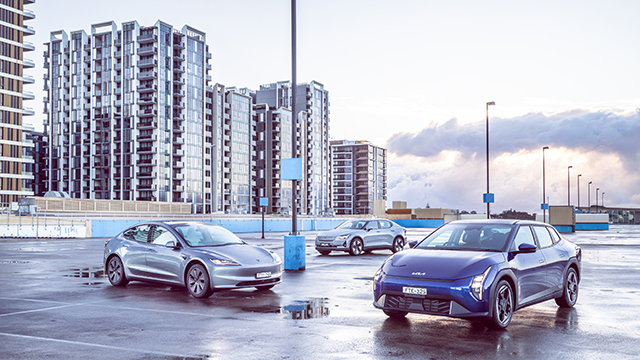
The burgeoning electric vehicle industry looms as the biggest beneficiary. As it experiences unprecedented interest, our comparison test shines a light on three of the best long-range EVs in the mid-size sedan segment – historically an Aussie staple.
The Tesla Model 3 is the original poster child of the bunch and, thanks to a decent overhaul in 2024, it’s still as relevant as ever. Its latest challenger is Kia’s new EV4, which comes with a sharp price and compelling spatial layout. They’re up against the Polestar 2 liftback, an option for those who still question whether an EV is really suitable for them (your correspondent included), offering a more traditional driving experience and sophisticated cabin ahead of an all-new refresh next year.
Nuts and bolts
Even amid heightened demand in Australia, the prices of mid-size electric sedans remain competitive, such is the rivalry between brands.
The newcomer Kia EV4 is officially the cheapest of our comparison, based on our requisite of three mid-tier cars offering the longest driving range possible. This particular Kia EV4 Earth Long Range variant is priced at $59,190 (plus on-road costs).
The Tesla Long-Range Premium Rear-Wheel Drive occupies the middle ground in the Model 3 line-up, priced at $61,900 (plus ORC) at the time of writing.
Lastly, the Polestar 2 Long Range Single Motor is the most expensive on paper, priced at $66,400 (plus ORC). However, Polestar officials point to a retail offer of $59,709 (plus ORC) at the time of writing – a price that has been offered since mid-2025 and is set to stay current until a new Polestar 2 emerges in 2027.
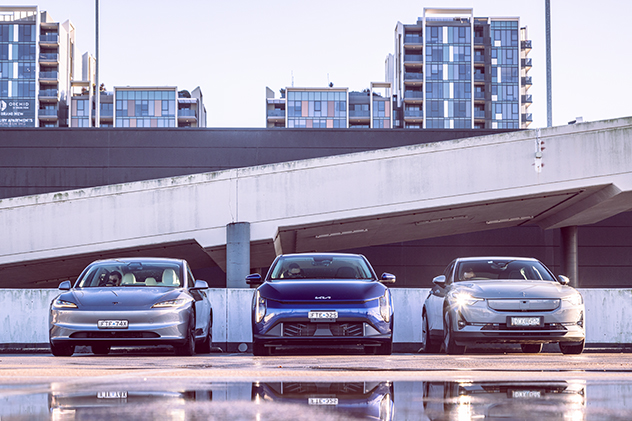
All three share artificial leather seats with front-seat warmers, electric driver’s seat adjustment, keyless entry, dual-zone climate control, and LED headlights with auto high beam. On the infotainment front, there’s a sprawling centre display across each, together with Bluetooth and digital radio. With no instrument cluster, the Tesla Model 3 differs from opponents in that it lacks Apple CarPlay or Android Auto, instead running its own native software.
Commensurate with five-star ANCAP ratings, safety comprises the usual suite of electronic stability control, anti-lock brakes and a full complement of airbags. All three offer extensive driver aids to prevent front and rear collisions, keep the vehicle in its lane and keep tabs on the driver. There are also reversing cameras and front and rear parking sensors across the board.
The Kia is the worst offender for needless beeping and bonging, sounding alarms every time you glance away from the road ahead or marginally exceed the posted speed limit. The Tesla isn’t much better, but the Polestar forgoes some of the latest (and more annoying) driver aids, yet keeps the important ones.
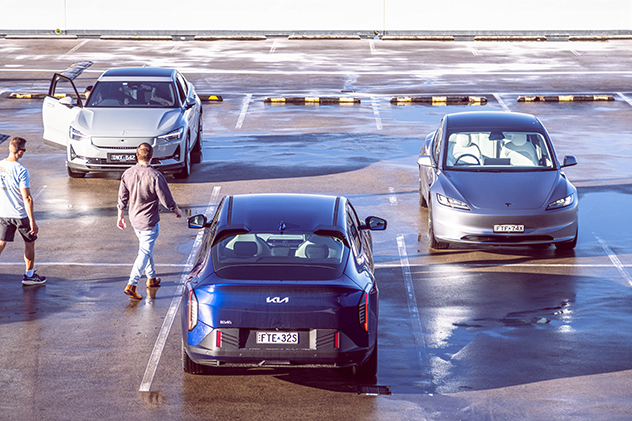
All three vehicles offer over-the-air updates, which enable efficiency improvements and the latest software, among other things. But the Kia stands alone as the only vehicle to offer native vehicle-to-load charging, meaning you can charge electrical appliances internally and externally on the go.
Ownership costs are another important consideration. Tesla doesn’t offer fixed servicing prices for the Model 3 or even servicing intervals. Kia says
the EV4 will cost $1308 to service over five years based on 12-month/15,000km intervals, while the Polestar will set buyers back $1131 for the first four years with two-year/20,000km intervals.
The Tesla and Polestar are backed by five-year/unlimited kilometre warranties in Australia, while the Kia is offered with a seven-year/unlimited kilometre fixture. Each is covered by a separate eight-year/160,000km battery warranty.
No vehicle here is offered with a spare wheel, all opting for a tyre inflation kit.
Charging and range
If you’ve been following the EV segment for the past decade, you’ll have noticed a huge improvement in range and charging capabilities. The dreaded ‘range anxiety’ is increasingly a throwback, or at least, that’s what our three candidates suggest on paper. All draw power from 82kWh batteries – the EV4 apportioning its drive via the front wheels, the Polestar 2 and Model 3 via the rears.
Big batteries generally mean big ranges. The Model 3 offers the best claimed WLTP range of 750km, while the Polestar is rated at 659km and the Kia’s at 612km.
The Polestar claims bragging rights for torque, at 490Nm, while the Tesla has a peak power figure of 235kW, helping explain its hastier 5.2 second 0-100km/h sprint. The Kia is down on outputs and acceleration.
Then there’s charging. Tesla and Polestar are clear winners here, thanks to their ability to offer 250kW maximum DC charging. The Kia trails with a maximum DC charging rate of 128kW. This means the Tesla and Polestar can better capitalise on public fast-charging infrastructure for shorter charging times. At home, though, all three offer comparable rates (maximum 11kW) using an AC charger.
Interiors
Although our trio shares similar dimensions (about 4.7 metres long), their interior layouts couldn’t be more different. The Polestar is more of a traditional choice – the car’s original combustion vehicle origins mean there are legacies like a transmission tunnel in both rows, and less incidental storage. There are merits to this layout though, with the best seats of the three and even a traditional luxury car smell.
The Tesla Model 3, on the other hand, feels unapologetically futuristic, with next to no physical buttons and an expansive tinted glass roof, which offers an airy cabin feel but is prone to radiating heat on even a warm autumn day. Yet it looks and feels plush inside, with quality materials and the only rear-seat screen offering. It’s lineball on the Polestar for rear-seat space, with moderate leg room, minimal toe room (by virtue of their batteries underneath), and just enough head space for a six-foot adult.
Then there’s the Kia. Although its exterior dimensions are the same, the EV4 offers considerably more room across both rows of seating, as well as the best incidental storage offering. It’s the only one of our three to offer a traditional starter button (a weird observation, but trust us, it’s just easier to live with) and the outlook is airy and unobscured.
Boot proportions are quite comparable – 407 litres for the Polestar, 490 litres for the Kia and 594 litres for the Tesla – though the Polestar’s liftback design means easier open access. The Tesla and Polestar also offer frunk storage underneath their bonnets.
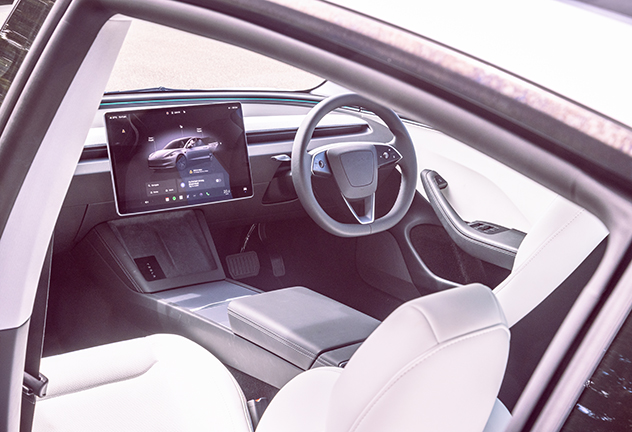
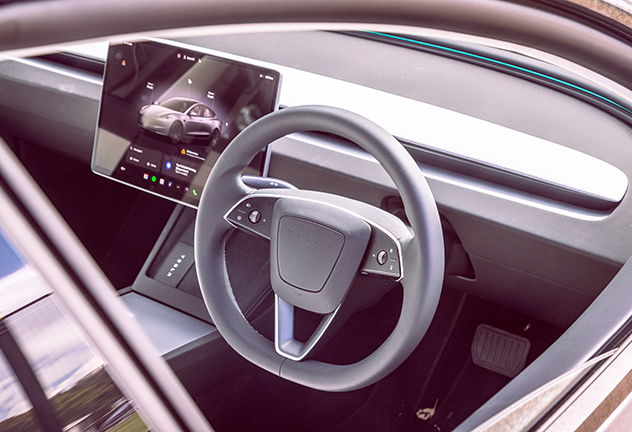
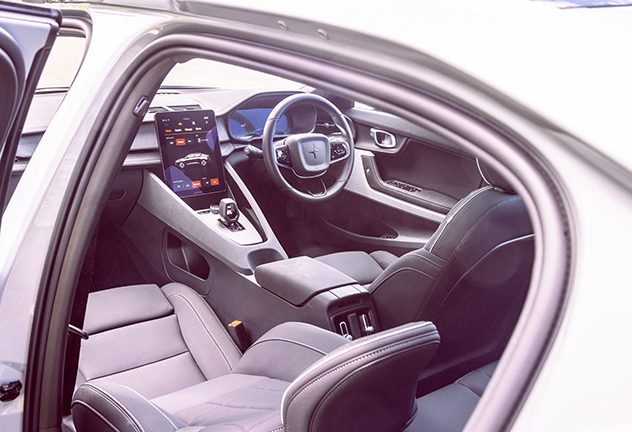
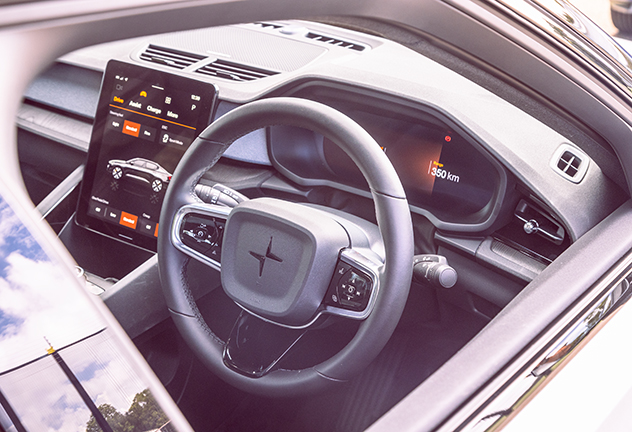
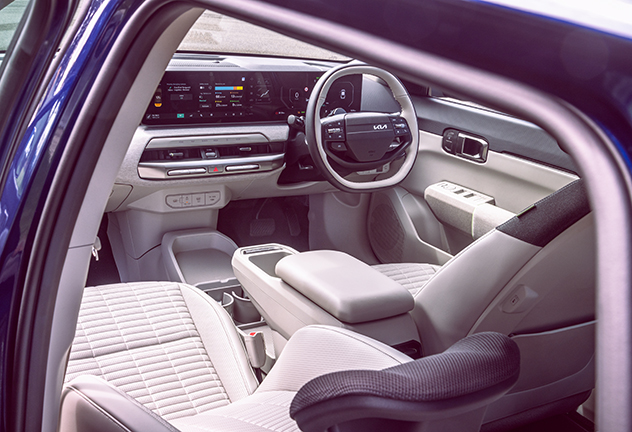
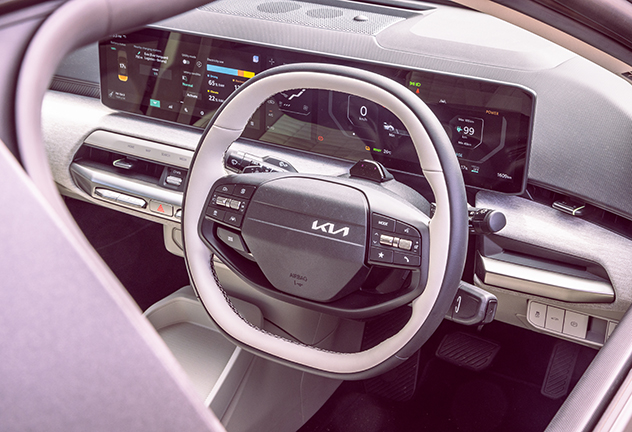
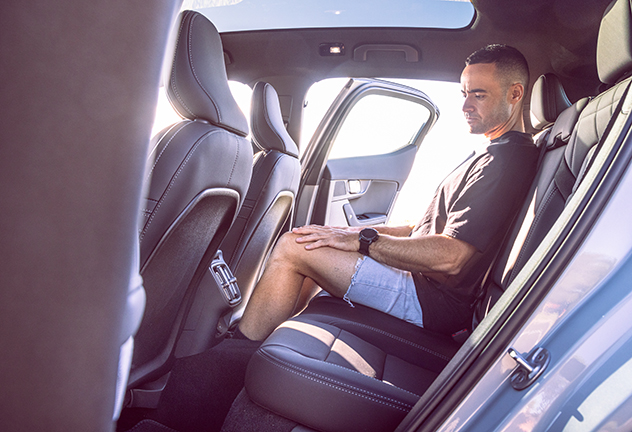
Although this trio shares similar dimensions (about 4.7 metres long), their interior layouts couldn’t be more different.
— Sam Charlwood
Drive time
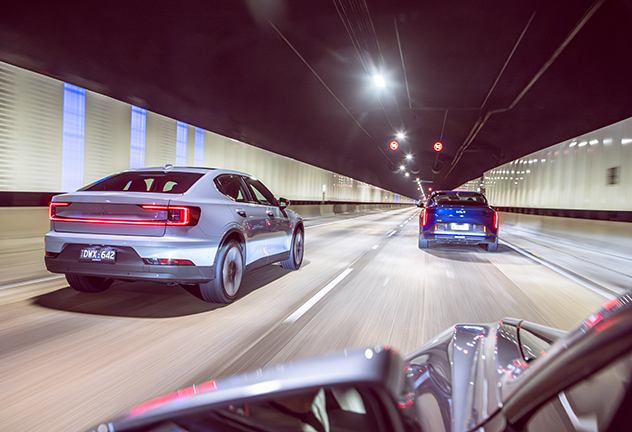
Along with its more traditional interior layout, the Polestar best mimics combustion driving, with considered weighting to the steering and brake-pedal modulation, and a linear feeling in the way it piles on speed. It shifts weight to the outside wheels through corners like a traditional sedan too, with terrific tactility and balance wrought from its rear-drive origins. But it’s afflicted with a noticeable thudding action over small road imperfections and lacks the bump compliance and noise insulation of its peers.
The Tesla feels like an arcade game in this company; the steering is inert and heavy in its standard setting, and far too reactive to driver inputs off-centre. Equally, the Tesla’s inability to adjust the regenerative braking in any capacity means you’re reliant on the default setting. It’s simply too aggressive at times, inducing some motion sickness with the way it tries to capture energy. That said, the Tesla still feels the best of the lot when it comes to recharging and real-world efficiency, while its cabin is controlled and whisper-quiet on a variety of roads.
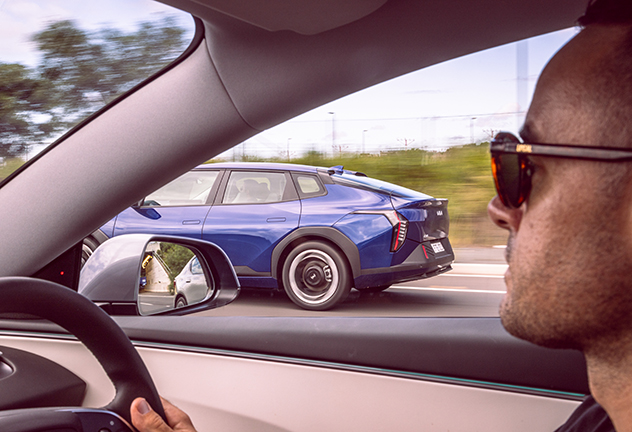
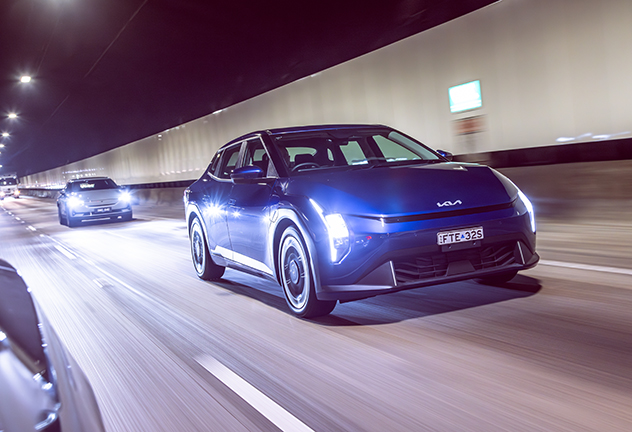
That leaves the Kia, which offers smart and sensible road dynamics, if a little bland on account of its front-drive origins. A localised ride and handling tune ensures a neutral character in the Kia’s approach to daily conveyance – supple enough to soak up rougher roads, yet with steering that weighs up adequately (if a little lightly) and feels direct in the hands. The Kia masks its size quite cleverly and is the quietest of the trio on test, but does feel a little languid when pushed compared to the acceleration of its peers.
The point worth making is all three competitors offer a well-rounded drive, equally adept at cross-country crusing and daily commuting. The Tesla returned the best energy consumption average on test (13.4kWh/100km), followed closely by the Kia (14.2kWh/100km) and lastly the Polestar (16.3kWh/100km).
Verdict
As is usually the case with modern comparison tests, there’s a way to justify each of these cars as your winner. The Polestar offers the most familiar facade of the three, with old-world luxury traits and a feeling of quality and cohesion in its build. For the tech-bros, there’s a certain charm in the Tesla’s onboard software and minimalism, ditto the efficacy of its peerless battery range and drivetrain. It epitomises its ‘disruptor’ tag in every way.
But the Kia is a victorious blend of both, offering considerably more interior space, a sharper entry price and real-world amenity that ought to last well beyond an expensive fuel bubble. It is also the easiest of our bunch to live with – at a time when more Aussies than ever are considering a switch to an EV.
Specifications
Polestar 2
Powertrain: single e-motor RWD + 81.4kWh battery
Power: 220kW
Torque: 490Nm
Range: 659km (WLTP)
ANCAP: 5 stars
Price: $66,400 (plus ORC)
Tesla Model 3
Powertrain: single e-motor RWD +
82kWh battery
Power: 235kW
Torque: 450Nm
Range: 750km (WLTP)
ANCAP: 5 stars
Price: $61,900 (plus ORC)
Kia EV4
Powertrain: single e-motor FWD + 82kWh battery
Power: 150kW
Torque: 283Nm
Range: 612km (WLTP)
ANCAP: 5 stars
Price: $59,190 (plus ORC)