NSW Government to explore insurance scheme for e-bike users

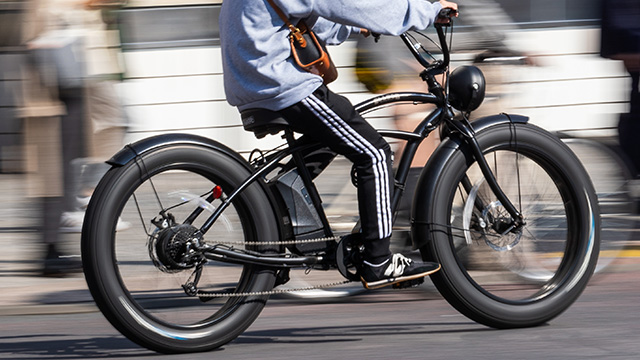
The NSW Government is set to announce new reforms for e-bike use in NSW, including exploring insurance options, as authorities grapple with rising injuries and a wave of incidents involving large groups of riders.
It comes off the back of a campaign spearheaded by the NRMA to introduce registration and identification requirements for e-bikes, and also e-scooters should they become legal in the future in NSW. The NRMA is also supporting extending enforcement and police powers, including potential confiscation of e-bikes for illegal use.
In the wake of another e-bike related group incident on the Sydney Harbour Bridge yesterday, a Transport for NSW spokesperson has confirmed to Open Road that the department has tasked NSW Treasury with exploring multiple insurance angles that would apply to both private and registered e-bike owners.
In a statement to Open Road, Transport for NSW confirmed a raft of insurance options are being explored, including a compulsory CTP-style of insurance that currently applies to registered motor vehicles.
“The NSW Government is exploring options for e-micromobility insurance, including potential settings, considering the need for people injured by devices to be effectively supported, affordability, existing insurance settings and viability of those arrangements. NSW Treasury is the lead agency for this work,” the statement said.
“There are more than a million e-bikes and e-scooters in NSW which is why we are building a safety-focused set of rules to protect riders and pedestrians.
“The NSW Government has tasked Treasury with exploring insurance options. The public will be invited to comment on those this year.”
The news comes as dozens of e-bike riders convened on the Sydney Harbour Bridge on Tuesday, interrupting traffic on the main deck of the bridge before evading police.
The NRMA is spearheading calls for set of reforms around e-bike use in NSW, which is currently largely unregulated. NRMA spokesman Peter Khoury weighed in on the topic on Wednesday, welcoming calls for an e-bike registration scheme and urging authorities to extend reforms to e-scooters should they become legal in the future in NSW.
“Clearly, NSW and Australia has a problem on its hands. It clearly has a serious road safety problem on its hands,” Khoury said.
“What we need to do is find a way to get these kids off these bikes. And absolutely get these kids off our roads while they’re riding these bikes.”
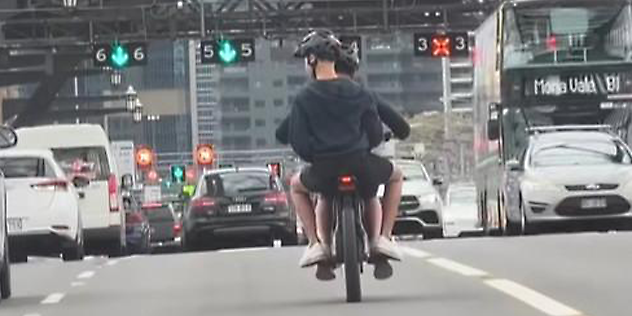
An e-bike on the Sydney Harbour Bridge.
On top of registration and closing insurance gaps to support riders and vulnerable road users, Mr Khoury said more powers were needed for authorities to be able to penalise offending e-bike riders, including police and council park rangers.
“This can’t be a problem for the police to have to deal with alone. This needs to be an all-of-community approach,” Khoury said.
The NSW Police and NSW Police Association have declined to comment, citing the issue as a legislation matter.
Mr Khoury said parents had the potential to take the e-bikes matter into their own hands by not purchasing high-powered e-bikes for their children. At the time of writing, only Queensland enforces a 16-year-old age limit for e-bikes that are throttle assisted.
“We can’t have children riding illegally across the Harbour Bridge in peak hour,” he said.
Figures provided by research firm Expert Market Research reveals an explosion in Australian e-bike sales, with the segment experience experiencing a 745 per cent uplift since 2019, to 253,987 units in 2025. Those figures comprise two major e-bike types: pedal-assist e-bikes or pedalecs (like mountain bikes), and more powerful electric pedal-assist cycles (also known by lawmakers are EPACS). Pedalecs are bicycles with a small motor that assists only when pedalling. More prominent in the headlines, EPACS or ‘fat bikes’ as they’re colloquially known, use motorised power to propel the bicycle with or without pedalling, and include popular brands like Fatboy, Dirodi and Amp Bros.
In Australia, throttle-assisted e-bikes are supposed to be governed by a maximum continuous output of 250 watts, a maximum pedal-assisted speed of 25km/h and a maximum throttle speed of 6km/h. But a legal loophole exists because those rules don’t apply to riding on private property.
Moreover, at the time of writing, law makers are powerless to stop the consumer from ‘tampering’ with a bike’s powertrain to exceed those figures. In some instances, the consumer is shown how to unlock more power from their bike in the user manual, under the veil of an ‘off-road mode’.
New South Wales will align with all other Australian states and territories by reimplementing a 250-watt maximum continuous power rating for e-bikes used in the state (down from 500 watts). Under a Bill passed in November, NSW will also mandate that approved operators of shared e-bike services “will need to hold comprehensive public liability insurance”.
“The NSW Government also supports the steps taken by the Commonwealth to reintroduce the European e-bike safety standard into national vehicle definitions,” the spokesperson said.
The NRMA supports the responsible use of e-bikes in NSW, but on the proviso they comply with the European standard.
The NRMA supports the growth of e-bikes where underpinned by strong safety standards, including EN 15194 compliance, a total power limit of 250 watts, a 25 km/h speed limit, robust battery safety rules, visible enforcement, and protections for riders and pedestrians.