Your ultimate EV buying guide


EVs (electric vehicles) are seeing a rise popularity, with sales jumping to 23 per cent of new car sales in June 2026. But should you get a new or used EV? And what about plugs, chargers and V2G? Here’s all you need to know for going electric in 2026.
Why buy an EV in 2026?
With fuel prices skyrocketing, it’s little wonder so many are switching to an EV. With an influx of models across wider price points, there’s more choice than ever for buyers.
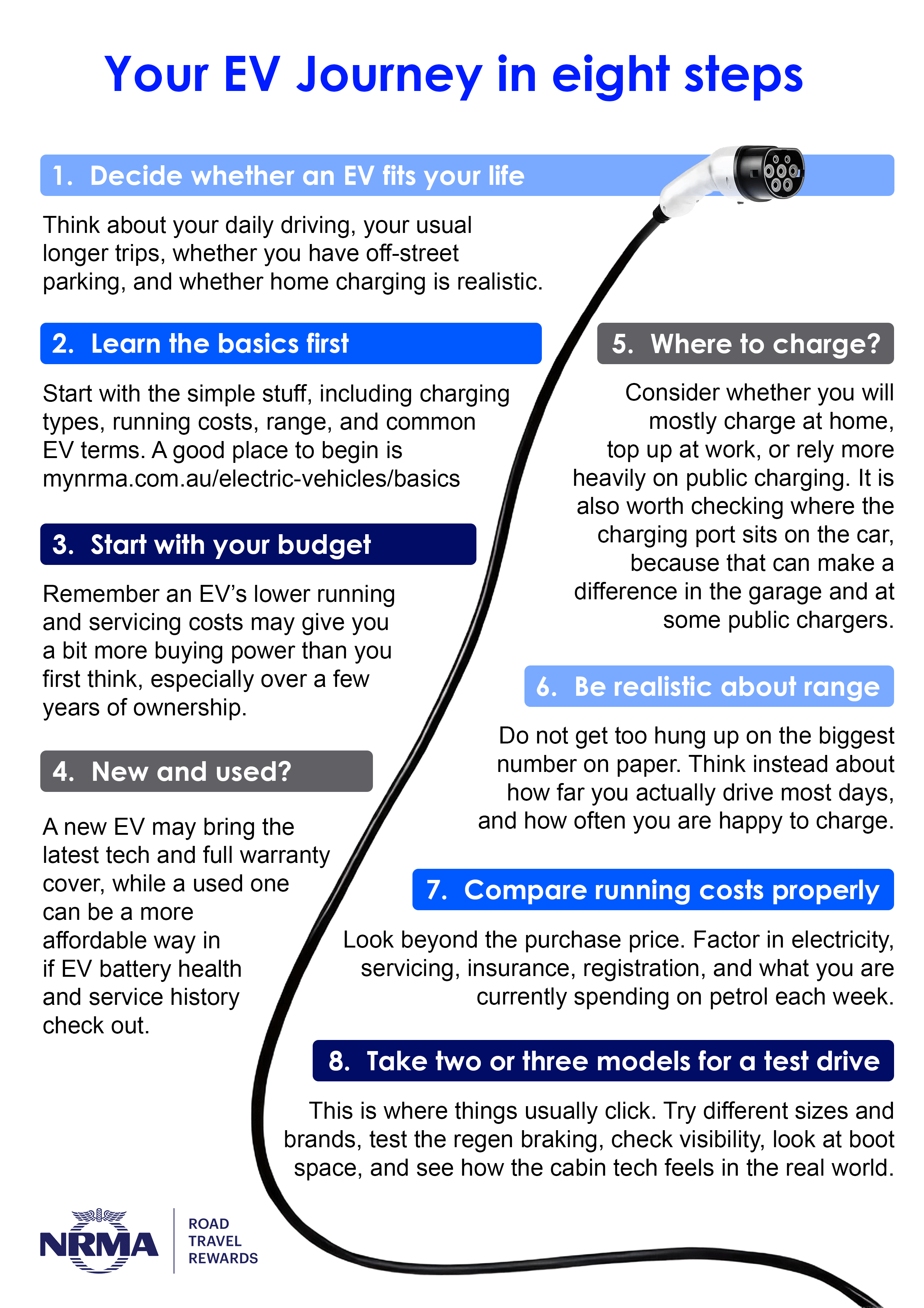
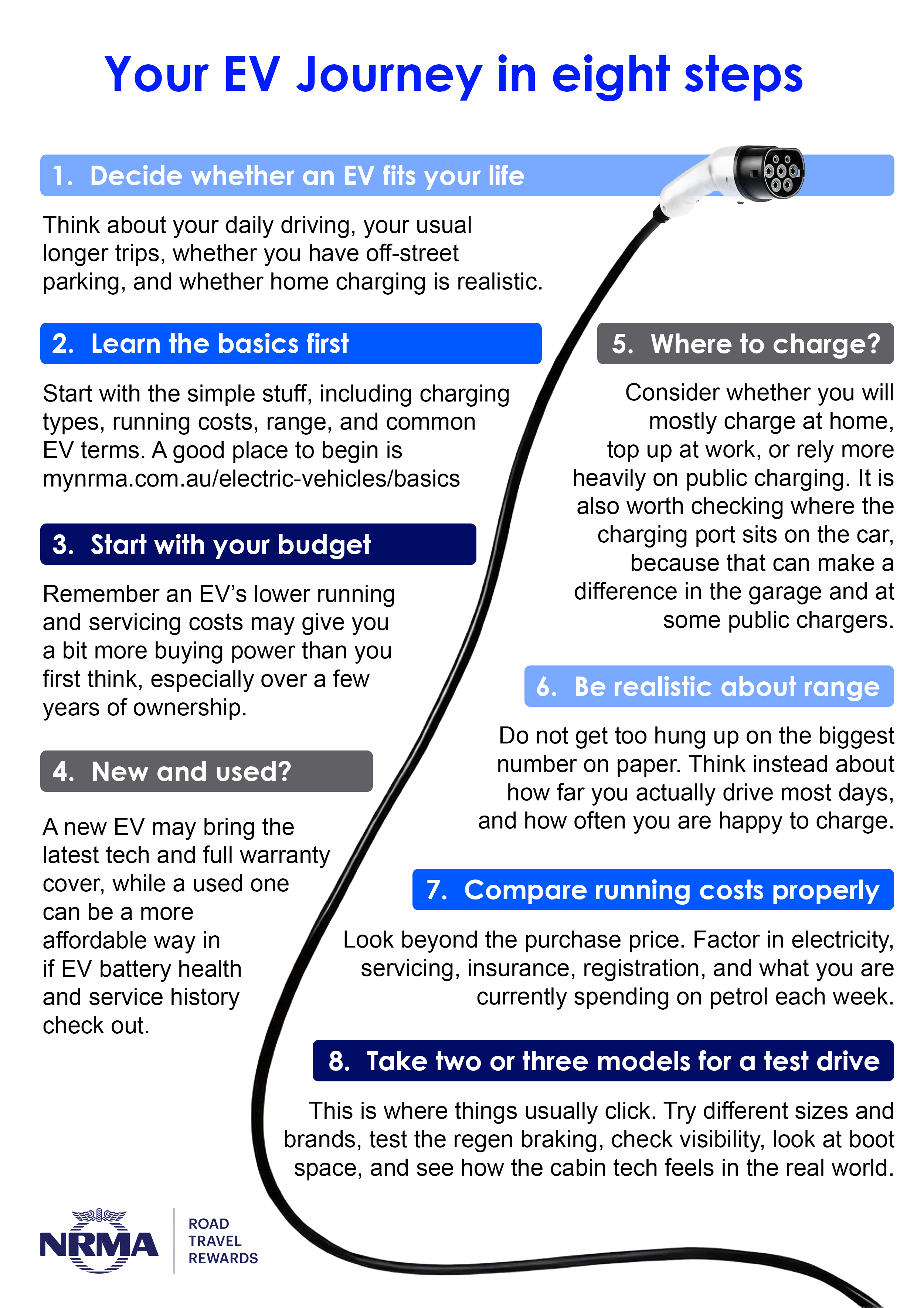
But where do you start? Surprisingly, the first step isn’t deciding on your budget – it’s learning what EVs in Australia are available. There are close to 150 models on the market today, starting with shorter range cheaper EVs from under $25,000, to just under $70,000 for long range EVs that can drive well over 600km on a single charge. There are also several EVs that can tow, and many EVs can power devices and tools.
Ask yourself: how long is my weekly commute? Can I charge at home or will I rely on a nearby public charger? Many EV drivers only need to charge once or twice a week, either overnight at home or while doing activities like shopping or going to the gym.
Another consideration is whether you take regular regional road trips, and what chargers are available on those routes. Apps like Plugshare, A Better Route Planner and the My NRMA app to find NRMA EV chargers can help you determine where you’d be likely to charge outside of your home turf.
Opting for an EV has never been easier, but it’s not for everyone. Apartment living, no off-street parking, regular long-distance towing, or sparse regional charging corridors can all change the equation. But for an increasing number of drivers, the key EV question isn’t “Could I live with one?” but “Which kind of EV would suit me best?”
EVs: the basics
Shifting from filling up the tank to charging a battery can sound overwhelming, but it’s not as complicated as it sounds once you strip the jargon away.
At its simplest, AC charging is the slower sort you usually use at home, work, or destinations where the car can sit for at least a few hours. DC charging is faster – between 15 to 45 minutes depending on the charger and the EV – and what you use when you are out on the road and want to add range quickly. Some shopping centres will have both options, allowing you to choose depending on how long you will be there. Mostly, you can think of AC as your usual refill and DC as a road-trip top-up.
One important thing to look at when choosing an EV is how fast it can charge. Some EVs are modest on AC but strong on DC. Others are fine for overnight charging at home but are less impressive on a highway run. This can make a big difference if you drive long trips regularly, but less so if you’re buying a daily runabout.
Charge rates are measured in kilowatts (kW), and the number on the spec sheet is the maximum rate it charges when the battery is close to empty. As a battery ‘fills up’, the charge rate slows down. If charging speed is important to you, an EV with over 100kW DC charging is more desirable than one that charges under 100kW. Always check individual model charge rates before buying.
Want to know more about EVs and charging? A good place to begin is mynrma.com.au/electric-vehicles/basics
New vs used
Your budget for an EV could be more than you think, because energy and maintenance costs will be lower (see below). That said, EVs also start from below $25,000 before on-roads and there are currently 12 models that start under $40,000 (google “cheap EVs”).
The new-car market is where the latest tech, longest warranties and strongest finance offers usually sit. It is also where buyers get the most choice. A new EV makes sense if you want the latest safety kit, up-to-date tech and styling, longer driving range, or if you are salary packaging through work. At the time of writing, eligible electric cars can still attract an FBT exemption, while plug-in hybrids are no longer eligible.
A used EV, though, can be the smarter buy for households chasing lower upfront costs. Australia’s second-hand EV market is growing, helped by the steady flow of new models, and with novated lease and fleet vehicles coming into circulation.
The key is to look beyond odometer readings: get an EV battery health check, and consider remaining warranty and service records. Because there are fewer moving parts with an EV drivetrain, niggling combustion engine concerns can be dropped. In other words, treat it like a used car, just with a few different questions in the mix.
If you are looking at a used EV, do check what type of plug it uses. Older models like the Nissan Leaf or Mitsubishi i-Miev are very cheap secondhand but use CHAdeMO plugs so public charging gets trickier.
Be realistic about real world range
Range still sells cars, and fair enough too. Nobody wants to feel like an EV is a downgrade from their old car. But real-world usability is about more than the biggest number on the spec sheet.
Most car makers list WLTP range, which is based on a lab test. Real world range depends on driving style and conditions but many EVs can achieve lab test ranges with conservative driving. Range anxiety – worrying about running out of charge – fades with lived experience, and concerns around charging access and value tending to soften with ownership.
For most people, the daily reality is far less dramatic than the mental arithmetic they do before buying. If your usual driving is well within the car’s comfort zone, you may not need the longest-range variant at all. Bigger batteries can bring extra range, yes, but they also bring more cost and extra weight. Sometimes the smarter buy is the middle of the range, not the hero grade.
This is also where real-world conditions matter. Highway speeds, towing, cold weather, heavy loads, terrain and strong use of heating or cooling can all knock range about. Having an EV with an app to start the air-con while it’s plugged in is a bonus, as is a heat pump. Driving like your right foot owes you money can also reduce range significantly; though the instant torque is fun, this will also chew through energy and tyres.
To get an idea of how far EVs can really drive, consider hiring an EV for a week with SIXT (members get a 20 per cent discount) or visit realworld.org.au which has tested 11 pure EV models in real world conditions.
— Bridie Schmidt
Home charging
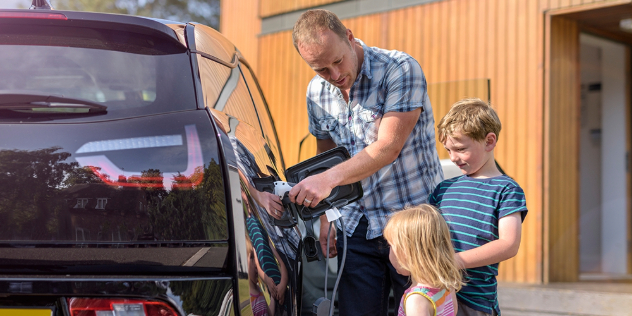
Charging at home is where an EV starts to feel different from a petrol car. You’re not making a special trip to fuel up and households with rooftop solar can reap even more benefits.
The Electric Vehicle Council’s 2025 ownership survey found 85 per cent of EV drivers charged at home and the average cost per charge was $16 for a 60kWh standard range battery.
This doesn’t mean home charging is one-size-fits-all. Some households will be fine using a standard power point for low daily kilometres, but they should get an electrician to run a dedicated 15-amp outlet from the circuit board so they can use other power-hungry devices at the same time. Power point charging adds around 15-25km per hour.
Others will want a wallbox installed for smarter scheduling, solar integration and faster charging – an 11kW wallbox can add 65km per hour or double that if you have three-phase power. The decision comes down to how much you drive, when you are home, and whether you want to wake up to a full battery every morning.
Public charging
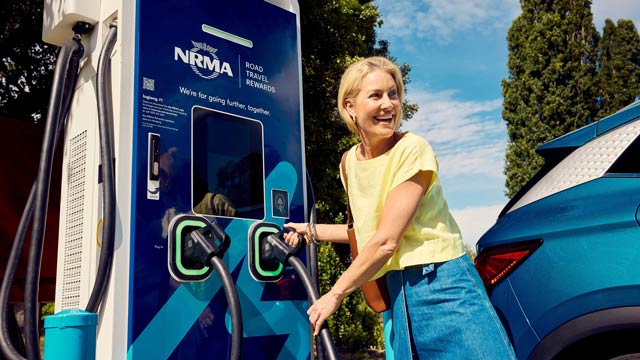
Public EV charging – such as NRMA's EV charging network – looms large in people’s minds, mainly because it’s the most visible part of EV ownership, yet often it’s only an occasional practice.
How fast a public DC charger can add range depends on its charge rate and that of your EV. DC chargers usually charge between 50kW and 350kW, but if your EV’s maximum rate is 80kW then it won’t charge any faster.
Before you leave home, download apps and add payment methods for the networks you plan to use. It can also make sense to order an RFID card from the major networks as some chargers are in areas with patchy phone reception.
Meanwhile, apps like Plugshare and A Better Route Planner are handy tools for identifying charger status and location. Drivers increasingly lean on them and the NRMA regularly updates its charger maintenance and outages on Plugshare to help members keep up-to-date when out on the road.
For many EV owners, public charging is a backup and usually for road trips, so be aware of your needs before you buy.
How the NRMA EV network fits in
The NRMA operates 176 fast charging sites with 580 plugs across Australia, and many of our sites have access to multiple networks (including satellite networks in remote areas) to mitigate redundancy and help maintain connectivity if one mobile network experiences an unplanned outage.
The NRMA also offers public Wi-Fi in locations where mobile connectivity is poor to enable the use of the app to start a charge session, and is increasing the number of locations with tap-and-go payments. Note, if a driver's app does not have connectivity, charging may not activate regardless of a site's reception status.
The network is continuing to grow. During the 2025–26 financial year, the NRMA added 166 new plugs nationwide and upgraded 9 sites to improve charger availability and reliability.
The NRMA also regularly updates charger maintenance and outage information on the My NRMA app and PlugShare, helping EV drivers check charger status and plan ahead while they are on the road.
Savings and costs
There are more cost benefits to owning an EV than saving on saving on fuel bills. Servicing and maintenance can be simpler, because there are fewer moving parts and no engine oil changes, and many carmakers offer capped price servicing at a lower rate than their combustion engine counterparts.
But not every cost line automatically falls in the EV’s favour. Tyres for EVs can be an added expense where EV-specific ranges are priced higher, insurance can be more on some models (particularly performance variants), and public DC charging is usually dearer than charging at home.
While the upfront price gap between an EV and an equivalent petrol model has narrowed, it hasn’t disappeared across every segment. The smarter comparison is the total ownership cost over time. Purchase price matters, but so does what you spend each week, each service interval, and each year you keep the car.
The 'next big thing'
EV tech is unquestionably moving quickly and better batteries, smarter software and more capable charging will continue to arrive. It doesn’t mean you should keep waiting forever, but there are a few future-facing features worth understanding.
Vehicle-to-load (V2L) lets EVs power appliances and tools and is already widely available in South Korean and Chinese EV brands. It can be handy on camping trips, at worksites or during short outages.
Vehicle-to-grid, or V2G, (V2G) is the more ambitious version, where the car can send energy back to the grid, and vehicle-to-home (V2H) can support your home’s electrical system. The NRMA is trialling V2G in partnership with Amber Electric, with promising results so far.
For most buyers, though, these technologies will be a bonus rather than the main reason to purchase. The better approach is to buy the car that works for your life now, while thinking about the next logical step, such as smart charging using solar.